OCR · GCSE · History
Course version: J410 · Version from Mar 2026
Form and Function c.1000–1750 (J410/12 and J410/13) - The appearance and…
Full specification wording
Castles: Form and Function c.1000–1750 (J410/12 and J410/13) - The appearance and layout of Kenilworth Castle at different times in its history: The evidence used by historians e.g. contracts, architect plans, contemporary drawings, aerial photographs.
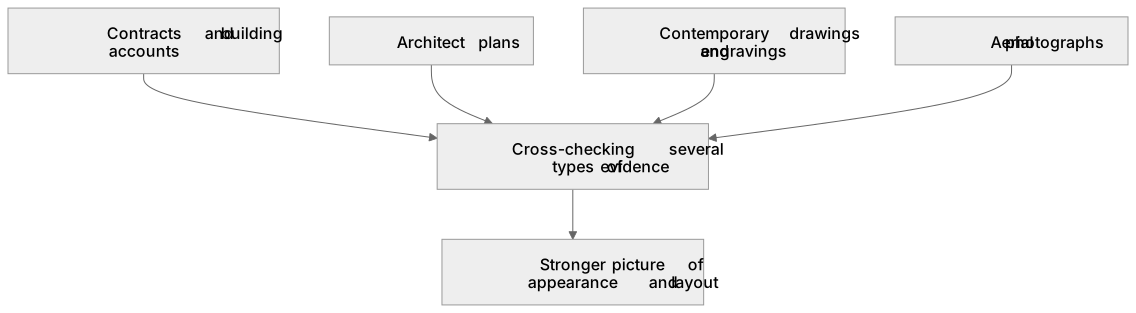
Historians reconstruct how Kenilworth Castle looked and was laid out at different dates by combining several kinds of evidence rather than trusting one source.
Checked against the OCR J410 specification (opens in a new tab) on .
- Point 3 of 3
- 4 key terms
Study notes
From the checked teaching notes for this specification point.
The idea
Historians reconstruct how Kenilworth Castle looked and was laid out at different dates by combining several kinds of evidence rather than trusting one source. Contracts and building accounts record what was commissioned, who was paid and when work happened, so they can date phases such as the Norman keep or later Tudor additions. Architect plans show intended design, though the finished building may differ. Contemporary drawings and engravings show appearance at a moment in time but may flatter or simplify. Aerial photographs reveal the whole plan, earthworks and later changes visible from above. Each type has limits, so a historian cross-checks them: a contract date, a plan and an aerial view together give a stronger picture of layout than any one alone.
What earns the marks
- Identifies contracts and building accounts as evidence of what was commissioned, paid for and when, helping date phases of building.
- Explains that architect plans show intended design and layout, which may differ from what was actually built.
- Recognises that contemporary drawings and engravings show appearance at a particular moment but may be inaccurate or flattering.
- States that aerial photographs reveal overall plan, earthworks and later alterations visible from above.
- Explains that historians cross-check several types of evidence because each has limitations.
Common mistakes and how to put them right
Treats a single contemporary drawing as a complete and accurate record.
Put it right: Recognise that drawings can flatter or simplify and need checking against other evidence.
Assumes architect plans show exactly what was built.
Put it right: Note that plans show intention and the finished building may differ.
Ignores aerial photographs as mere pictures.
Put it right: Recognise that they reveal overall layout, earthworks and later changes.
Believes one source type is enough to reconstruct appearance.
Put it right: Explain that historians combine and cross-check evidence.
Exam tips
- Match each evidence type to what it can and cannot show before choosing an answer.
- Look for the option that stresses cross-checking several sources rather than relying on one.
- Reject answers that claim any single source gives a complete, certain picture of the castle's layout.
Try the lesson
The start of the Castles: Form and Function c.1000–1750 (J410/12 and J410/13) - The appearance and layout of Kenilworth Castle at different times in its history: The evidence used by historians e.g. contracts, architect plans, contemporary drawings, aerial photographs. lesson, made from checked teaching notes for this specification point.
Have a go first
Which type of evidence would a historian use to find out the exact dimensions of a room in Kenilworth Castle as it was originally built?
Listen
Historians reconstruct how Kenilworth Castle looked and was laid out at different dates by combining several kinds of evidence rather than trusting one source. Contracts and building accounts record what was commissioned, who was paid and when work happened, so they can date phases such as the Norman keep or later Tudor additions. Architect plans show intended design, though the finished building may differ. Contemporary drawings and engravings show appearance at a moment in time but may flatter or simplify. Aerial photographs reveal the whole plan, earthworks and later changes visible from above. Each type has limits, so a historian cross-checks them: a contract date, a plan and an aerial view together give a stronger picture of layout than any one alone. A strong answer earns marks for these points. Identifies contracts and building accounts as evidence of what was commissioned, paid for and when, helping date phases of building. Explains that architect plans show intended design and layout, which may differ from what was actually built. Recognises that contemporary drawings and engravings show appearance at a particular moment but may be inaccurate or flattering. States that aerial photographs reveal overall plan, earthworks and later alterations visible from above. Exam tip: Match each evidence type to what it can and cannot show before choosing an answer.
See it
Key words
Say what each word means before you turn the card.
Types of historical evidence
Try answering aloud or in your head before turning the card.
Reliability and limitations of sources
Try answering aloud or in your head before turning the card.
Reconstructing appearance and layout
Try answering aloud or in your head before turning the card.
Cross-checking evidence
Try answering aloud or in your head before turning the card.
See every definition
- Types of historical evidence
- Contracts, architect plans, contemporary drawings and aerial photographs are the kinds of evidence historians use.
- Reliability and limitations of sources
- Each type has limits, so no single source should be trusted alone.
- Reconstructing appearance and layout
- Historians work out how Kenilworth Castle looked and was laid out at different dates by combining several kinds of evidence.
- Cross-checking evidence
- A contract date, a plan and an aerial view together give a stronger picture of layout than any one alone.
Label the diagram
Some boxes have lost their names. Pick the right name for each number.
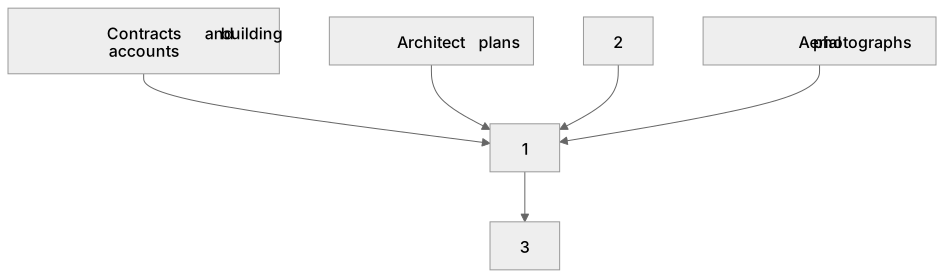
1Box 1
2Box 2
3Box 3
There is more to this lesson
The full lesson goes on to check your understanding and help you earn the marks. Create a free account to carry on, with your progress saved.
A week of Premium from your first lesson · Then the free plan continues · No card, no charge
Test your understanding of Castles: Form and Function c.1000–1750 (J410/12 and J410/13) - The appearance and layout of Kenilworth Castle at different times in its history: The evidence used by historians e.g. contracts, architect plans, contemporary drawings, aerial photographs.
Active recall beats re-reading. Take an instant quiz now to test what you’ve learned and lock it into long-term memory.
A week of Premium from your first lesson · Then the free plan continues · No card, no charge