OCR · GCSE · History
Course version: J410 · Version from Mar 2026
Form and Function c.1000–1750 (J410/12 and J410/13) - The appearance and…
Full specification wording
Castles: Form and Function c.1000–1750 (J410/12 and J410/13) - The appearance and layout of Kenilworth Castle at different times in its history: When and why these features were installed or removed, including the slighting.
This target asks you to date each major change to Kenilworth's appearance and layout and to explain the motive behind it, including the slighting.
Checked against the OCR J410 specification (opens in a new tab) on .
- Point 2 of 3
- 4 key terms
Study notes
From the checked teaching notes for this specification point.
The idea
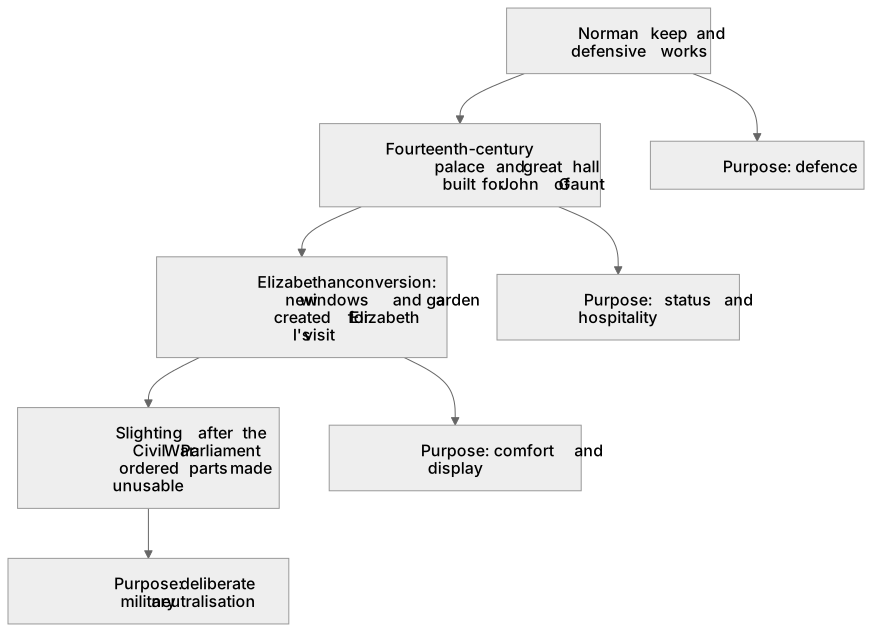
This target asks you to date each major change to Kenilworth's appearance and layout and to explain the motive behind it, including the slighting. Learn a sequence: the Norman keep and defensive works, the fourteenth-century palace and great hall built for John of Gaunt, the Elizabethan conversion with new windows and a garden created for Elizabeth I's visit, and the slighting after the Civil War when Parliament ordered parts of the castle made unusable. For each feature, link the date to a purpose: defence, status and hospitality, comfort and display, or deliberate military neutralisation. A question may ask which change was defensive, which was for show, or why demolition followed a siege.
What earns the marks
- Identifies the slighting as deliberate damage intended to make the castle indefensible after the Civil War.
- Links the Elizabethan changes to hospitality and display for a royal visit rather than to defence.
- Dates a named feature to the period in which it was built or altered.
- Explains a motive for removal, such as preventing the castle being garrisoned again.
Common mistakes and how to put them right
Treats the slighting as accidental ruin from weathering.
Put it right by explaining it was ordered demolition.
Assumes every change improved defence.
Put it right by noting later work served comfort and status.
Ignores chronology and mixes medieval and Elizabethan work.
Put it right by placing each feature in its period.
Exam tips
- Match each feature to a date band before choosing an option.
- Ask what purpose the change served: defence, display or denial of a stronghold.
- Eliminate options that describe damage as natural decay when the source points to deliberate slighting.
Try the lesson
The start of the Castles: Form and Function c.1000–1750 (J410/12 and J410/13) - The appearance and layout of Kenilworth Castle at different times in its history: When and why these features were installed or removed, including the slighting. lesson, made from checked teaching notes for this specification point.
Have a go first
What does the term 'slighting' mean when applied to a castle?
Listen
This target asks you to date each major change to Kenilworth's appearance and layout and to explain the motive behind it, including the slighting. Learn a sequence: the Norman keep and defensive works, the fourteenth-century palace and great hall built for John of Gaunt, the Elizabethan conversion with new windows and a garden created for Elizabeth I's visit, and the slighting after the Civil War when Parliament ordered parts of the castle made unusable. For each feature, link the date to a purpose: defence, status and hospitality, comfort and display, or deliberate military neutralisation. A question may ask which change was defensive, which was for show, or why demolition followed a siege. A strong answer earns marks for these points. Identifies the slighting as deliberate damage intended to make the castle indefensible after the Civil War. Links the Elizabethan changes to hospitality and display for a royal visit rather than to defence. Dates a named feature to the period in which it was built or altered. Explains a motive for removal, such as preventing the castle being garrisoned again. A common slip: Treats the slighting as accidental ruin from weathering. Instead, explaining it was ordered demolition. Exam tip: Match each feature to a date band before choosing an option.
See it
Key words
Say what each word means before you turn the card.
Chronology of change at Kenilworth
Try answering aloud or in your head before turning the card.
Purpose of castle features
Try answering aloud or in your head before turning the card.
Defence versus display
Try answering aloud or in your head before turning the card.
The slighting after the Civil War
Try answering aloud or in your head before turning the card.
See every definition
- Chronology of change at Kenilworth
- Dating each major change to Kenilworth's appearance and layout and placing each feature in its period.
- Purpose of castle features
- Linking the date of each feature to a purpose: defence, status and hospitality, comfort and display, or deliberate military neutralisation.
- Defence versus display
- Distinguishing changes made for defence from later work that served comfort and status rather than defence.
- The slighting after the Civil War
- Deliberate damage ordered by Parliament to make parts of the castle unusable and indefensible after the Civil War.
Label the diagram
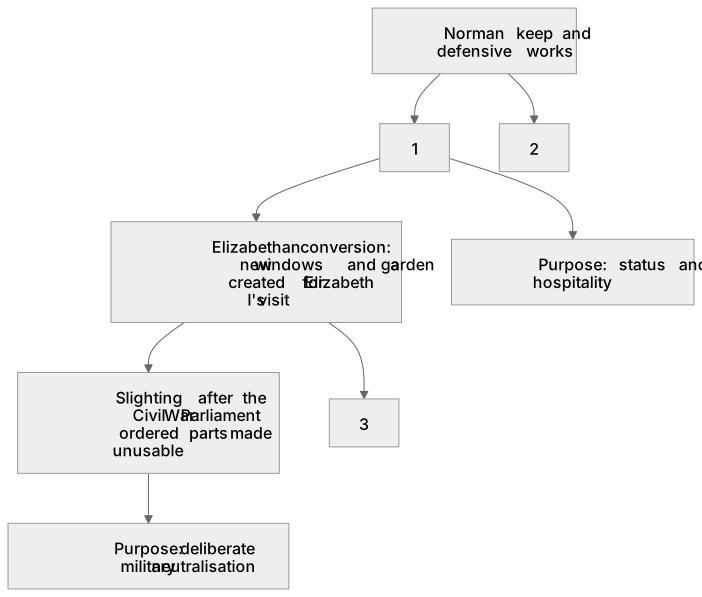
Some boxes have lost their names. Pick the right name for each number.
1Box 1
2Box 2
3Box 3
There is more to this lesson
The full lesson goes on to check your understanding and help you earn the marks. Create a free account to carry on, with your progress saved.
A week of Premium from your first lesson · Then the free plan continues · No card, no charge
Test your understanding of Castles: Form and Function c.1000–1750 (J410/12 and J410/13) - The appearance and layout of Kenilworth Castle at different times in its history: When and why these features were installed or removed, including the slighting.
Active recall beats re-reading. Take an instant quiz now to test what you’ve learned and lock it into long-term memory.
A week of Premium from your first lesson · Then the free plan continues · No card, no charge