OCR · GCSE · History
Course version: J410 · Version from Mar 2026
Form and Function c.1000–1750 (J410/12 and J410/13) - The location of…
Full specification wording
Castles: Form and Function c.1000–1750 (J410/12 and J410/13) - The location of Kenilworth Castle: The specific physical location of Kenilworth Castle.
The physical location of a castle means its site and situation: the ground it occupies and the natural features around it.
Checked against the OCR J410 specification (opens in a new tab) on .
- Point 3 of 4
- 4 key terms
Study notes
From the checked teaching notes for this specification point.
The idea
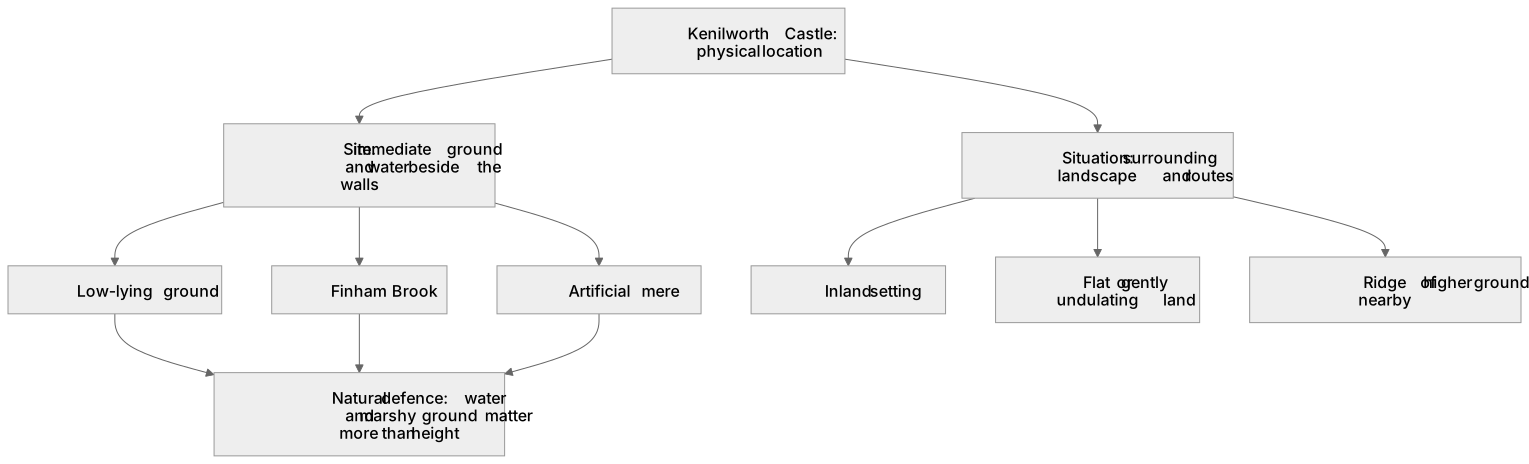
The physical location of a castle means its site and situation: the ground it occupies and the natural features around it. Kenilworth Castle sits on low ground beside a stream, the Finham Brook, with a broad artificial lake (the mere) created around the castle and a ridge of higher ground nearby. Its situation is inland and low-lying rather than on a coastal cliff or a steep hilltop. To answer, separate site (the immediate ground and water beside the walls) from situation (the surrounding landscape and routes). A useful method is to ask what defends the castle naturally: here the water and marshy ground of the mere and brook matter more than height. Do not describe the castle as built on a high coastal headland, which misreads its physical setting.
What earns the marks
- Describes the castle as standing on low-lying ground beside water rather than on a steep hilltop.
- Identifies the brook and the artificial mere as features of the physical setting.
- Explains that the surrounding land is inland and flat or gently undulating.
- Distinguishes the immediate site of the castle from its wider situation in the landscape.
Common mistakes and how to put them right
Describes Kenilworth Castle as perched on a high cliff above the sea.
Put it right by describing low inland ground beside water.
Treats the mere as a natural lake.
Put it right by describing it as an artificial body of water created for the castle.
Gives only the county and omits the physical setting.
Put it right by describing the ground and water around the walls.
Exam tips
- Separate site from situation in your thinking before selecting an option.
- Use the presence of water and flat ground as the key physical clues.
- Reject any option that places the castle on a coast or a mountain, which contradicts its inland setting.
Try the lesson
The start of the Castles: Form and Function c.1000–1750 (J410/12 and J410/13) - The location of Kenilworth Castle: The specific physical location of Kenilworth Castle. lesson, made from checked teaching notes for this specification point.
Have a go first
Kenilworth Castle was built on low-lying ground beside which natural feature that helped supply its defensive water?
Listen
The physical location of a castle means its site and situation: the ground it occupies and the natural features around it. Kenilworth Castle sits on low ground beside a stream, the Finham Brook, with a broad artificial lake (the mere) created around the castle and a ridge of higher ground nearby. Its situation is inland and low-lying rather than on a coastal cliff or a steep hilltop. To answer, separate site (the immediate ground and water beside the walls) from situation (the surrounding landscape and routes). A useful method is to ask what defends the castle naturally: here the water and marshy ground of the mere and brook matter more than height. Do not describe the castle as built on a high coastal headland, which misreads its physical setting. A strong answer earns marks for these points. Describes the castle as standing on low-lying ground beside water rather than on a steep hilltop. Identifies the brook and the artificial mere as features of the physical setting. Explains that the surrounding land is inland and flat or gently undulating. Distinguishes the immediate site of the castle from its wider situation in the landscape. A common slip: Describes Kenilworth Castle as perched on a high cliff above the sea. Instead, describing low inland ground beside water. Exam tip: Separate site from situation in your thinking before selecting an option.
See it
Key words
Say what each word means before you turn the card.
Site and situation of a castle
Try answering aloud or in your head before turning the card.
Natural and artificial water defences
Try answering aloud or in your head before turning the card.
Lowland versus hilltop castle settings
Try answering aloud or in your head before turning the card.
Reading landscape features as evidence
Try answering aloud or in your head before turning the card.
See every definition
- Site and situation of a castle
- The ground a castle occupies and the natural features around it, separating the immediate ground and water beside the walls from the surrounding landscape and routes.
- Natural and artificial water defences
- Water and marshy ground that defend a castle naturally, such as the brook, together with an artificial body of water created for the castle, the mere.
- Lowland versus hilltop castle settings
- A castle on low-lying inland ground beside water rather than on a steep hilltop or a high coastal headland.
- Reading landscape features as evidence
- Asking what defends the castle naturally, where water and marshy ground matter more than height, and using water and flat ground as the key physical clues.
Label the diagram
Some boxes have lost their names. Pick the right name for each number.
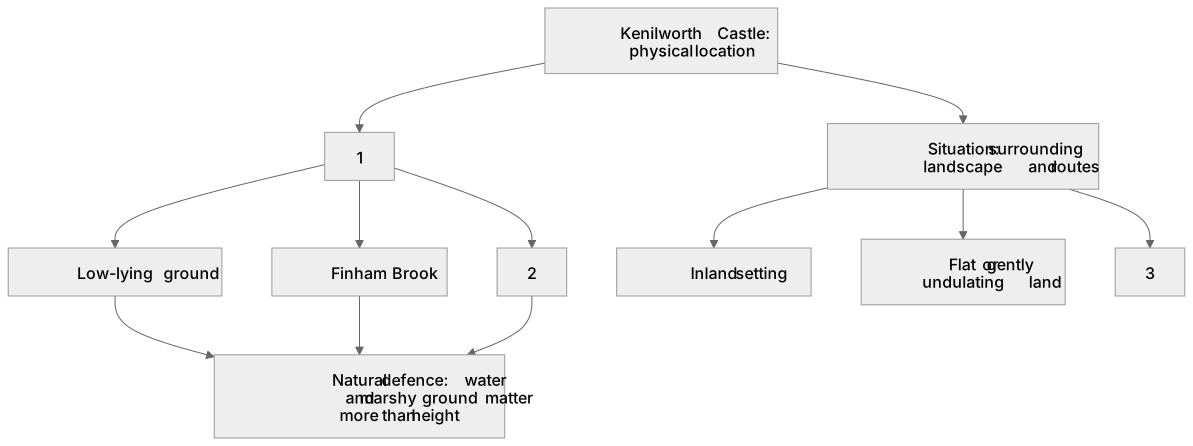
1Box 1
2Box 2
3Box 3
There is more to this lesson
The full lesson goes on to check your understanding and help you earn the marks. Create a free account to carry on, with your progress saved.
A week of Premium from your first lesson · Then the free plan continues · No card, no charge
Test your understanding of Castles: Form and Function c.1000–1750 (J410/12 and J410/13) - The location of Kenilworth Castle: The specific physical location of Kenilworth Castle.
Active recall beats re-reading. Take an instant quiz now to test what you’ve learned and lock it into long-term memory.
A week of Premium from your first lesson · Then the free plan continues · No card, no charge