OCR · GCSE · Physical Education
Skeletal System: Structure and Functions
This guide provides a comprehensive overview of the Skeletal System for OCR GCSE PE students. It covers the major bones, the six key functions of the skeleton, and provides exam-focused advice to help candidates maximise their marks on this essential topic.
- 6 min read
- 3 worked examples
- 4 practice questions
- 6 key terms
Study Notes
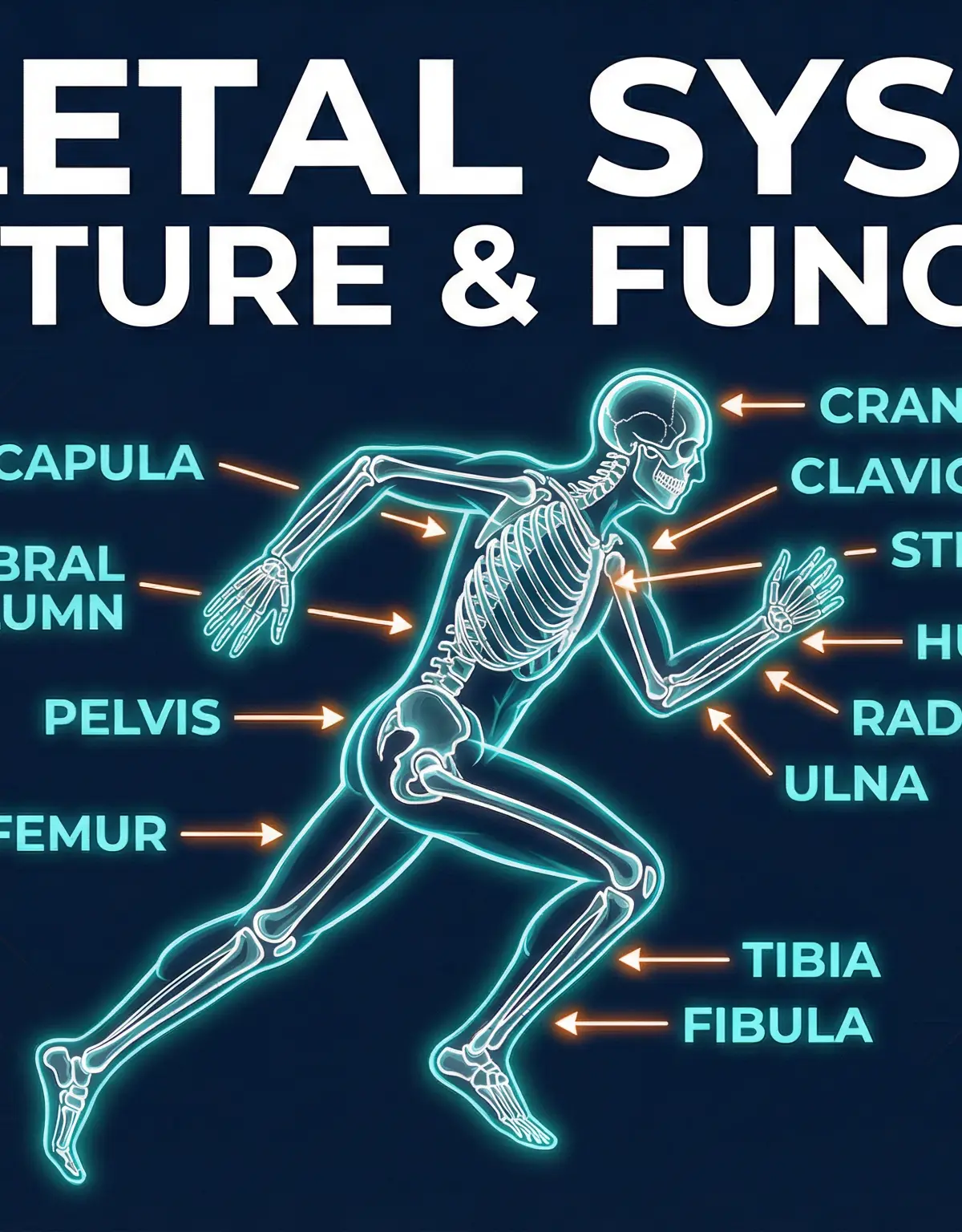
Overview
Welcome to your deep-dive study guide for Topic 1.1: The Skeletal System, a cornerstone of the OCR GCSE Physical Education specification (J587). A solid understanding of anatomy and physiology is essential for explaining how the body performs in sport. This topic will provide you with the foundational knowledge of bone identification and the critical functions the skeleton performs. Mastery of this area is not just about memorisation; it is about applying your knowledge to sporting contexts, a key skill assessed under AO2. This guide will equip you with the precise terminology, conceptual understanding, and exam technique required to achieve the highest marks.

Key Knowledge & Theory
Core Concepts
The primary focus for OCR candidates is twofold: first, the accurate identification of the major bones of the human skeleton using scientific terminology; second, a detailed understanding of the six functions of the skeleton, with the ability to apply each to a practical sporting example.
1. Identification of Major BonesCandidates must be able to identify the following bones. Using lay terms like 'collarbone' instead of 'clavicle' will not be awarded marks.
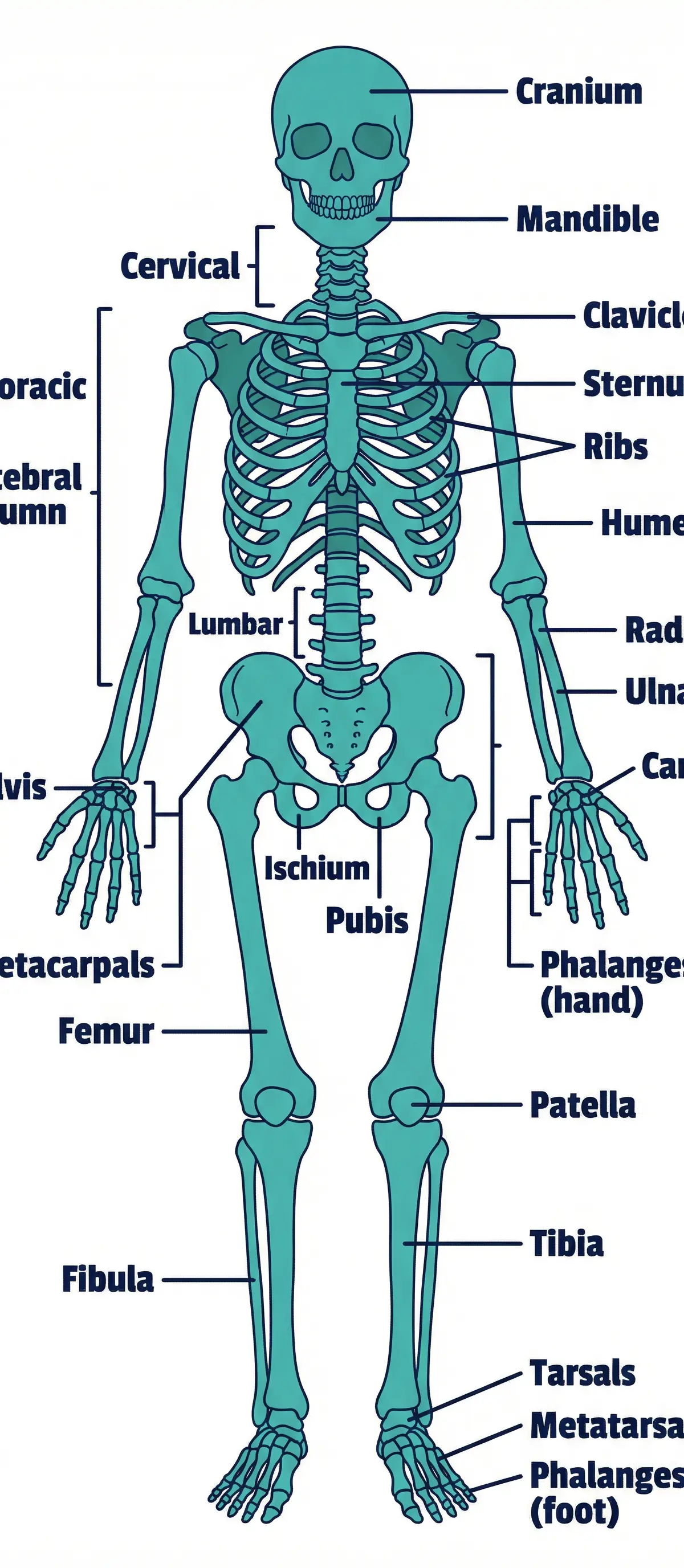
- Cranium: Protects the brain.
- Clavicle: The collarbone.
- Scapula: The shoulder blade.
- Sternum: The breastbone, anchoring the ribs.
- Ribs: Form the thoracic cage, protecting the heart and lungs.
- Vertebral Column: The spine, divided into Cervical, Thoracic, and Lumbar regions.
- Humerus: The long bone of the upper arm.
- Radius & Ulna: The two bones of the forearm. The Radius is on the thumb side.
- Pelvis: Comprised of the ilium, ischium, and pubis; a key site for muscle attachment.
- Femur: The thigh bone; the longest and strongest bone in the body.
- Patella: The kneecap.
- Tibia & Fibula: The two bones of the lower leg. The Tibia is the larger, weight-bearing bone (shin bone).
- Carpals, Metacarpals, Phalanges: Bones of the hand and wrist.
- Tarsals, Metatarsals, Phalanges: Bones of the foot and ankle.
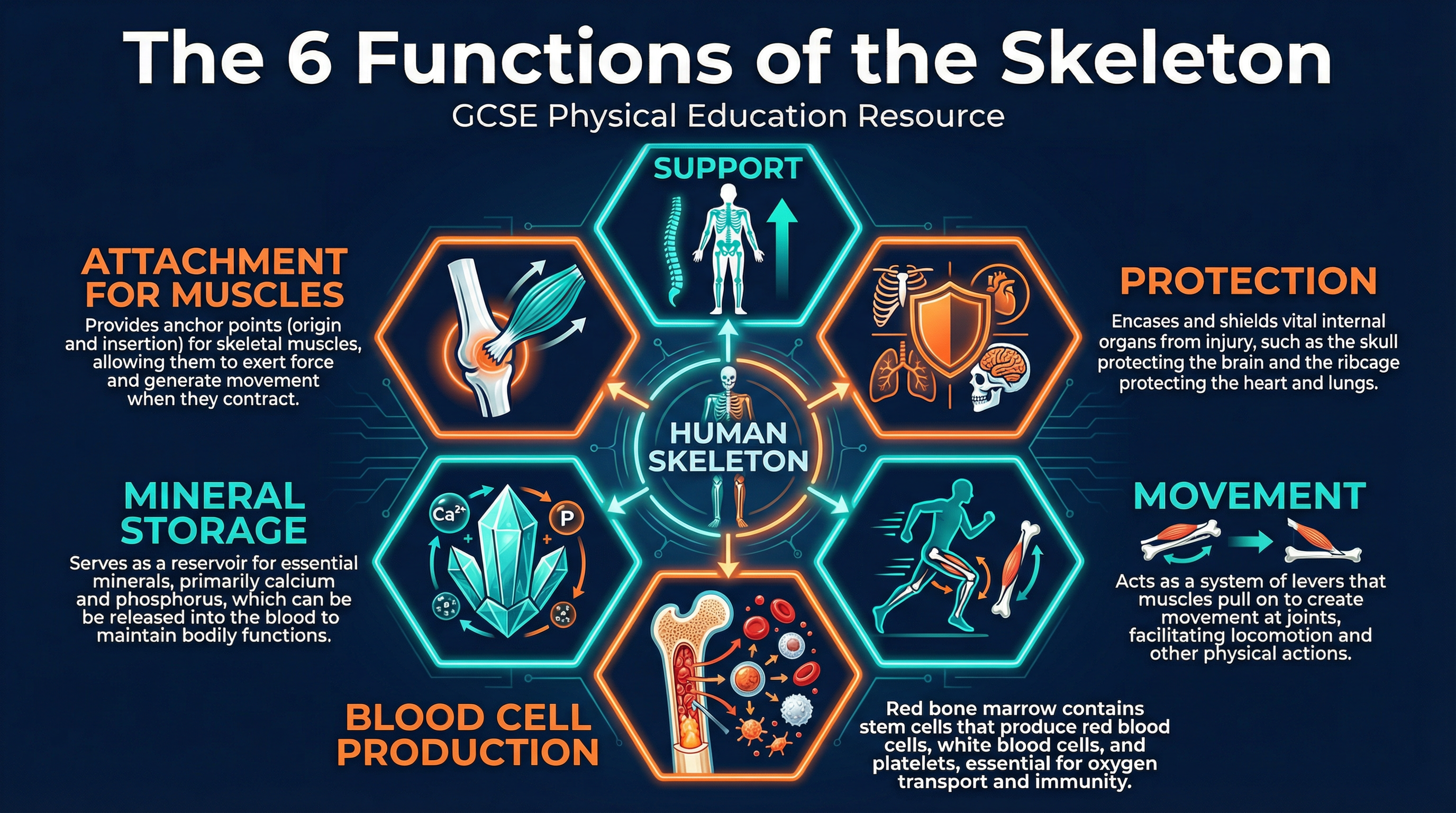
2. The Six Functions of the SkeletonCandidates must be able to explain these six functions, providing a sporting context for each. This is a classic AO2 (Application) question.
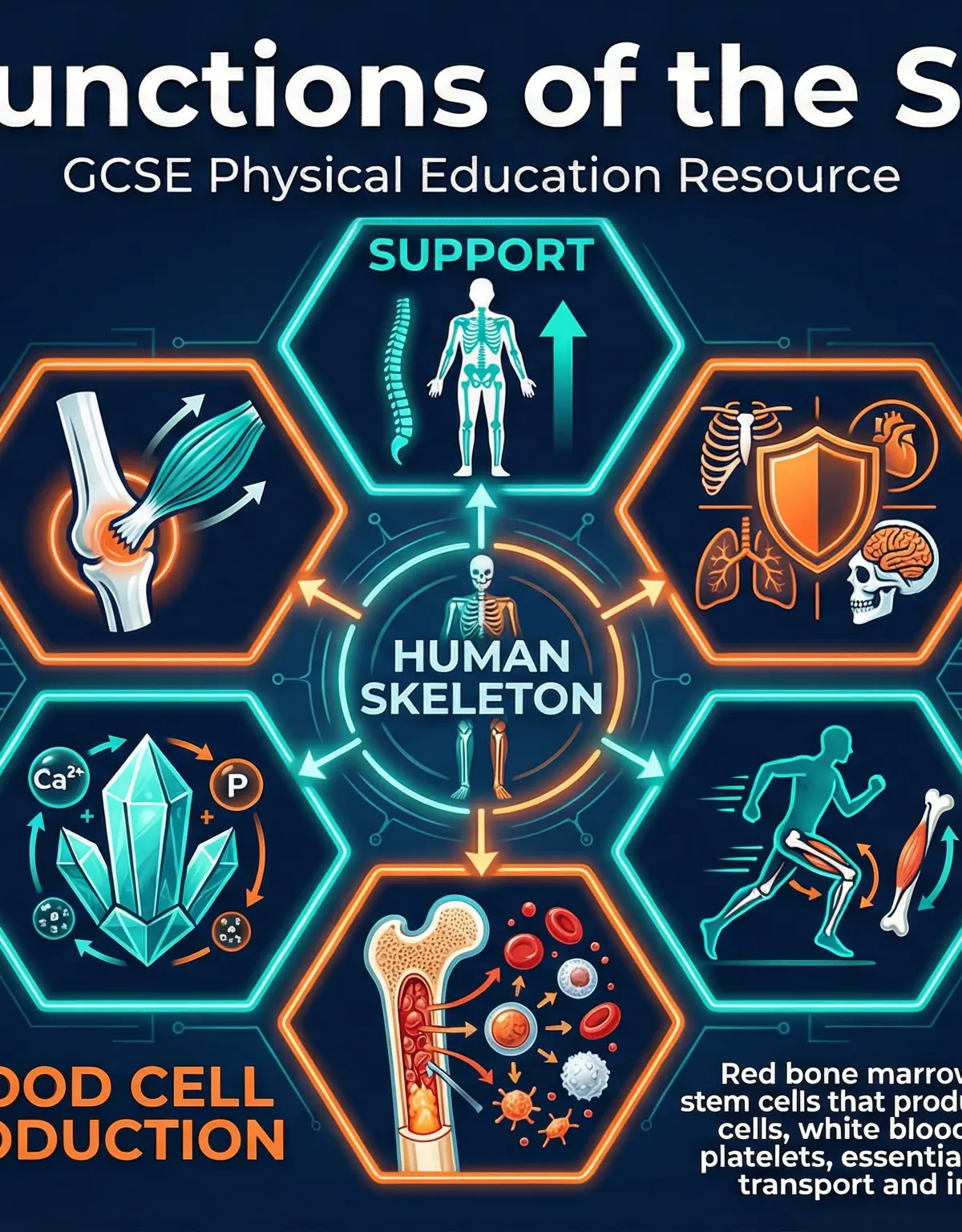
| Function | Mechanism | Sporting Example |
|---|---|---|
| Support | Provides a rigid framework for the body, giving it shape and preventing collapse. | The vertebral column supports the torso of a gymnast holding a handstand. |
| Protection | Hard, bony structures encase and protect vital internal organs from impact. | The cranium protects the brain when a footballer heads the ball. The ribcage protects the heart and lungs during a tackle in rugby. |
| Movement | Acts as a system of levers. Muscles attach to bones, and when they contract, they pull on the bones to create movement at a joint. | The femur and tibia act as levers during a penalty kick in football, allowing the leg to swing with power. |
| Attachment for Muscles | Provides a surface for skeletal muscles to attach to (via tendons). This allows force to be transmitted to the skeleton. | The large surface area of the scapula allows for the attachment of multiple muscles responsible for the powerful arm action in a tennis serve. |
| Blood Cell Production | Red bone marrow, found in the ends of long bones and in flat bones (e.g., sternum, pelvis), produces red blood cells, white blood cells, and platelets. | An endurance athlete, like a marathon runner, relies on efficient red blood cell production to transport oxygen to their working muscles. |
| Mineral Storage | Bones act as a reservoir for essential minerals, primarily calcium and phosphorus, releasing them into the bloodstream when needed. | Calcium is vital for muscle contraction and nerve transmission, ensuring a sprinter can react quickly to the starting pistol. |
Technical Vocabulary
Using precise language is critical. Examiners award marks for the use of correct scientific terminology.
- Anterior/Posterior: Front/Back
- Superior/Inferior: Above/Below
- Medial/Lateral: Towards the midline/Away from the midline
- Origin/Insertion: The fixed point of muscle attachment (origin) and the moving point of muscle attachment (insertion).
- Leverage: The mechanical advantage gained by using a lever (a bone) to move a load.
- Haematopoiesis: The process of blood cell formation in the bone marrow.
Exam Component
Written Exam Knowledge
In the written paper, questions on the skeletal system will test AO1 (Knowledge), AO2 (Application), and AO3 (Analysis/Evaluation). You can expect:
- Multiple Choice Questions: Identifying a specific bone from a diagram.
- Short Answer Questions (1-4 marks): Naming bones, stating functions, or providing a simple sporting example.
- Extended Response Questions (6-9 marks): Analysing how the skeletal system contributes to a complex sporting action, or evaluating its importance for performance. For these, you must link multiple concepts together (e.g., leverage, protection, and support in the context of a single sport).
Visual Resources
2 diagrams and illustrations
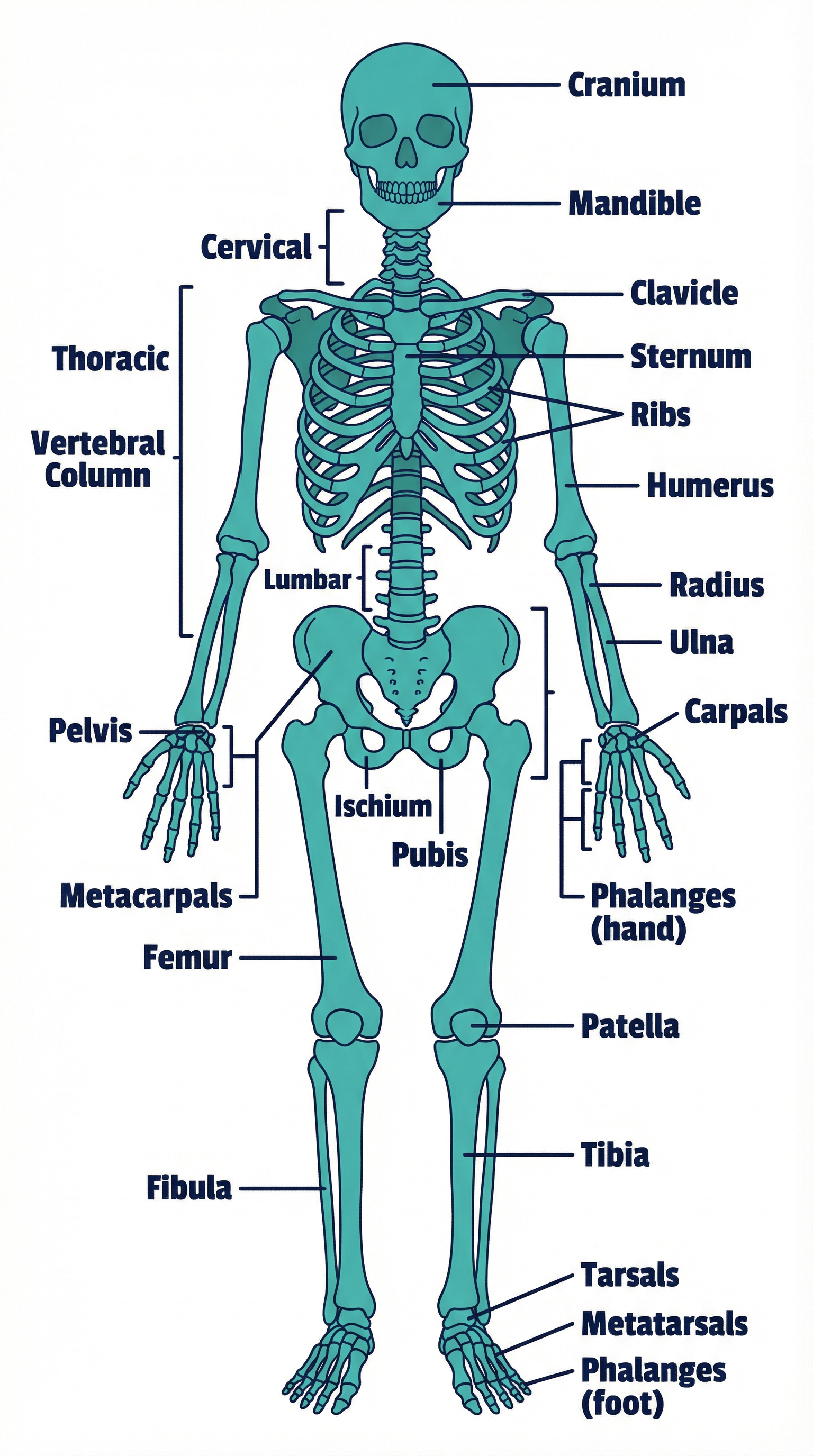
Interactive Diagrams
1 interactive diagram to visualise key concepts
Conceptual Flow Outline
Flowchart for approaching a 6-mark analysis question.
Worked Examples
3 worked examples — open one to explore the question and available guidance.
Practice Questions
Test your understanding — click to reveal model answers
Identify the scientific name for the collarbone and the shoulder blade. (2 marks)
Hint: Examiners will not award marks for common or lay terms.
Describe two ways the skeleton protects a performer in a game of football. (4 marks)
Hint: Think about different parts of the body and what vital organs they contain. Name the bone and the organ it protects.
Explain the role of the skeleton in producing red blood cells and why this is important for a long-distance cyclist. (3 marks)
Hint: Where are blood cells made? What do red blood cells do? Why is this particularly important for an endurance athlete?
Evaluate the importance of the different functions of the skeleton to a trampolinist. (9 marks)
Hint: This is an AO3 question. You need to make judgements. Which functions are MOST important? Why? Use the PEEL structure for a high-level response.