OCR · A-Level · Psychology
Course version: H567 · Version from Sept 2015
Make order of magnitude calculations (to include: estimating the mean test…
Full specification wording
D.1 – handling data: Make order of magnitude calculations (to include: estimating the mean test score for a large number of participants on the basis of the total overall score)
This is deliberate approximation: round the awkward numbers to something you can hold in your head, do the arithmetic, then check the answer sits in a sensible band rather than being ten times too…
- Point 10 of 17
- 3 key terms
Study notes
From the teaching notes for this specification point.
The idea
This is deliberate approximation: round the awkward numbers to something you can hold in your head, do the arithmetic, then check the answer sits in a sensible band rather than being ten times too large or too small. The examinable version is recovering an average from a total, since dividing an overall score by the number of participants returns the mean without anyone ever seeing an individual score, and the reverse step multiplies a reported mean by the sample size to recover the total. It also polices other people figures, so a study claiming an average of forty words recalled from a list of twenty has gone wrong somewhere, and a count of helping responses larger than the number of trials run cannot stand. Marks come from working that shows which numbers were rounded and in which direction the estimate will therefore lean.
What earns the marks
- The method, rounding each figure to one significant figure, doing the division or multiplication with the rounded values, and saying whether the estimate will sit slightly above or below the true figure.
- Recovering an average by dividing the total of all scores by the number of participants, with the units of the original measure carried through to the answer.
- Checking the answer against the possible range, so an estimated average has to fall between the smallest and the largest score the measure allows.
- Stating the limits of an estimate, that it is a working figure for judging plausibility and not a result to be reported as though it had been measured.
Common mistakes and how to put them right
Dividing by the number of conditions rather than the number of participants when recovering an average from a grand total.
Rounding to a convenient number and then presenting the estimate as exact, complete with decimal places the rounding cannot support.
Losing a factor of ten by miscounting zeros once the total runs into thousands, which is the classic slip this skill is meant to catch.
Never checking the answer against the scale, so an estimated recall score larger than the number of items on the list is written down and left there.
Exam tips
- Items often say estimate rather than calculate, which is permission to round, so do not spend time on long division that earns nothing extra.
- Write down the rounded numbers you used, because the mark is for a sensible method and a marker cannot award it to a lone figure.
- Expect this to be one step inside a longer question, such as checking whether a reported mean is consistent with a table of totals before you comment on the finding.
Try the lesson
The start of the D.1 – handling data: Make order of magnitude calculations (to include: estimating the mean test score for a large number of participants on the basis of the total overall score) lesson, made from teaching notes for this specification point.
Have a go first
A study yields a total overall score of 41,250 from a sample of 8,100 participants. Using an order of magnitude calculation, what is the estimated mean test score?
Listen
This is deliberate approximation: round the awkward numbers to something you can hold in your head, do the arithmetic, then check the answer sits in a sensible band rather than being ten times too large or too small. The examinable version is recovering an average from a total, since dividing an overall score by the number of participants returns the mean without anyone ever seeing an individual score, and the reverse step multiplies a reported mean by the sample size to recover the total. It also polices other people figures, so a study claiming an average of forty words recalled from a list of twenty has gone wrong somewhere, and a count of helping responses larger than the number of trials run cannot stand. Marks come from working that shows which numbers were rounded and in which direction the estimate will therefore lean. A strong answer earns marks for these points. the method, rounding each figure to one significant figure, doing the division or multiplication with the rounded values, and saying whether the estimate will sit slightly above or below the true figure. Recovering an average by dividing the total of all scores by the number of participants, with the units of the original measure carried through to the answer. Checking the answer against the possible range, so an estimated average has to fall between the smallest and the largest score the measure allows. Stating the limits of an estimate, that it is a working figure for judging plausibility and not a result to be reported as though it had been measured. Exam tip: Items often say estimate rather than calculate, which is permission to round, so do not spend time on long division that earns nothing extra.
See it
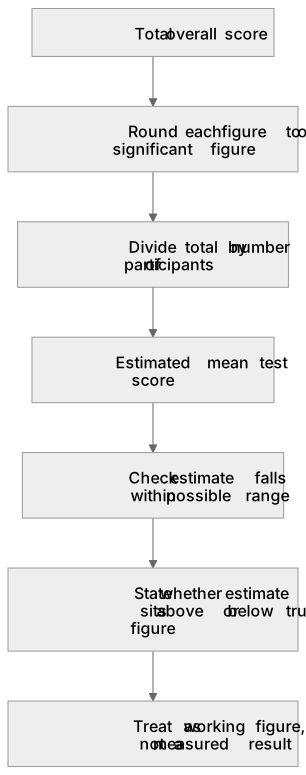
Put it in order
Put these steps in the order they happen.
- 1. Treat as working figure, not a measured result
- 2. State whether estimate sits above or below true figure
- 3. Divide total by number of participants
- 4. Check estimate falls within possible range
- 5. Total overall score
- 6. Round each figure to one significant figure
- 7. Estimated mean test score
Key words
Say what each word means before you turn the card.
estimation from totals
Try answering aloud or in your head before turning the card.
recovering a mean
Try answering aloud or in your head before turning the card.
plausibility checks
Try answering aloud or in your head before turning the card.
See every definition
- estimation from totals
- Deliberate approximation in which awkward numbers are rounded to something you can hold in your head, the arithmetic is done, and the answer is checked to sit in a sensible band.
- recovering a mean
- Dividing an overall score by the number of participants returns the mean without anyone ever seeing an individual score.
- plausibility checks
- Checking the answer against the possible range, so an estimated average has to fall between the smallest and the largest score the measure allows.
Label the diagram
Some boxes have lost their names. Pick the right name for each number.
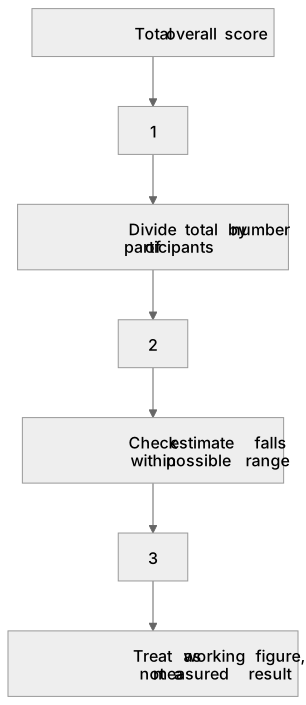
1Box 1
2Box 2
3Box 3
There is more to this lesson
The full lesson goes on to check your understanding and help you earn the marks. Create a free account to carry on, with your progress saved.
A week of Premium from your first lesson · Then the free plan continues · No card, no charge
Test your understanding of D.1 – handling data: Make order of magnitude calculations (to include: estimating the mean test score for a large number of participants on the basis of the total overall score)
Active recall beats re-reading. Take an instant quiz now to test what you’ve learned and lock it into long-term memory.
A week of Premium from your first lesson · Then the free plan continues · No card, no charge