OCR · A-Level · Psychology
Course version: H567 · Version from Sept 2015
Use a statistical test (to include: calculating a non-parametric test of…
Full specification wording
D.1 – handling data: Use a statistical test (to include: calculating a non-parametric test of differences using data from a given experiment)
To calculate a non-parametric test of differences using data from a given experiment, specific steps apply.
- Point 9 of 17
- 3 key terms
Study notes
From the teaching notes for this specification point.
The idea
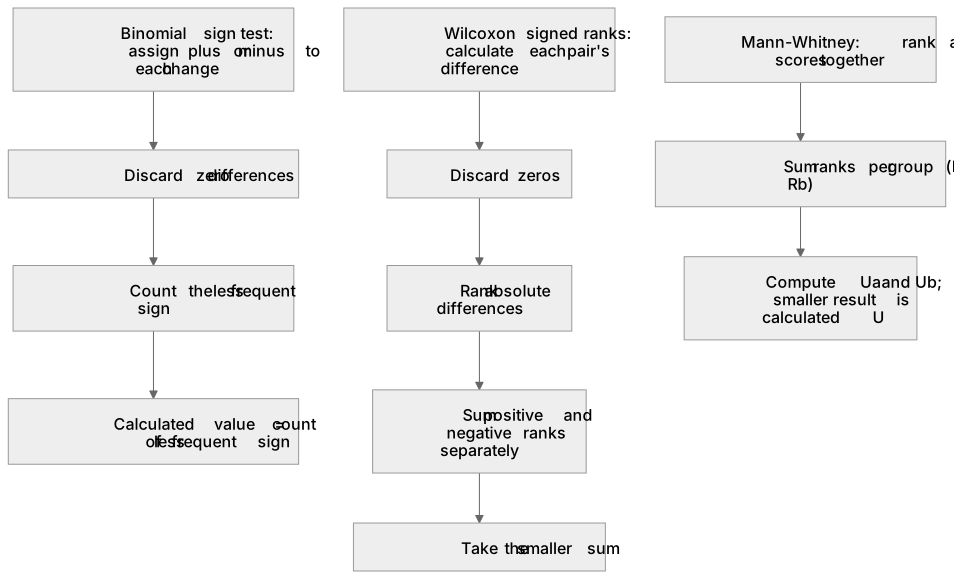
To calculate a non-parametric test of differences using data from a given experiment, specific steps apply. For the binomial sign test, assign a plus or minus to each change. For example, if memory scores change by +2, 0, -4, and +2, discard the zero, leaving two pluses and one minus. The less frequent sign is minus (count = 1), so the calculated value is 1 (N=3). For the Wilcoxon signed ranks test, calculate each pair's difference, discard zeros, rank absolute differences, sum positive and negative ranks separately, and take the smaller sum. For the Mann-Whitney test, rank all scores together, sum ranks per group ($R_a$, $R_b$), and use $U_a = n_a n_b + \frac{n_a(n_a+1)}{2} - R_a$ to find $U_a$. Calculate this for both groups; the smaller result is the calculated $U$.
What earns the marks
- Stating the decision rule accurately: for the sign test, Wilcoxon, and Mann-Whitney, the calculated value must be equal to or less than the critical value to be significant.
- Demonstrating correct ranking procedures, including assigning tied scores the mean of the ranks they would have occupied.
- Showing the full calculation for the Mann-Whitney test by pooling scores, ranking them, summing the ranks for each group, and computing the final U value.
- Reporting the outcome by naming the test, calculated value, sample size (excluding zero differences where applicable), significance level, hypothesis direction, and whether the null hypothesis is rejected.
Common mistakes and how to put them right
Counting the more frequent sign in the binomial sign test, which produces a calculated value that cannot reach the critical value.
Put it right: Count the less frequent sign.
Ranking Wilcoxon differences with their minus signs attached.
Put it right: Rank the differences by their absolute values, ignoring the positive or negative signs during the ranking step.
Misinterpreting the Mann-Whitney formula outcome.
Put it right: Applying the formula using group A's rank sum ($R_a$) calculates group A's U value ($U_a$), not group B's. Both $U_a$ and $U_b$ must be calculated to find the smaller final U.
Exam tips
- Clearly lay out your working when calculating a test of difference; a correct final figure standing alone may score fewer marks than a flawed final figure with a visible, correct method.
- Read the hypothesis carefully to determine if it is directional (one-tailed) or non-directional (two-tailed), as this dictates which column of the critical value table you must use.
Try the lesson
The start of the D.1 – handling data: Use a statistical test (to include: calculating a non-parametric test of differences using data from a given experiment) lesson, made from teaching notes for this specification point.
Have a go first
When calculating a Sign test for an experiment comparing two conditions, a researcher finds 12 positive differences, 4 negative differences, and 2 zero differences. What is the calculated value of S?
Listen
To calculate a non-parametric test of differences using data from a given experiment, specific steps apply. For the binomial sign test, assign a plus or minus to each change. For example, if memory scores change by +2, 0, -4, and +2, discard the zero, leaving two pluses and one minus. The less frequent sign is minus (count = 1), so the calculated value is 1 (N=3). For the Wilcoxon signed ranks test, calculate each pair's difference, discard zeros, rank absolute differences, sum positive and negative ranks separately, and take the smaller sum. For the Mann-Whitney test, rank all scores together, sum ranks per group (R_a, R_b), and use U_a = n_a n_b + \frac{n_a(n_a+1)}{2} - R_a to find U_a. Calculate this for both groups; the smaller result is the calculated U. A strong answer earns marks for these points. Stating the decision rule accurately: for the sign test, Wilcoxon, and Mann-Whitney, the calculated value must be equal to or less than the critical value to be significant. Demonstrating correct ranking procedures, including assigning tied scores the mean of the ranks they would have occupied. Showing the full calculation for the Mann-Whitney test by pooling scores, ranking them, summing the ranks for each group, and computing the final U value. Reporting the outcome by naming the test, calculated value, sample size (excluding zero differences where applicable), significance level, hypothesis direction, and whether the null hypothesis is rejected. Exam tip: Clearly lay out your working when calculating a test of difference; a correct final figure standing alone may score fewer marks than a flawed final figure with a visible, correct method.
See it
Key words
Say what each word means before you turn the card.
non-parametric inferential tests
Try answering aloud or in your head before turning the card.
ranking and tied scores
Try answering aloud or in your head before turning the card.
calculating tests of difference
Try answering aloud or in your head before turning the card.
See every definition
- non-parametric inferential tests
- Tests of difference calculated from data from a given experiment, including the binomial sign test, the Wilcoxon signed ranks test and the Mann-Whitney test.
- ranking and tied scores
- Assigning ranks to scores, with tied scores given the mean of the ranks they would have occupied.
- calculating tests of difference
- Working through the steps of a test of difference, such as assigning signs, ranking absolute differences or pooling scores, and reporting the outcome.
Label the diagram
Some boxes have lost their names. Pick the right name for each number.
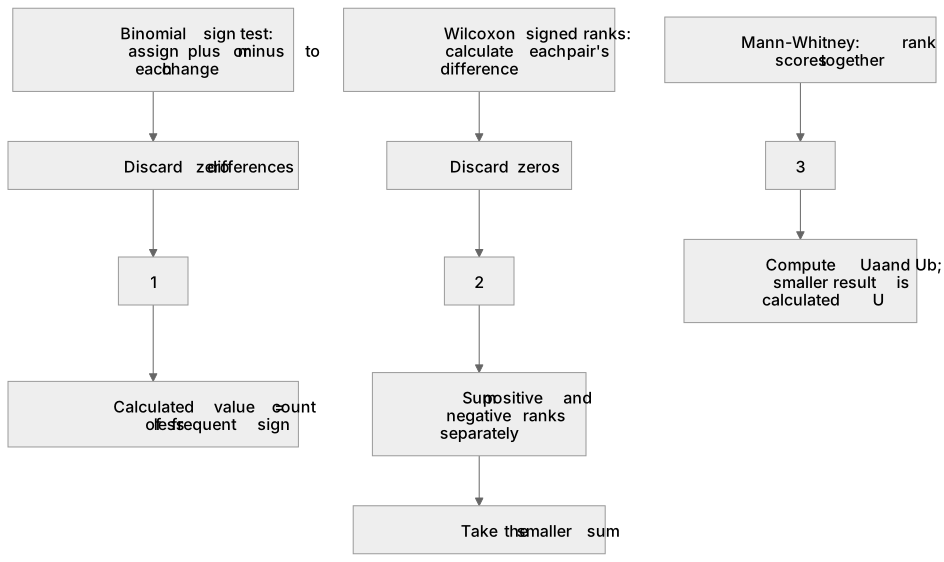
1Box 1
2Box 2
3Box 3
There is more to this lesson
The full lesson goes on to check your understanding and help you earn the marks. Create a free account to carry on, with your progress saved.
A week of Premium from your first lesson · Then the free plan continues · No card, no charge
Test your understanding of D.1 – handling data: Use a statistical test (to include: calculating a non-parametric test of differences using data from a given experiment)
Active recall beats re-reading. Take an instant quiz now to test what you’ve learned and lock it into long-term memory.
A week of Premium from your first lesson · Then the free plan continues · No card, no charge