OCR · A-Level · Psychology
Course version: H567 · Version from Sept 2015
Citing academic references: a familiarity with citing academic research…
Full specification wording
Report writing: Citing academic references: a familiarity with citing academic research using the Harvard system of referencing, e.g. Milgram, S. (1963) Behavioral study of obedience. Journal of Abnormal and Social Psychology, 67, (4), 371–378.
The purpose of a citation is retrievability: a reader should be able to go to a database and find the exact article you leant on.
- Point 3 of 4
- 3 key terms
Study notes
From the teaching notes for this specification point.
The idea
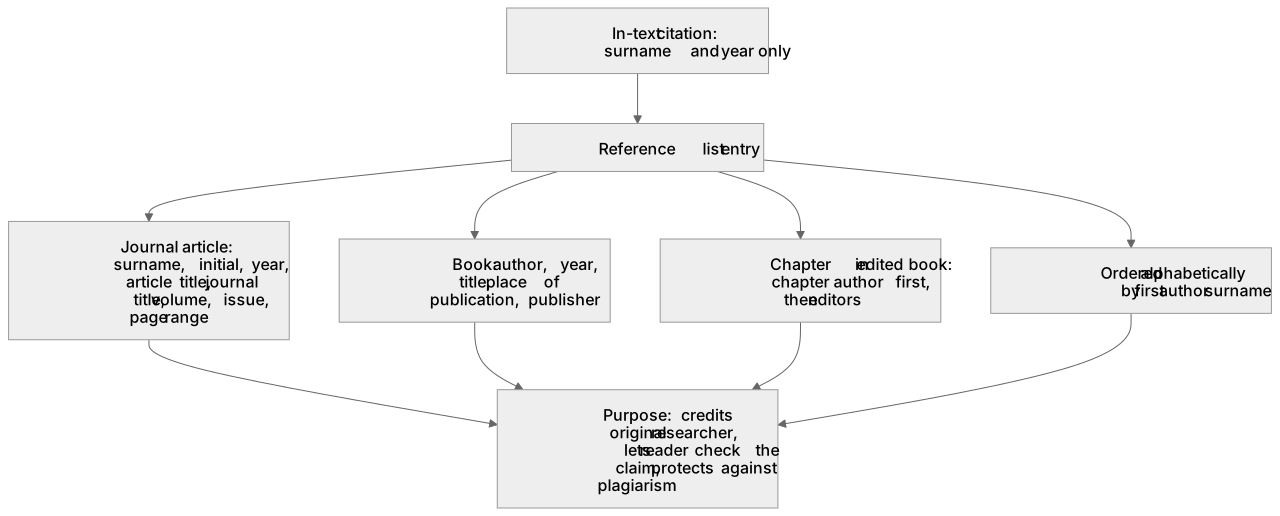
The purpose of a citation is retrievability: a reader should be able to go to a database and find the exact article you leant on. Inside the body of a report you give surname and year only, either as Milgram found that all forty of his participants continued to three hundred volts, with the year bracketed after his name, or as a bracketed surname and year at the end of the sentence. In the list at the back the elements run surname, initial, year, article title, journal title, volume, issue and page range, and entries are ordered alphabetically by first author surname. A book swaps the journal details for place of publication and publisher, and a chapter names its own author first and then the editors. Get the order right and the punctuation follows.
What earns the marks
- An in-text citation is surname and year only; a marker credits Loftus and Palmer with the year bracketed, and does not credit a full title or a web address dropped into the prose.
- For a journal article give author surname and initial, year in brackets, article title, journal name, volume, issue and page numbers, in that order.
- For a book give author, year, title, place of publication and publisher; for a chapter in an edited book, name the chapter author first and then the editors of the volume.
- Say why the convention exists: it credits the original researcher, lets a reader check the claim for themselves, and protects the writer against a charge of plagiarism.
Common mistakes and how to put them right
Citing a textbook or a revision site for a finding that belongs to the original researcher.
Put it right: The reference should point at the paper that reported the data.
Listing references in the order they were mentioned.
Put it right: Harvard style orders the list alphabetically by first author surname, with the earliest year first where the same author appears twice.
Putting the initial before the surname in the reference list, which makes the list impossible to alphabetise and loses the convention mark.
Exam tips
- You may be given a reference with its elements jumbled and asked to identify the volume, the year or the journal title, so learn which slot each element occupies rather than memorising one example.
- Short items ask you to explain one reason researchers reference their sources; answer with credit to the original author and with checkability, never with the idea that it looks professional.
- If asked to write a reference from details given in a scenario, keep the order and bracket the year, because the marks are for the convention rather than for the content.
Try the lesson
The start of the Report writing: Citing academic references: a familiarity with citing academic research using the Harvard system of referencing, e.g. Milgram, S. (1963) Behavioral study of obedience. Journal of Abnormal and Social Psychology, 67, (4), 371–378. lesson, made from teaching notes for this specification point.
Have a go first
A student is writing a reference for a journal article by Jane Smith published in 2020, titled 'Memory recall', in the Journal of Cognitive Psychology, volume 12, issue 3, pages 45-60. Which of the following is the correct Harvard reference?
Listen
The purpose of a citation is retrievability: a reader should be able to go to a database and find the exact article you leant on. Inside the body of a report you give surname and year only, either as Milgram found that all forty of his participants continued to three hundred volts, with the year bracketed after his name, or as a bracketed surname and year at the end of the sentence. In the list at the back the elements run surname, initial, year, article title, journal title, volume, issue and page range, and entries are ordered alphabetically by first author surname. A book swaps the journal details for place of publication and publisher, and a chapter names its own author first and then the editors. Get the order right and the punctuation follows. A strong answer earns marks for these points. An in-text citation is surname and year only; a marker credits Loftus and Palmer with the year bracketed, and does not credit a full title or a web address dropped into the prose. For a journal article give author surname and initial, year in brackets, article title, journal name, volume, issue and page numbers, in that order. For a book give author, year, title, place of publication and publisher; for a chapter in an edited book, name the chapter author first and then the editors of the volume. Say why the convention exists: it credits the original researcher, lets a reader check the claim for themselves, and protects the writer against a charge of plagiarism. Exam tip: You may be given a reference with its elements jumbled and asked to identify the volume, the year or the journal title, so learn which slot each element occupies rather than memorising one example.
See it
Key words
Say what each word means before you turn the card.
Harvard convention
Try answering aloud or in your head before turning the card.
in-text citation
Try answering aloud or in your head before turning the card.
retrievability
Try answering aloud or in your head before turning the card.
See every definition
- Harvard convention
- A system of referencing academic research in which the elements of a reference are given in a set order and the punctuation follows.
- in-text citation
- Inside the body of a report, surname and year only, either with the year bracketed after the name or as a bracketed surname and year at the end of the sentence.
- retrievability
- The purpose of a citation, so that a reader should be able to go to a database and find the exact article you leant on.
Label the diagram
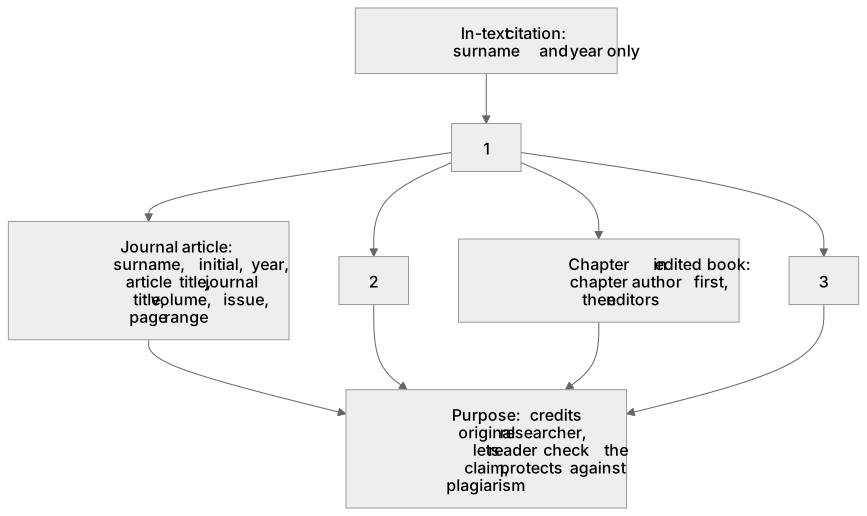
Some boxes have lost their names. Pick the right name for each number.
1Box 1
2Box 2
3Box 3
There is more to this lesson
The full lesson goes on to check your understanding and help you earn the marks. Create a free account to carry on, with your progress saved.
A week of Premium from your first lesson · Then the free plan continues · No card, no charge
Test your understanding of Report writing: Citing academic references: a familiarity with citing academic research using the Harvard system of referencing, e.g. Milgram, S. (1963) Behavioral study of obedience. Journal of Abnormal and Social Psychology, 67, (4), 371–378.
Active recall beats re-reading. Take an instant quiz now to test what you’ve learned and lock it into long-term memory.
A week of Premium from your first lesson · Then the free plan continues · No card, no charge