AQA · GCSE · Religious Studies
Course version: 8062 · Version from Sept 2018
Hinduism - 3.1.4.1 Beliefs and teachings: beyond, as a personal loving God
In Hinduism, the ultimate reality, Brahman, can be understood in two main ways.
- Point 6 of 19
- 4 key terms
Study notes
From the teaching notes for this specification point.
The idea
In Hinduism, the ultimate reality, Brahman, can be understood in two main ways. This statement focuses on the concept of God as 'beyond' the physical universe (transcendent) yet simultaneously accessible as a personal, loving deity. This is often referred to as Saguna Brahman (Brahman with qualities) or Bhagavan. Unlike an abstract, impersonal force, a personal loving God can be approached through devotion (bhakti), prayer, and worship (puja). For example, Vaishnavas worship Vishnu or Krishna as a supreme, personal, and loving Lord who cares deeply for humanity and intervenes in the world to restore dharma. This dual nature allows Hindus to revere a God who is infinitely greater than the cosmos, yet intimately involved in the lives of devotees.
What earns the marks
- Define 'beyond' as transcendence, meaning God exists outside the limitations of the physical universe.
- Explain 'personal loving God' using the term Saguna Brahman (Brahman with form or qualities) or Bhagavan.
- Connect the concept of a personal God to the practice of bhakti (loving devotion) and puja (worship).
- Provide an example of a personal deity, such as Krishna or Rama, who demonstrates love and care for humanity.
Common mistakes and how to put them right
Thinking 'beyond' means God is completely detached from the world.
Put it right: Explain that while God is transcendent (beyond), God is also immanent and personal, actively loving and caring for devotees.
Confusing Nirguna Brahman with a personal loving God.
Put it right: Use Saguna Brahman or Bhagavan when referring to God with personal, loving qualities, as Nirguna Brahman is without form or attributes.
Assuming all Hindus view God only as an impersonal force.
Put it right: Acknowledge that many Hindus, particularly followers of Bhakti traditions, view God primarily as a personal, loving supreme being.
Exam tips
- Use the Sanskrit terms 'Saguna Brahman' or 'Bhagavan' to demonstrate a high level of subject knowledge when discussing a personal God.
- Link the concept of a personal, loving God to specific practices like puja or bhakti yoga to show how belief influences action.
- When evaluating the nature of God, contrast the idea of a personal loving God with the concept of an impersonal ultimate reality (Nirguna Brahman).
Try the lesson
The start of the Hinduism - 3.1.4.1 Beliefs and teachings: beyond, as a personal loving God lesson, made from teaching notes for this specification point.
Have a go first
Which Hindu concept refers to the understanding of the divine as existing 'beyond, as a personal loving God'?
Listen
In Hinduism, the ultimate reality, Brahman, can be understood in two main ways. This statement focuses on the concept of God as 'beyond' the physical universe (transcendent) yet simultaneously accessible as a personal, loving deity. This is often referred to as Saguna Brahman (Brahman with qualities) or Bhagavan. Unlike an abstract, impersonal force, a personal loving God can be approached through devotion (bhakti), prayer, and worship (puja). For example, Vaishnavas worship Vishnu or Krishna as a supreme, personal, and loving Lord who cares deeply for humanity and intervenes in the world to restore dharma. This dual nature allows Hindus to revere a God who is infinitely greater than the cosmos, yet intimately involved in the lives of devotees. A strong answer earns marks for these points. Define 'beyond' as transcendence, meaning God exists outside the limitations of the physical universe. Explain 'personal loving God' using the term Saguna Brahman (Brahman with form or qualities) or Bhagavan. Connect the concept of a personal God to the practice of bhakti (loving devotion) and puja (worship). Provide an example of a personal deity, such as Krishna or Rama, who demonstrates love and care for humanity. A common slip: Thinking 'beyond' means God is completely detached from the world. Instead, Explain that while God is transcendent (beyond), God is also immanent and personal, actively loving and caring for devotees. Exam tip: Use the Sanskrit terms 'Saguna Brahman' or 'Bhagavan' to demonstrate a high level of subject knowledge when discussing a personal God.
See it
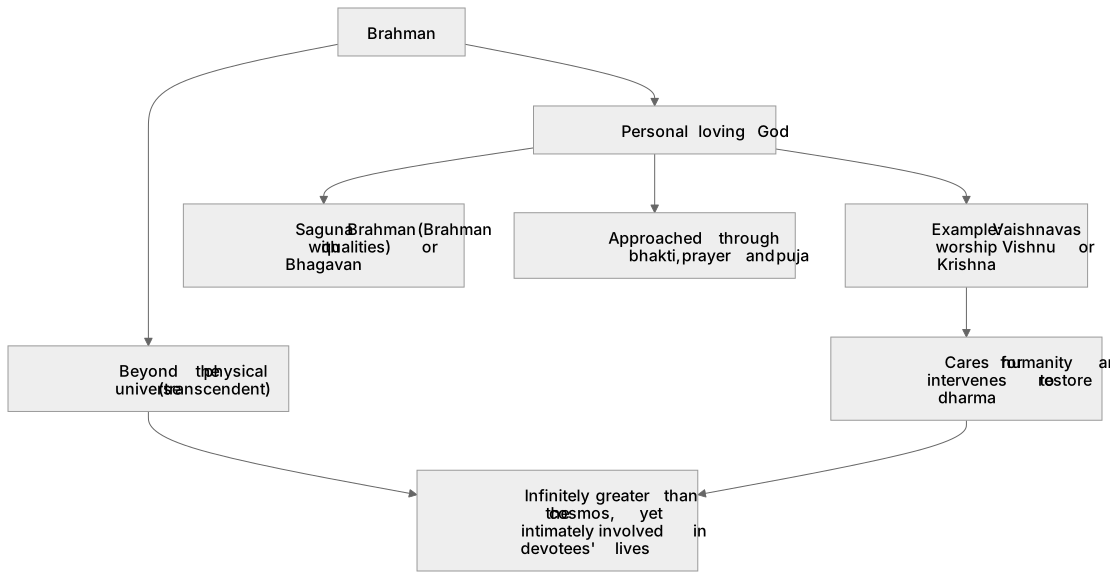
Key words
Say what each word means before you turn the card.
Transcendence
Try answering aloud or in your head before turning the card.
Saguna Brahman
Try answering aloud or in your head before turning the card.
Bhakti (Devotion)
Try answering aloud or in your head before turning the card.
Bhagavan
Try answering aloud or in your head before turning the card.
See every definition
- Transcendence
- The concept of God as 'beyond' the physical universe, existing outside its limitations.
- Saguna Brahman
- Brahman with qualities, referring to God as a personal, loving deity who can be approached through devotion.
- Bhakti (Devotion)
- Loving devotion through which a personal loving God can be approached, along with prayer and worship.
- Bhagavan
- A term for God understood as a personal, loving deity, alongside Saguna Brahman.
Label the diagram
Some boxes have lost their names. Pick the right name for each number.
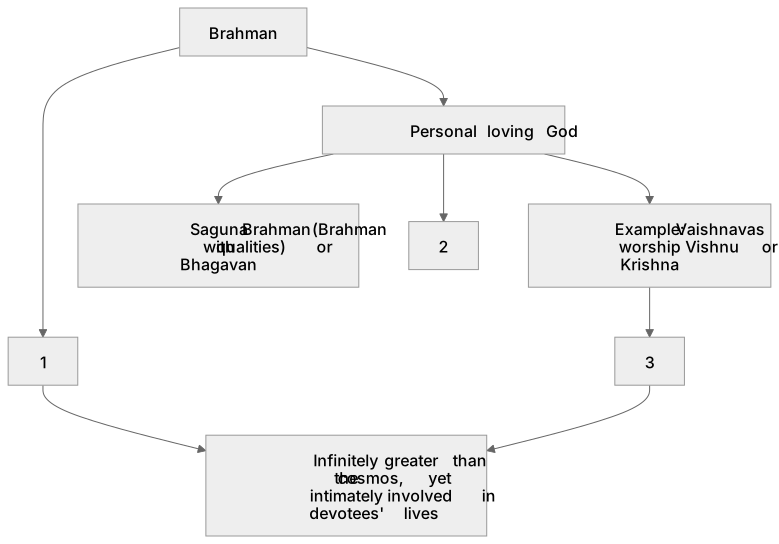
1Box 1
2Box 2
3Box 3
There is more to this lesson
The full lesson goes on to check your understanding and help you earn the marks. Create a free account to carry on, with your progress saved.
A week of Premium from your first lesson · Then the free plan continues · No card, no charge
Test your understanding of Hinduism - 3.1.4.1 Beliefs and teachings: beyond, as a personal loving God
Active recall beats re-reading. Take an instant quiz now to test what you’ve learned and lock it into long-term memory.
A week of Premium from your first lesson · Then the free plan continues · No card, no charge