AQA · GCSE · Religious Studies
Course version: 8062 · Version from Sept 2018
Hinduism - 3.1.4.1 Beliefs and teachings: Brihadaranyaka Upanishad 391.
The Brihadaranyaka Upanishad is a foundational Hindu scripture exploring the nature of reality.
- Point 7 of 19
- 3 key terms
Study notes
From the teaching notes for this specification point.
The idea
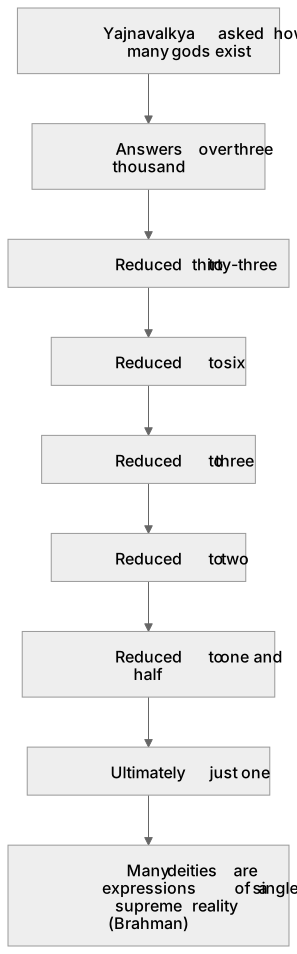
The Brihadaranyaka Upanishad is a foundational Hindu scripture exploring the nature of reality. The specific reference 3.9.1 (often cited as 391) contains a famous philosophical dialogue between the sage Yajnavalkya and Shakalya. When asked how many gods exist, Yajnavalkya initially answers with over three thousand, but through repeated questioning, systematically reduces the number to thirty-three, then six, three, two, one and a half, and ultimately just one. This passage is crucial for understanding the Hindu concept of the divine: it teaches that while there are many manifestations and deities (polytheism or a pantheon), they are all ultimately expressions of a single, unified, supreme reality or Brahman (monism).
What earns the marks
- Identify the Brihadaranyaka Upanishad as a key Shruti text that explores the nature of Brahman and the self (Atman).
- Describe the dialogue in section 3.9.1 where the number of gods is reduced from thousands down to a single ultimate reality.
- Explain that this passage justifies the Hindu belief that the many deities are simply different forms or expressions of the one supreme Brahman.
- Use this scripture as evidence to support arguments about Hindu monism (all is one) or the relationship between the many gods and the one God.
Common mistakes and how to put them right
Stating that this Upanishad proves Hinduism is strictly polytheistic.
Put it right: Explain that while it acknowledges many gods, the passage ultimately concludes there is only one supreme reality (Brahman).
Misattributing the teaching to the Bhagavad Gita or the Vedas generally.
Put it right: Specifically name the Brihadaranyaka Upanishad when referencing the dialogue about the reducing number of gods.
Thinking the text dismisses the lesser gods as fake.
Put it right: Clarify that the text validates the many gods as real manifestations or powers of the one supreme Brahman, rather than dismissing them.
Exam tips
- Memorise the core message of this passage (many gods reducing to one) to use as a powerful quote or reference in questions about the nature of God.
- Use this reference to contrast the diverse visual representations of Hindu deities with the underlying philosophical belief in a single Brahman.
- When asked about the relationship between Brahman and the deities, cite Yajnavalkya's dialogue to demonstrate deep scriptural knowledge.
Try the lesson
The start of the Hinduism - 3.1.4.1 Beliefs and teachings: Brihadaranyaka Upanishad 391. lesson, made from teaching notes for this specification point.
Have a go first
What is the central teaching about the gods in the dialogue found in Brihadaranyaka Upanishad 3.9.1?
Listen
The Brihadaranyaka Upanishad is a foundational Hindu scripture exploring the nature of reality. The specific reference 3.9.1 (often cited as 391) contains a famous philosophical dialogue between the sage Yajnavalkya and Shakalya. When asked how many gods exist, Yajnavalkya initially answers with over three thousand, but through repeated questioning, systematically reduces the number to thirty-three, then six, three, two, one and a half, and ultimately just one. This passage is crucial for understanding the Hindu concept of the divine: it teaches that while there are many manifestations and deities (polytheism or a pantheon), they are all ultimately expressions of a single, unified, supreme reality or Brahman (monism). A strong answer earns marks for these points. Identify the Brihadaranyaka Upanishad as a key Shruti text that explores the nature of Brahman and the self (Atman). Describe the dialogue in section 3.9.1 where the number of gods is reduced from thousands down to a single ultimate reality. Explain that this passage justifies the Hindu belief that the many deities are simply different forms or expressions of the one supreme Brahman. Use this scripture as evidence to support arguments about Hindu monism (all is one) or the relationship between the many gods and the one God. A common slip: Stating that this Upanishad proves Hinduism is strictly polytheistic. Instead, Explain that while it acknowledges many gods, the passage ultimately concludes there is only one supreme reality (Brahman). Exam tip: Memorise the core message of this passage (many gods reducing to one) to use as a powerful quote or reference in questions about the nature of God.
See it
Key words
Say what each word means before you turn the card.
Monism vs Polytheism
Try answering aloud or in your head before turning the card.
Nature of Brahman
Try answering aloud or in your head before turning the card.
Manifestations of the Divine
Try answering aloud or in your head before turning the card.
See every definition
- Monism vs Polytheism
- The passage teaches that while there are many manifestations and deities, they are all ultimately expressions of a single, unified, supreme reality.
- Nature of Brahman
- A single, unified, supreme reality of which the many manifestations and deities are ultimately expressions.
- Manifestations of the Divine
- The many deities are different forms or expressions of the one supreme Brahman, validated as real manifestations or powers rather than dismissed.
Label the diagram
Some boxes have lost their names. Pick the right name for each number.
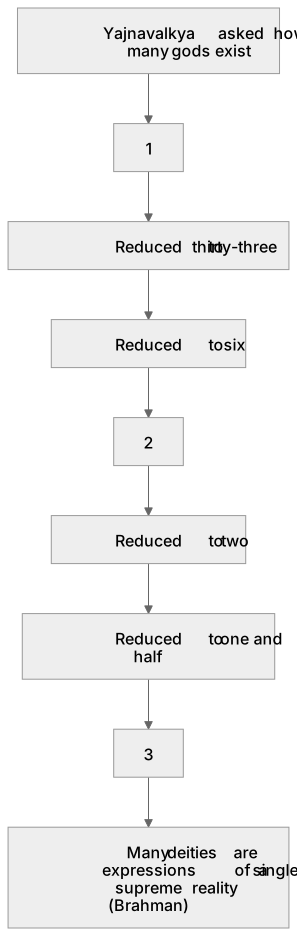
1Box 1
2Box 2
3Box 3
There is more to this lesson
The full lesson goes on to check your understanding and help you earn the marks. Create a free account to carry on, with your progress saved.
A week of Premium from your first lesson · Then the free plan continues · No card, no charge
Test your understanding of Hinduism - 3.1.4.1 Beliefs and teachings: Brihadaranyaka Upanishad 391.
Active recall beats re-reading. Take an instant quiz now to test what you’ve learned and lock it into long-term memory.
A week of Premium from your first lesson · Then the free plan continues · No card, no charge