AQA · GCSE · Religious Studies
Course version: 8062 · Version from Sept 2018
Hinduism - 3.1.4.1 Beliefs and teachings: How the divine presents:
In Hinduism, the ultimate reality is Brahman, a supreme, infinite, and formless spirit known as Nirguna Brahman.
- Point 8 of 19
- 4 key terms
Study notes
From the teaching notes for this specification point.
The idea
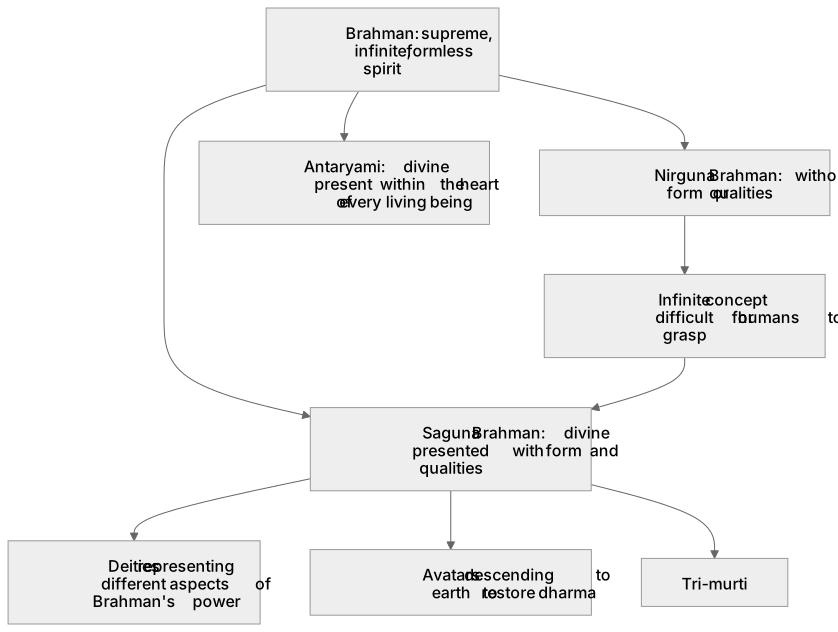
In Hinduism, the ultimate reality is Brahman, a supreme, infinite, and formless spirit known as Nirguna Brahman. Because an infinite concept is difficult for humans to grasp, the divine presents itself in accessible forms with distinct qualities, known as Saguna Brahman. This allows devotees to connect with God personally. The divine manifests through various deities representing different aspects of Brahman's power. For example, the divine presents as avatars descending to earth to restore dharma, and as the Tri-murti. Furthermore, the divine is present within the heart of every living being as the antaryami (inner controller). This diversity explains why Hinduism features many deities while maintaining a core belief in one ultimate reality.
What earns the marks
- Explain the distinction between Nirguna Brahman (formless) and Saguna Brahman (with form).
- Identify that the divine presents itself in multiple forms to make the infinite accessible to human understanding.
- Describe the concept of antaryami, where the divine is present within the heart of all living beings.
- Explain that all individual deities are manifestations of the one supreme reality, Brahman.
Common mistakes and how to put them right
Stating that Hindus believe in completely separate, independent gods.
Put it right: Explain that all deities are different presentations of the one ultimate reality, Brahman.
Confusing Nirguna and Saguna Brahman.
Put it right: Nirguna is without form or qualities, while Saguna is the divine presented with form and qualities.
Assuming the divine only presents in heaven.
Put it right: Note that the divine presents on earth as avatars and within individuals as the antaryami.
Exam tips
- Use the terms Nirguna and Saguna Brahman to demonstrate a high-level understanding of how the divine presents.
- When evaluating whether Hinduism is polytheistic, use the concept of the divine presenting in many forms to argue for its underlying monotheism.
- Link the presentation of the divine to worship practices, explaining how physical images (murtis) help Hindus focus on Saguna Brahman.
Try the lesson
The start of the Hinduism - 3.1.4.1 Beliefs and teachings: How the divine presents: lesson, made from teaching notes for this specification point.
Have a go first
In Hinduism, what term is used to describe the divine presenting itself as a personal God with form and qualities?
Listen
In Hinduism, the ultimate reality is Brahman, a supreme, infinite, and formless spirit known as Nirguna Brahman. Because an infinite concept is difficult for humans to grasp, the divine presents itself in accessible forms with distinct qualities, known as Saguna Brahman. This allows devotees to connect with God personally. The divine manifests through various deities representing different aspects of Brahman's power. For example, the divine presents as avatars descending to earth to restore dharma, and as the Tri-murti. Furthermore, the divine is present within the heart of every living being as the antaryami (inner controller). This diversity explains why Hinduism features many deities while maintaining a core belief in one ultimate reality. A strong answer earns marks for these points. Explain the distinction between Nirguna Brahman (formless) and Saguna Brahman (with form). Identify that the divine presents itself in multiple forms to make the infinite accessible to human understanding. Describe the concept of antaryami, where the divine is present within the heart of all living beings. Explain that all individual deities are manifestations of the one supreme reality, Brahman. A common slip: Stating that Hindus believe in completely separate, independent gods. Instead, explain that all deities are different presentations of the one ultimate reality, Brahman. Exam tip: Use the terms Nirguna and Saguna Brahman to demonstrate a high-level understanding of how the divine presents.
See it
Key words
Say what each word means before you turn the card.
Brahman
Try answering aloud or in your head before turning the card.
Saguna Brahman
Try answering aloud or in your head before turning the card.
Antaryami
Try answering aloud or in your head before turning the card.
Avatars
Try answering aloud or in your head before turning the card.
See every definition
- Brahman
- The ultimate reality, a supreme, infinite, and formless spirit known as Nirguna Brahman.
- Saguna Brahman
- The divine presenting itself in accessible forms with distinct qualities, allowing devotees to connect with God personally.
- Antaryami
- The divine present within the heart of every living being as the inner controller.
- Avatars
- Forms in which the divine presents as it descends to earth to restore dharma.
Label the diagram
Some boxes have lost their names. Pick the right name for each number.
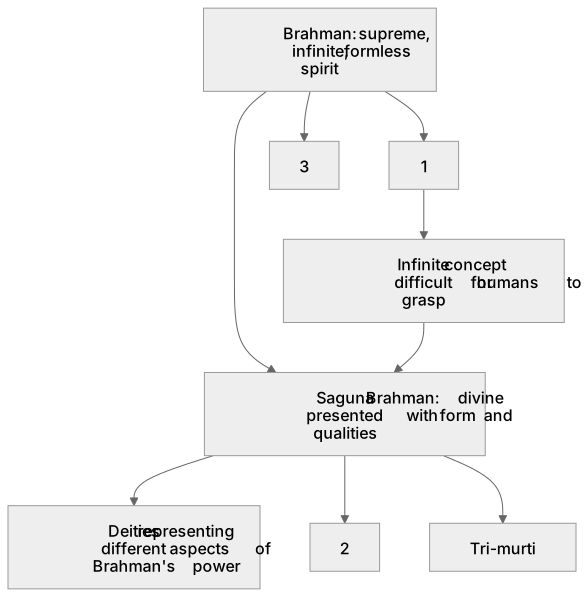
1Box 1
2Box 2
3Box 3
There is more to this lesson
The full lesson goes on to check your understanding and help you earn the marks. Create a free account to carry on, with your progress saved.
A week of Premium from your first lesson · Then the free plan continues · No card, no charge
Test your understanding of Hinduism - 3.1.4.1 Beliefs and teachings: How the divine presents:
Active recall beats re-reading. Take an instant quiz now to test what you’ve learned and lock it into long-term memory.
A week of Premium from your first lesson · Then the free plan continues · No card, no charge