AQA · GCSE · Religious Studies
Course version: 8062 · Version from Sept 2018
The Tri-murti: Brahma, Vishnu and Shiva
Full specification wording
Hinduism - 3.1.4.1 Beliefs and teachings: the Tri-murti: Brahma, Vishnu and Shiva
The Tri-murti represents the three primary manifestations of Brahman, responsible for the continuous cycle of the universe.
- Point 9 of 19
- 3 key terms
Study notes
From the teaching notes for this specification point.
The idea
The Tri-murti represents the three primary manifestations of Brahman, responsible for the continuous cycle of the universe. It consists of Brahma the Creator, Vishnu the Preserver, and Shiva the Destroyer. Brahma creates the universe and all life, though he is rarely worshipped today. Vishnu sustains and protects the universe, maintaining cosmic order (dharma) and descending as avatars like Krishna when evil threatens the world. Shiva is the destroyer, whose role is to destroy the universe at the end of its cycle so it can be recreated, representing the necessary balance of life and death. Together, these three deities illustrate how the divine manages the endless cycle of creation, preservation, and destruction in Hindu cosmology.
What earns the marks
- Identify the three deities of the Tri-murti and their specific cosmic roles: Brahma (Creator), Vishnu (Preserver), and Shiva (Destroyer).
- Explain that the Tri-murti represents three distinct aspects or functions of the one supreme reality, Brahman.
- Describe Vishnu's role in maintaining dharma, including his descent to earth as avatars during times of crisis.
- Explain Shiva's role as a transformative force, destroying the universe to allow for new creation.
Common mistakes and how to put them right
Confusing Brahma (the creator deity) with Brahman (the ultimate reality).
Put it right: Clearly distinguish Brahma as a personal god within the Tri-murti and Brahman as the supreme, formless spirit.
Viewing Shiva's destructive role as evil.
Put it right: Explain that Shiva's destruction is a positive, necessary step for recreation and the continuation of the cosmic cycle.
Stating that Brahma is the most widely worshipped deity.
Put it right: Note that Brahma has very few temples, whereas Vishnu and Shiva have millions of devoted followers.
Exam tips
- Always link the roles of the Tri-murti back to the cyclical nature of time and the universe in Hindu belief.
- Use the Tri-murti as a prime example when explaining how the formless Brahman takes on specific forms (Saguna Brahman) to perform cosmic functions.
- Ensure correct spelling of Brahma, Brahman, and Brahmin, as confusing these terms will lose marks for inaccuracy.
Try the lesson
The start of the Hinduism - 3.1.4.1 Beliefs and teachings: the Tri-murti: Brahma, Vishnu and Shiva lesson, made from teaching notes for this specification point.
Have a go first
Which three deities make up the Hindu Tri-murti?
Listen
The Tri-murti represents the three primary manifestations of Brahman, responsible for the continuous cycle of the universe. It consists of Brahma the Creator, Vishnu the Preserver, and Shiva the Destroyer. Brahma creates the universe and all life, though he is rarely worshipped today. Vishnu sustains and protects the universe, maintaining cosmic order (dharma) and descending as avatars like Krishna when evil threatens the world. Shiva is the destroyer, whose role is to destroy the universe at the end of its cycle so it can be recreated, representing the necessary balance of life and death. Together, these three deities illustrate how the divine manages the endless cycle of creation, preservation, and destruction in Hindu cosmology. A strong answer earns marks for these points. Identify the three deities of the Tri-murti and their specific cosmic roles: Brahma (Creator), Vishnu (Preserver), and Shiva (Destroyer). Explain that the Tri-murti represents three distinct aspects or functions of the one supreme reality, Brahman. Describe Vishnu's role in maintaining dharma, including his descent to earth as avatars during times of crisis. Explain Shiva's role as a transformative force, destroying the universe to allow for new creation. A common slip: Confusing Brahma (the creator deity) with Brahman (the ultimate reality). Instead, clearly distinguish Brahma as a personal god within the Tri-murti and Brahman as the supreme, formless spirit. Exam tip: Always link the roles of the Tri-murti back to the cyclical nature of time and the universe in Hindu belief.
See it
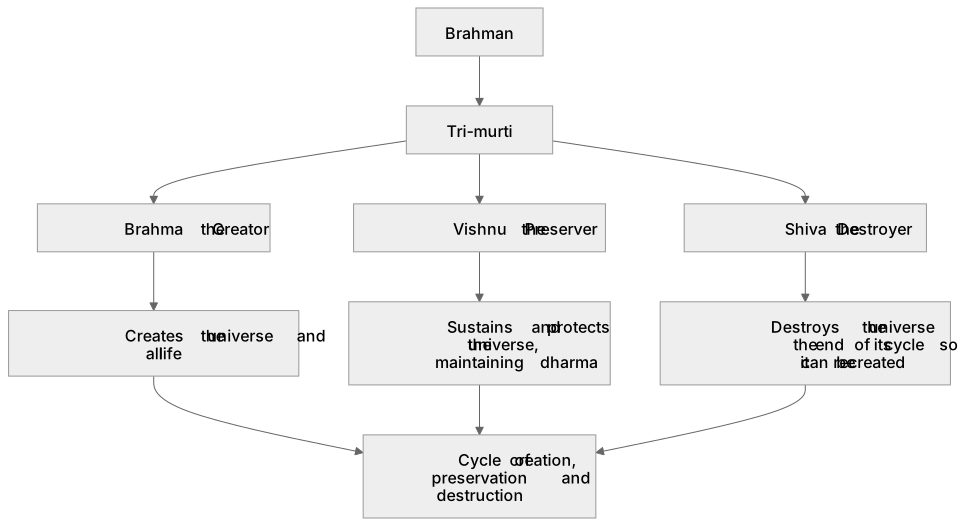
Key words
Say what each word means before you turn the card.
Tri-murti
Try answering aloud or in your head before turning the card.
Avatars
Try answering aloud or in your head before turning the card.
Dharma
Try answering aloud or in your head before turning the card.
See every definition
- Tri-murti
- Represents the three primary manifestations of Brahman, responsible for the continuous cycle of the universe.
- Avatars
- Vishnu descends as these, like Krishna, when evil threatens the world.
- Dharma
- Cosmic order, which Vishnu sustains and protects.
Label the diagram
Some boxes have lost their names. Pick the right name for each number.
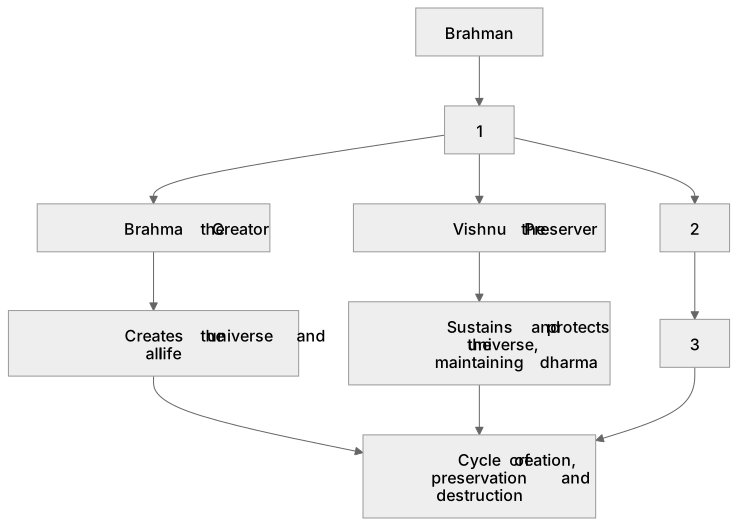
1Box 1
2Box 2
3Box 3
There is more to this lesson
The full lesson goes on to check your understanding and help you earn the marks. Create a free account to carry on, with your progress saved.
A week of Premium from your first lesson · Then the free plan continues · No card, no charge
Test your understanding of Hinduism - 3.1.4.1 Beliefs and teachings: the Tri-murti: Brahma, Vishnu and Shiva
Active recall beats re-reading. Take an instant quiz now to test what you’ve learned and lock it into long-term memory.
A week of Premium from your first lesson · Then the free plan continues · No card, no charge