AQA · GCSE · Religious Studies
Course version: 8062 · Version from Sept 2018
Hinduism - 3.1.4.2 Practices: sacred plants and animals
In Hinduism, the divine is present in all living things, leading to the veneration of specific flora and fauna.
- Point 8 of 26
- 3 key terms
Study notes
From the teaching notes for this specification point.
The idea
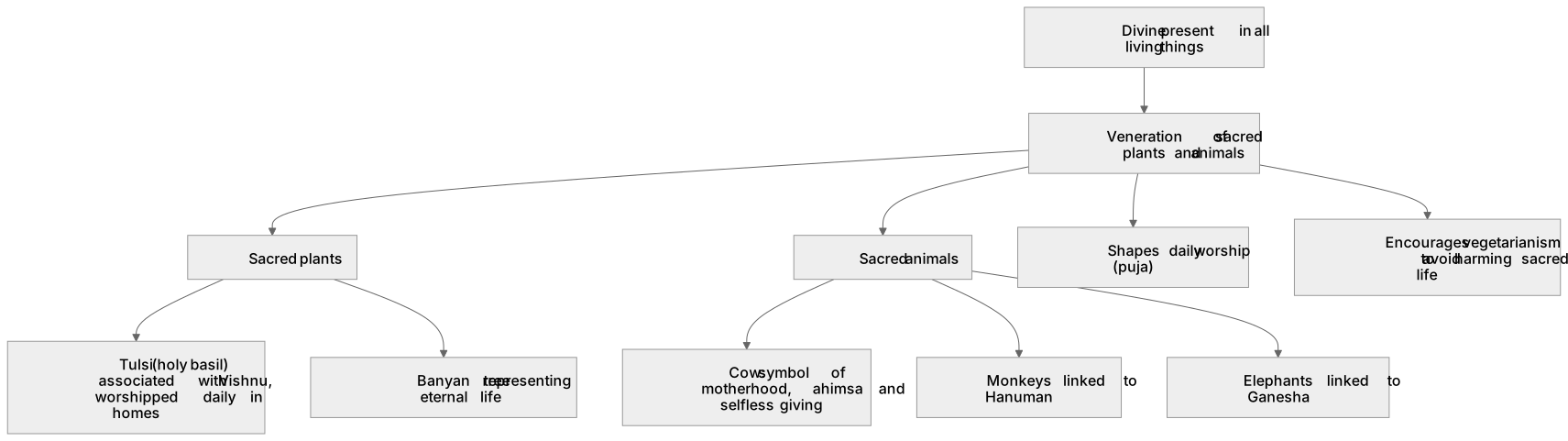
In Hinduism, the divine is present in all living things, leading to the veneration of specific flora and fauna. Sacred plants include the Tulsi (holy basil), which is associated with Lord Vishnu and worshipped daily in many homes for protection and spiritual purity. The Banyan tree is also revered, representing eternal life. Among animals, the cow is the most respected, seen as a symbol of motherhood, non-violence (ahimsa), and selfless giving. Monkeys (linked to Hanuman) and elephants (linked to Ganesha) are also honoured. This deep reverence shapes daily worship (puja) and encourages dietary practices such as vegetarianism to avoid harming sacred life.
What earns the marks
- Explain the significance of the cow as a symbol of motherhood, selfless giving, and ahimsa.
- Describe the use of sacred plants like the Tulsi shrub in daily household puja and its association with Vishnu.
- Link the reverence for plants and animals to the belief that Brahman is present in all living beings.
- Discuss how the sacredness of animals influences Hindu lifestyle choices, such as adopting a vegetarian diet.
Common mistakes and how to put them right
Claiming that Hindus worship cows as gods.
Put it right: Explain that cows are deeply respected and revered as symbols of motherhood and life, not worshipped as deities themselves.
Overlooking the role of sacred plants in daily life.
Put it right: Include specific examples like the Tulsi plant and its central role in household shrines and daily puja.
Stating all Hindus must be vegetarian.
Put it right: Note that while vegetarianism is encouraged due to ahimsa and the sacredness of animals, it is not strictly mandatory for all Hindus.
Exam tips
- Always name specific examples of sacred plants (e.g., Tulsi, Lotus, Banyan) and animals (e.g., cows, monkeys, elephants) to gain higher marks.
- Connect the respect for animals directly to the principle of ahimsa (non-violence) and the accumulation of good karma.
- Use the reverence for plants and animals as evidence when answering questions on Hindu environmental attitudes.
Try the lesson
The start of the Hinduism - 3.1.4.2 Practices: sacred plants and animals lesson, made from teaching notes for this specification point.
Have a go first
Which of the following animals is widely considered sacred in Hinduism and is often associated with the goddess Prithvi (Mother Earth)?
Listen
In Hinduism, the divine is present in all living things, leading to the veneration of specific flora and fauna. Sacred plants include the Tulsi (holy basil), which is associated with Lord Vishnu and worshipped daily in many homes for protection and spiritual purity. The Banyan tree is also revered, representing eternal life. Among animals, the cow is the most respected, seen as a symbol of motherhood, non-violence (ahimsa), and selfless giving. Monkeys (linked to Hanuman) and elephants (linked to Ganesha) are also honoured. This deep reverence shapes daily worship (puja) and encourages dietary practices such as vegetarianism to avoid harming sacred life. A strong answer earns marks for these points. Explain the significance of the cow as a symbol of motherhood, selfless giving, and ahimsa. Describe the use of sacred plants like the Tulsi shrub in daily household puja and its association with Vishnu. Link the reverence for plants and animals to the belief that Brahman is present in all living beings. Discuss how the sacredness of animals influences Hindu lifestyle choices, such as adopting a vegetarian diet. A common slip: Claiming that Hindus worship cows as gods. Instead, Explain that cows are deeply respected and revered as symbols of motherhood and life, not worshipped as deities themselves. Exam tip: Always name specific examples of sacred plants (e.g., Tulsi, Lotus, Banyan) and animals (e.g., cows, monkeys, elephants) to gain higher marks.
See it
Key words
Say what each word means before you turn the card.
Ahimsa
Try answering aloud or in your head before turning the card.
Puja
Try answering aloud or in your head before turning the card.
Immanence of Brahman
Try answering aloud or in your head before turning the card.
See every definition
- Ahimsa
- Non-violence, which the cow symbolises and which encourages dietary practices such as vegetarianism to avoid harming sacred life.
- Puja
- Daily worship, shaped by deep reverence for sacred plants and animals, in which the Tulsi is worshipped daily in many homes.
- Immanence of Brahman
- The belief that the divine is present in all living things, linking reverence for plants and animals to Brahman being present in all living beings.
Label the diagram
Some boxes have lost their names. Pick the right name for each number.
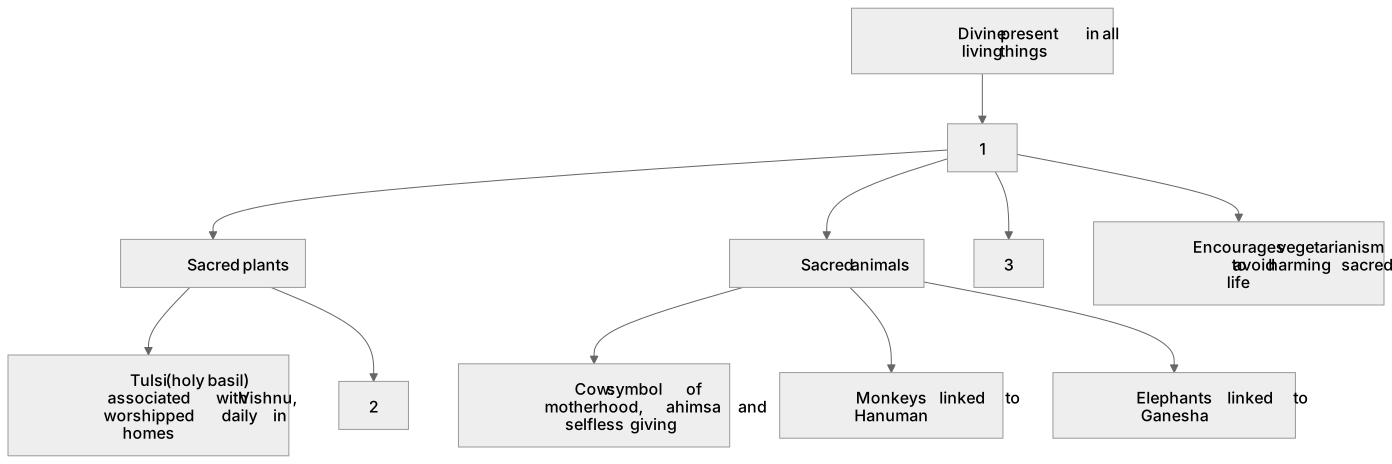
1Box 1
2Box 2
3Box 3
There is more to this lesson
The full lesson goes on to check your understanding and help you earn the marks. Create a free account to carry on, with your progress saved.
A week of Premium from your first lesson · Then the free plan continues · No card, no charge
Test your understanding of Hinduism - 3.1.4.2 Practices: sacred plants and animals
Active recall beats re-reading. Take an instant quiz now to test what you’ve learned and lock it into long-term memory.
A week of Premium from your first lesson · Then the free plan continues · No card, no charge