AQA · GCSE · Religious Studies
Course version: 8062 · Version from Sept 2018
Beliefs about life after death, including judgement and resurrection.
Full specification wording
Judaism - 3.1.6.1 Beliefs and teachings: Beliefs about life after death, including judgement and resurrection.
Judaism focuses primarily on the present life (Olam Ha-Ze) rather than the afterlife (Olam Ha-Ba), meaning beliefs about life after death are diverse and less dogmatic.
- Point 7 of 15
- 4 key terms
Study notes
From the teaching notes for this specification point.
The idea
Judaism focuses primarily on the present life (Olam Ha-Ze) rather than the afterlife (Olam Ha-Ba), meaning beliefs about life after death are diverse and less dogmatic. Orthodox Jews often believe in a physical resurrection of the dead during the Messianic age, requiring bodies to be buried intact. Reform Jews generally reject physical resurrection, focusing instead on the immortality of the soul. Beliefs about judgement vary; some believe judgement happens shortly after death, while others anticipate a Day of Judgement after the Messiah arrives. The concept of Gehenna serves as a temporary place of purification for souls, rather than eternal damnation, highlighting God's mercy.
What earns the marks
- Explain the distinction between Olam Ha-Ze (the present world) and Olam Ha-Ba (the world to come).
- Contrast Orthodox beliefs in physical resurrection with Reform beliefs in the immortality of the soul.
- Describe Jewish views on judgement, including the idea of a future Day of Judgement or immediate judgement after death.
- Explain the concept of Gehenna as a place of temporary purification rather than a permanent hell.
Common mistakes and how to put them right
Assuming all Jews believe in a physical resurrection.
Put it right by explaining that Reform Jews typically believe only in the immortality of the soul.
Confusing Jewish concepts of Gehenna with the Christian concept of eternal Hell.
Put it right by noting Gehenna is usually viewed as a temporary state of purification lasting up to twelve months.
Stating that the afterlife is the central focus of Judaism.
Put it right by emphasising that Judaism is primarily focused on living a good life in the present world (Olam Ha-Ze).
Exam tips
- Use the Hebrew terms Olam Ha-Ze and Olam Ha-Ba to demonstrate specific subject knowledge.
- When evaluating beliefs about the afterlife, contrast Orthodox and Reform perspectives to show understanding of diversity within Judaism.
- Link beliefs about physical resurrection to Jewish burial practices, such as the prohibition of cremation in Orthodox Judaism.
Try the lesson
The start of the Judaism - 3.1.6.1 Beliefs and teachings: Beliefs about life after death, including judgement and resurrection. lesson, made from teaching notes for this specification point.
Have a go first
In Jewish tradition, what is the name of the place of spiritual purification where souls may be judged and cleansed after death?
Listen
Judaism focuses primarily on the present life (Olam Ha-Ze) rather than the afterlife (Olam Ha-Ba), meaning beliefs about life after death are diverse and less dogmatic. Orthodox Jews often believe in a physical resurrection of the dead during the Messianic age, requiring bodies to be buried intact. Reform Jews generally reject physical resurrection, focusing instead on the immortality of the soul. Beliefs about judgement vary; some believe judgement happens shortly after death, while others anticipate a Day of Judgement after the Messiah arrives. The concept of Gehenna serves as a temporary place of purification for souls, rather than eternal damnation, highlighting God's mercy. A strong answer earns marks for these points. Explain the distinction between Olam Ha-Ze (the present world) and Olam Ha-Ba (the world to come). Contrast Orthodox beliefs in physical resurrection with Reform beliefs in the immortality of the soul. Describe Jewish views on judgement, including the idea of a future Day of Judgement or immediate judgement after death. Explain the concept of Gehenna as a place of temporary purification rather than a permanent hell. A common slip: Assuming all Jews believe in a physical resurrection. Instead, explaining that Reform Jews typically believe only in the immortality of the soul. Exam tip: Use the Hebrew terms Olam Ha-Ze and Olam Ha-Ba to demonstrate specific subject knowledge.
See it
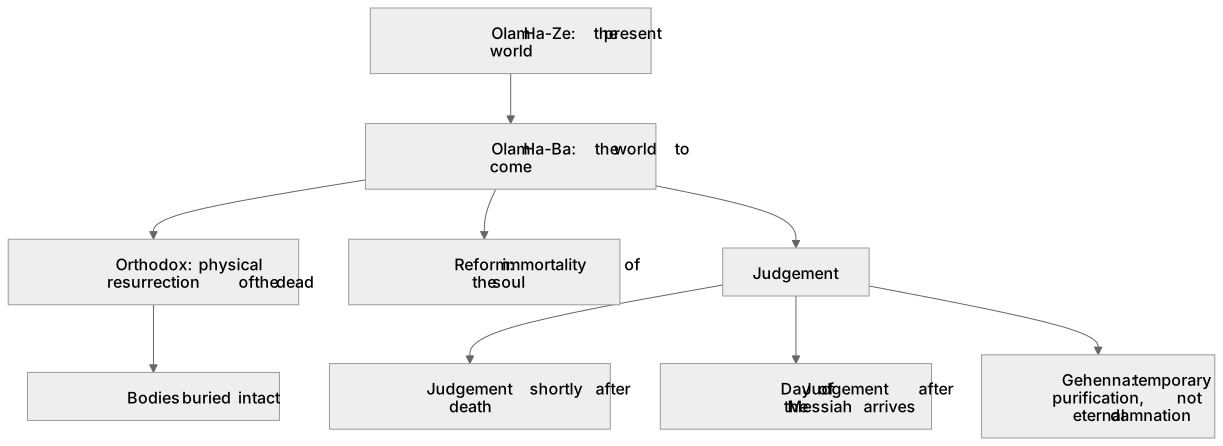
Key words
Say what each word means before you turn the card.
Olam Ha-Ba (The World to Come)
Try answering aloud or in your head before turning the card.
Resurrection and the Soul
Try answering aloud or in your head before turning the card.
Divine Judgement
Try answering aloud or in your head before turning the card.
Diversity of Jewish Belief
Try answering aloud or in your head before turning the card.
See every definition
- Olam Ha-Ba (The World to Come)
- The afterlife, which Judaism focuses on less than the present life, so beliefs about it are diverse and less dogmatic.
- Resurrection and the Soul
- Orthodox Jews often believe in a physical resurrection of the dead during the Messianic age, while Reform Jews generally reject physical resurrection and focus on the immortality of the soul.
- Divine Judgement
- Beliefs about judgement vary; some believe judgement happens shortly after death, while others anticipate a Day of Judgement after the Messiah arrives.
- Diversity of Jewish Belief
- Beliefs about life after death are diverse and less dogmatic, with Orthodox and Reform Jews differing on resurrection and the soul.
Label the diagram
Some boxes have lost their names. Pick the right name for each number.
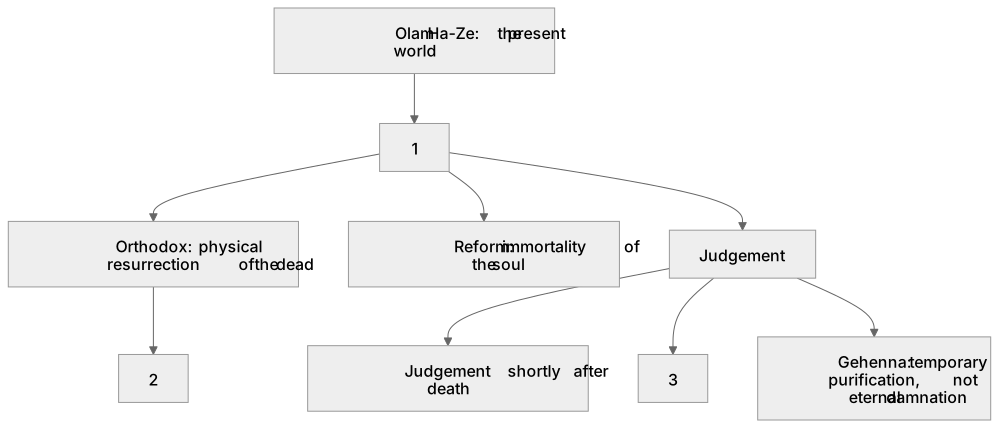
1Box 1
2Box 2
3Box 3
There is more to this lesson
The full lesson goes on to check your understanding and help you earn the marks. Create a free account to carry on, with your progress saved.
A week of Premium from your first lesson · Then the free plan continues · No card, no charge
Test your understanding of Judaism - 3.1.6.1 Beliefs and teachings: Beliefs about life after death, including judgement and resurrection.
Active recall beats re-reading. Take an instant quiz now to test what you’ve learned and lock it into long-term memory.
A week of Premium from your first lesson · Then the free plan continues · No card, no charge