AQA · GCSE · Religious Studies
Course version: 8062 · Version from Sept 2018
Judaism - 3.1.6.1 Beliefs and teachings: The divine presence (Shekhinah).
The Shekhinah refers to the divine presence of God on Earth.
- Point 6 of 15
- 4 key terms
Study notes
From the teaching notes for this specification point.
The idea
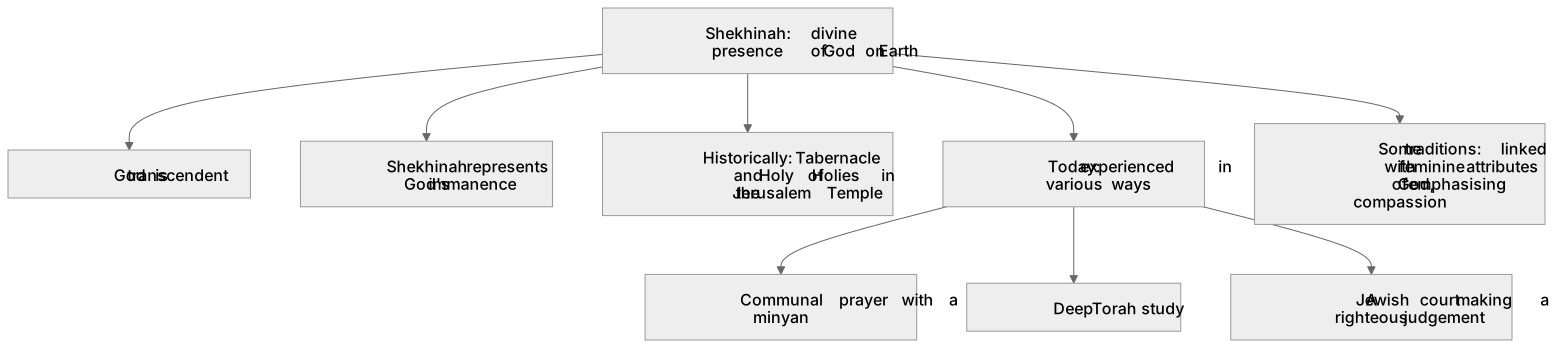
The Shekhinah refers to the divine presence of God on Earth. While God is transcendent, the Shekhinah represents God's immanence—His dwelling among humanity. Historically, it was associated with the Tabernacle and the Holy of Holies in the Jerusalem Temple, symbolising God's presence among the Israelites. Today, Jews experience the Shekhinah in various ways, such as during communal prayer with a minyan (quorum of ten), deep Torah study, or when a Jewish court makes a righteous judgement. Some traditions also link the Shekhinah with the feminine attributes of God, emphasising compassion. Understanding the Shekhinah helps Jews feel a direct, personal connection to God in their daily spiritual and communal lives.
What earns the marks
- The Shekhinah translates to God's 'dwelling' or 'settling' and represents the divine presence on Earth.
- Historically, the Shekhinah was believed to reside in the Tabernacle and the Temple in Jerusalem.
- The Shekhinah can be experienced today through communal prayer (minyan) and the study of the Torah.
- In some Jewish mystical traditions (Kabbalah), the Shekhinah is associated with the feminine, nurturing presence of God.
Common mistakes and how to put them right
Confusing the Shekhinah with a separate god or entity.
Put it right: Emphasise that the Shekhinah is not a separate being, but rather a manifestation of the one God's presence on Earth.
Stating that the Shekhinah can only be experienced in the synagogue.
Put it right: Clarify that while the synagogue is important, the Shekhinah can be experienced anywhere through prayer, study, and righteous actions.
Spelling Shekhinah incorrectly in ways that obscure the meaning.
Put it right: Learn the correct spelling (Shekhinah) and its literal translation as 'dwelling' or 'settling'.
Exam tips
- Use the concept of the Shekhinah to explain how God can be both transcendent (beyond the universe) and immanent (present in the world).
- Provide specific examples of when the Shekhinah is present, such as when ten Jews (a minyan) gather to pray.
- Link the Shekhinah to historical events, such as the pillar of fire and cloud that guided the Israelites, to show depth of knowledge.
Try the lesson
The start of the Judaism - 3.1.6.1 Beliefs and teachings: The divine presence (Shekhinah). lesson, made from teaching notes for this specification point.
Have a go first
What does the term 'Shekhinah' refer to in Jewish teachings?
Listen
The Shekhinah refers to the divine presence of God on Earth. While God is transcendent, the Shekhinah represents God's immanence—His dwelling among humanity. Historically, it was associated with the Tabernacle and the Holy of Holies in the Jerusalem Temple, symbolising God's presence among the Israelites. Today, Jews experience the Shekhinah in various ways, such as during communal prayer with a minyan (quorum of ten), deep Torah study, or when a Jewish court makes a righteous judgement. Some traditions also link the Shekhinah with the feminine attributes of God, emphasising compassion. Understanding the Shekhinah helps Jews feel a direct, personal connection to God in their daily spiritual and communal lives. A strong answer earns marks for these points. The Shekhinah translates to God's 'dwelling' or 'settling' and represents the divine presence on Earth. Historically, the Shekhinah was believed to reside in the Tabernacle and the Temple in Jerusalem. The Shekhinah can be experienced today through communal prayer (minyan) and the study of the Torah. In some Jewish mystical traditions (Kabbalah), the Shekhinah is associated with the feminine, nurturing presence of God. A common slip: Confusing the Shekhinah with a separate god or entity. Instead, Emphasise that the Shekhinah is not a separate being, but rather a manifestation of the one God's presence on Earth. Exam tip: Use the concept of the Shekhinah to explain how God can be both transcendent (beyond the universe) and immanent (present in the world).
See it
Key words
Say what each word means before you turn the card.
Immanence
Try answering aloud or in your head before turning the card.
Divine presence
Try answering aloud or in your head before turning the card.
Prayer and worship
Try answering aloud or in your head before turning the card.
The Temple
Try answering aloud or in your head before turning the card.
See every definition
- Immanence
- The presence of God dwelling among humanity on Earth, as represented by the Shekhinah.
- Divine presence
- The Shekhinah, referring to the presence of God on Earth.
- Prayer and worship
- Communal prayer with a minyan is one way Jews experience the Shekhinah today.
- The Temple
- Historically, the Shekhinah was associated with the Holy of Holies in the Jerusalem Temple.
Label the diagram
Some boxes have lost their names. Pick the right name for each number.
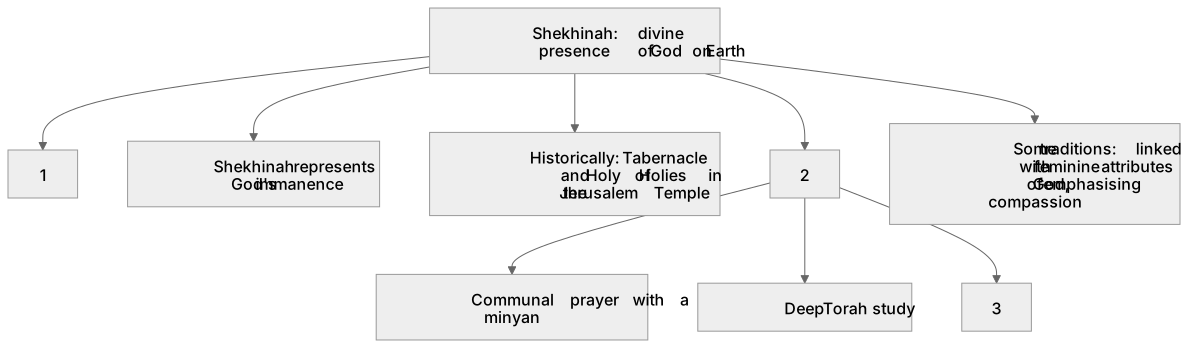
1Box 1
2Box 2
3Box 3
There is more to this lesson
The full lesson goes on to check your understanding and help you earn the marks. Create a free account to carry on, with your progress saved.
A week of Premium from your first lesson · Then the free plan continues · No card, no charge
Test your understanding of Judaism - 3.1.6.1 Beliefs and teachings: The divine presence (Shekhinah).
Active recall beats re-reading. Take an instant quiz now to test what you’ve learned and lock it into long-term memory.
A week of Premium from your first lesson · Then the free plan continues · No card, no charge