AQA · GCSE · Religious Studies
Course version: 8062 · Version from Sept 2018
The nature and role of the Messiah, including different views on the role…
Full specification wording
Judaism - 3.1.6.1 Beliefs and teachings: The nature and role of the Messiah, including different views on the role and importance of the Messiah.
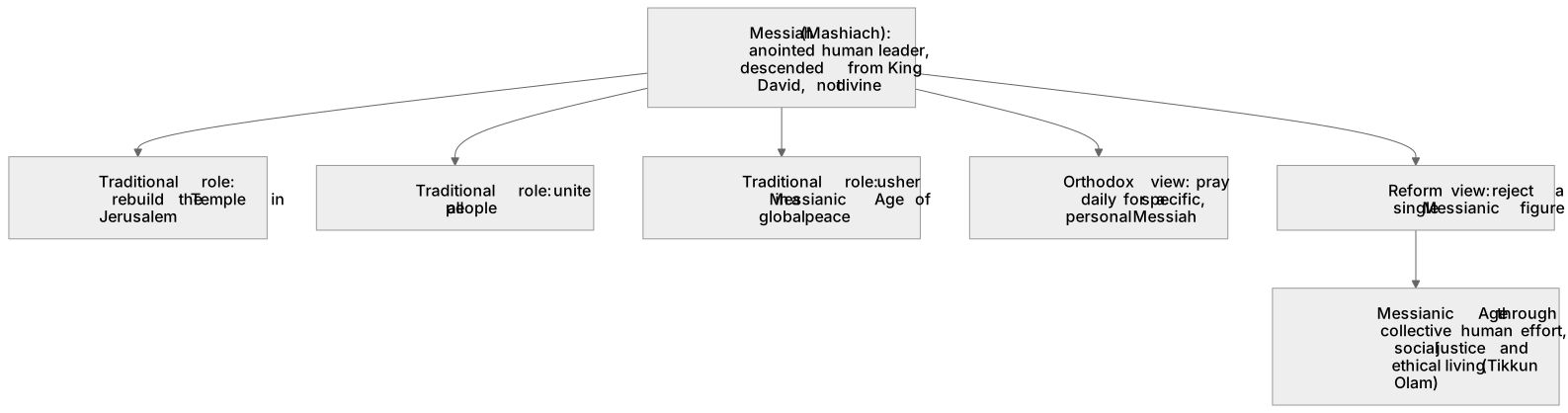
The Messiah (Mashiach) in Judaism is an anointed human leader, descended from King David, not a divine being.
- Point 8 of 15
- 4 key terms
Study notes
From the teaching notes for this specification point.
The idea
The Messiah (Mashiach) in Judaism is an anointed human leader, descended from King David, not a divine being. The traditional role of the Messiah includes rebuilding the Temple in Jerusalem, uniting all people, and ushering in a Messianic Age of global peace where all nations recognise the God of Israel. Orthodox Jews pray daily for the arrival of this specific, personal Messiah who will enact these physical and spiritual transformations. In contrast, Reform Jews generally reject the idea of a single Messianic figure. Instead, they focus on a Messianic Age achieved through collective human effort, social justice, and ethical living (Tikkun Olam) to bring about world peace.
What earns the marks
- Identify the nature of the Messiah as a human descendant of King David, rather than a divine figure.
- Outline the traditional roles of the Messiah, such as rebuilding the Temple, gathering exiles, and bringing global peace.
- Explain the Orthodox belief in a personal Messiah who will initiate the Messianic Age.
- Explain the Reform view that the Messianic Age will be brought about by collective human action and social justice, rather than a single individual.
Common mistakes and how to put them right
Describing the Jewish Messiah as a divine being or the Son of God.
Put it right by emphasising that the Mashiach is strictly a human leader.
Confusing Jewish and Christian views of the Messiah.
Put it right by focusing on the Jewish expectation of a future political and spiritual leader who has not yet arrived.
Stating that all Jews are waiting for a specific person to become the Messiah.
Put it right by explaining that Reform Jews work towards a Messianic Age rather than waiting for a personal Messiah.
Exam tips
- Clearly distinguish between the Orthodox belief in a personal Messiah and the Reform belief in a Messianic Age.
- Use the term 'Mashiach' (anointed one) to show accurate vocabulary.
- Link the Reform concept of the Messianic Age to the principle of Tikkun Olam (healing the world) in evaluation questions.
Try the lesson
The start of the Judaism - 3.1.6.1 Beliefs and teachings: The nature and role of the Messiah, including different views on the role and importance of the Messiah. lesson, made from teaching notes for this specification point.
Have a go first
What is the literal meaning of the word 'Messiah' (Mashiach) in Judaism?
Listen
The Messiah (Mashiach) in Judaism is an anointed human leader, descended from King David, not a divine being. The traditional role of the Messiah includes rebuilding the Temple in Jerusalem, uniting all people, and ushering in a Messianic Age of global peace where all nations recognise the God of Israel. Orthodox Jews pray daily for the arrival of this specific, personal Messiah who will enact these physical and spiritual transformations. In contrast, Reform Jews generally reject the idea of a single Messianic figure. Instead, they focus on a Messianic Age achieved through collective human effort, social justice, and ethical living (Tikkun Olam) to bring about world peace. A strong answer earns marks for these points. Identify the nature of the Messiah as a human descendant of King David, rather than a divine figure. Outline the traditional roles of the Messiah, such as rebuilding the Temple, gathering exiles, and bringing global peace. Explain the Orthodox belief in a personal Messiah who will initiate the Messianic Age. Explain the Reform view that the Messianic Age will be brought about by collective human action and social justice, rather than a single individual. A common slip: Describing the Jewish Messiah as a divine being or the Son of God. Instead, emphasising that the Mashiach is strictly a human leader. Exam tip: Clearly distinguish between the Orthodox belief in a personal Messiah and the Reform belief in a Messianic Age.
See it
Key words
Say what each word means before you turn the card.
The Nature of the Mashiach
Try answering aloud or in your head before turning the card.
The Messianic Age
Try answering aloud or in your head before turning the card.
Orthodox vs Reform Perspectives
Try answering aloud or in your head before turning the card.
Tikkun Olam and Social Justice
Try answering aloud or in your head before turning the card.
See every definition
- The Nature of the Mashiach
- An anointed human leader, descended from King David, not a divine being.
- The Messianic Age
- An age of global peace where all nations recognise the God of Israel.
- Orthodox vs Reform Perspectives
- Orthodox Jews pray daily for a specific, personal Messiah, while Reform Jews generally reject the idea of a single Messianic figure.
- Tikkun Olam and Social Justice
- Collective human effort, social justice and ethical living to bring about world peace.
Label the diagram
Some boxes have lost their names. Pick the right name for each number.
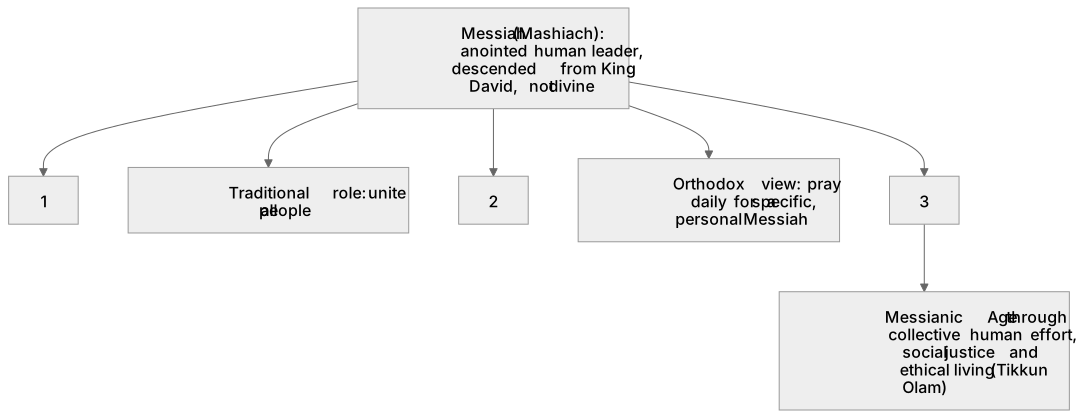
1Box 1
2Box 2
3Box 3
There is more to this lesson
The full lesson goes on to check your understanding and help you earn the marks. Create a free account to carry on, with your progress saved.
A week of Premium from your first lesson · Then the free plan continues · No card, no charge
Test your understanding of Judaism - 3.1.6.1 Beliefs and teachings: The nature and role of the Messiah, including different views on the role and importance of the Messiah.
Active recall beats re-reading. Take an instant quiz now to test what you’ve learned and lock it into long-term memory.
A week of Premium from your first lesson · Then the free plan continues · No card, no charge