AQA · GCSE · Religious Studies
Course version: 8062 · Version from Sept 2018
Judaism - 3.1.6.1 Beliefs and teachings: God as one
The belief in 'God as one' is the foundational principle of Judaism, establishing it as a strictly monotheistic religion.
- Point 3 of 15
- 4 key terms
Study notes
From the teaching notes for this specification point.
The idea
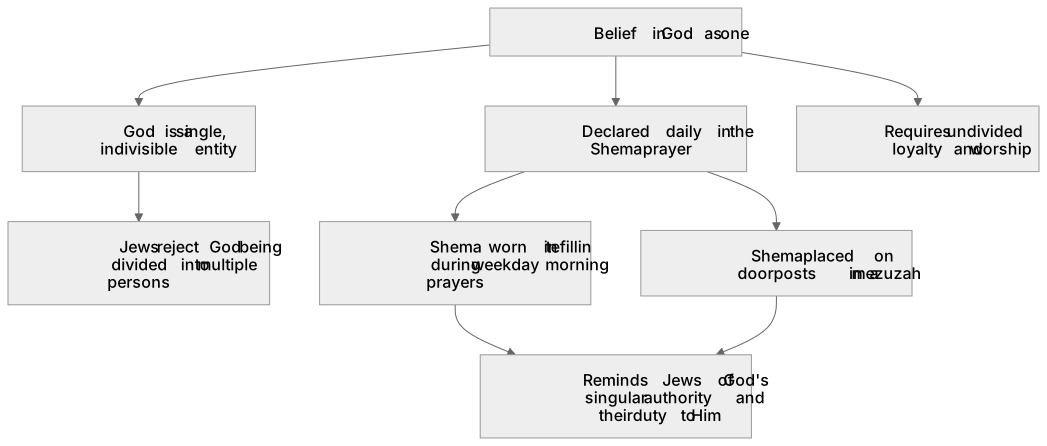
The belief in 'God as one' is the foundational principle of Judaism, establishing it as a strictly monotheistic religion. This concept means that God is a single, indivisible entity who is the sole source of all existence and law. Jews reject any idea of God being divided into multiple persons. This absolute unity is declared daily in the Shema prayer: 'Hear, O Israel! The Lord is our God, the Lord is one.' The oneness of God requires undivided loyalty and worship. To keep this central belief present in everyday life, the words of the Shema are physically worn in tefillin during weekday morning prayers and placed on doorposts in a mezuzah, constantly reminding Jews of God's singular authority and their duty to Him.
What earns the marks
- Identify monotheism as the core, foundational belief of Judaism.
- Reference the Shema as the primary daily declaration of God's oneness.
- Explain that God's indivisibility means He cannot be split into parts or persons, contrasting with other religious views.
- Describe how this belief influences Jewish practices, such as the use of the mezuzah on doorposts or wearing tefillin.
Common mistakes and how to put them right
Confusing Jewish monotheism with Christian monotheism.
Put it right: Explicitly state that Judaism rejects the concept of the Trinity, viewing God as strictly indivisible.
Stating the Shema is just a rule.
Put it right: Describe the Shema as a foundational prayer and declaration of faith recited twice daily.
Misspelling or misidentifying the objects containing the Shema.
Put it right: Use the correct terms 'mezuzah' for the doorpost case and 'tefillin' for the prayer boxes.
Exam tips
- Always quote or paraphrase the Shema when discussing the oneness of God to secure higher marks for referencing sacred texts.
- Link the belief in one God to the requirement for Jews to worship Him exclusively, referencing the Ten Commandments.
- Use the term 'monotheism' explicitly to demonstrate accurate theological vocabulary.
Try the lesson
The start of the Judaism - 3.1.6.1 Beliefs and teachings: God as one lesson, made from teaching notes for this specification point.
Have a go first
Which Jewish prayer most clearly expresses the belief that God is one?
Listen
The belief in 'God as one' is the foundational principle of Judaism, establishing it as a strictly monotheistic religion. This concept means that God is a single, indivisible entity who is the sole source of all existence and law. Jews reject any idea of God being divided into multiple persons. This absolute unity is declared daily in the Shema prayer: 'Hear, O Israel! The Lord is our God, the Lord is one. The oneness of God requires undivided loyalty and worship. To keep this central belief present in everyday life, the words of the Shema are physically worn in tefillin during weekday morning prayers and placed on doorposts in a mezuzah, constantly reminding Jews of God's singular authority and their duty to Him. A strong answer earns marks for these points. Identify monotheism as the core, foundational belief of Judaism. Reference the Shema as the primary daily declaration of God's oneness. Explain that God's indivisibility means He cannot be split into parts or persons, contrasting with other religious views. Describe how this belief influences Jewish practices, such as the use of the mezuzah on doorposts or wearing tefillin. A common slip: Confusing Jewish monotheism with Christian monotheism. Instead, Explicitly state that Judaism rejects the concept of the Trinity, viewing God as strictly indivisible. Exam tip: Always quote or paraphrase the Shema when discussing the oneness of God to secure higher marks for referencing sacred texts.
See it
Key words
Say what each word means before you turn the card.
Monotheism
Try answering aloud or in your head before turning the card.
The Shema
Try answering aloud or in your head before turning the card.
Mezuzah
Try answering aloud or in your head before turning the card.
Tefillin
Try answering aloud or in your head before turning the card.
See every definition
- Monotheism
- The foundational belief of Judaism that God is a single, indivisible entity who is the sole source of all existence and law.
- The Shema
- The prayer declaring God's oneness, recited daily: 'Hear, O Israel! The Lord is our God, the Lord is one.'
- Mezuzah
- A case placed on doorposts containing the words of the Shema, constantly reminding Jews of God's singular authority and their duty to Him.
- Tefillin
- Prayer boxes in which the words of the Shema are physically worn during weekday morning prayers.
Label the diagram
Some boxes have lost their names. Pick the right name for each number.
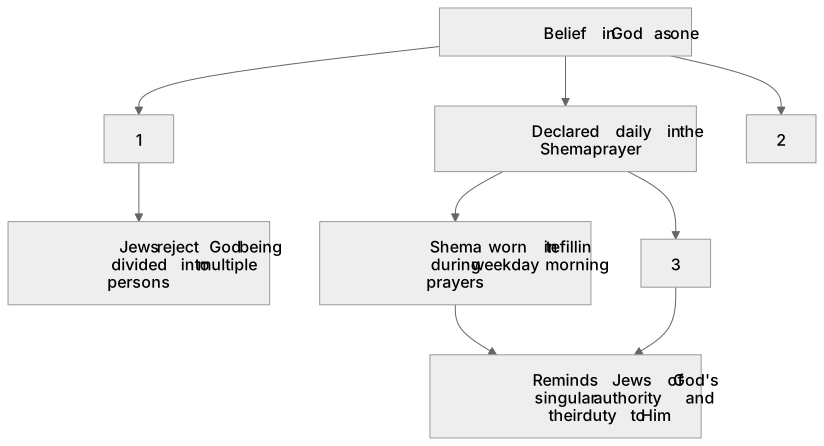
1Box 1
2Box 2
3Box 3
There is more to this lesson
The full lesson goes on to check your understanding and help you earn the marks. Create a free account to carry on, with your progress saved.
A week of Premium from your first lesson · Then the free plan continues · No card, no charge
Test your understanding of Judaism - 3.1.6.1 Beliefs and teachings: God as one
Active recall beats re-reading. Take an instant quiz now to test what you’ve learned and lock it into long-term memory.
A week of Premium from your first lesson · Then the free plan continues · No card, no charge