AQA · GCSE · Religious Studies
Course version: 8062 · Version from Sept 2018
Dietary laws and their significance, including different Jewish views…
Full specification wording
Practices: Dietary laws and their significance, including different Jewish views about their importance.
The Jewish dietary laws, known as Kashrut, dictate what foods are permissible to eat and how they must be prepared.
Checked against the AQA 8062 specification (opens in a new tab) on .
- Point 16 of 37
- 4 key terms
Study notes
From the checked teaching notes for this specification point.
The idea
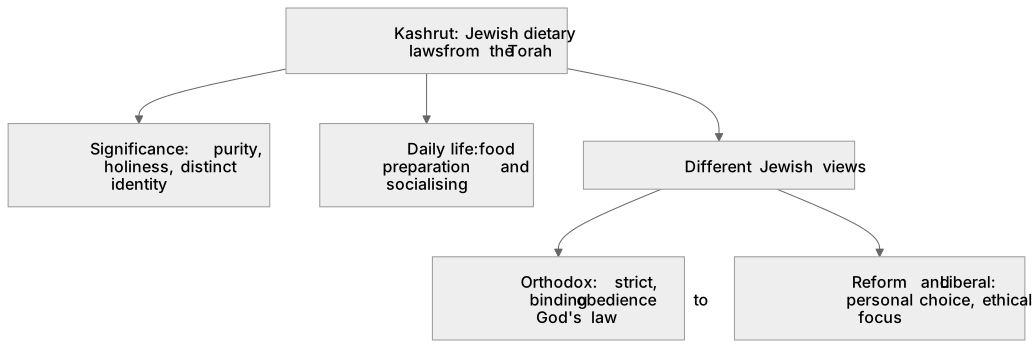
The Jewish dietary laws, known as Kashrut, dictate what foods are permissible to eat and how they must be prepared. These laws are significant because they are seen as a direct command from God in the Torah, helping Jews maintain purity, holiness, and a distinct cultural identity. For example, keeping separate utensils for meat and dairy reinforces daily mindfulness of faith. Different Jewish denominations hold varying views on their importance. Orthodox Jews strictly observe these laws as binding, believing they must be followed exactly as commanded without needing logical justification. In contrast, Reform and Liberal Jews often view the dietary laws as a matter of personal choice, adapting them to modern life or focusing more on the ethical principles behind food consumption rather than strict adherence to ancient rituals.
What earns the marks
- Identify Kashrut as the system of Jewish dietary laws derived from the Torah.
- Explain the significance of dietary laws in promoting holiness, obedience to God, and Jewish identity.
- Contrast Orthodox views (strict, binding obedience to God's law) with Reform views (personal choice, ethical focus).
- Describe how keeping dietary laws affects daily life, such as food preparation and socialising.
Common mistakes and how to put them right
Stating that all Jews follow dietary laws strictly.
Put it right: Specify that Orthodox Jews follow them strictly, while Reform Jews view them as a personal choice.
Claiming dietary laws are only about health and hygiene.
Put it right: Emphasise that their primary significance is obedience to God and maintaining spiritual purity.
Confusing the dietary laws with fasting rituals.
Put it right: Distinguish Kashrut (daily food rules) from fasting (such as on Yom Kippur).
Exam tips
- Use the term 'Kashrut' when referring to the system of dietary laws to demonstrate subject-specific vocabulary.
- When evaluating the importance of dietary laws, always contrast Orthodox and Reform perspectives to access higher marks.
- Link the observance of dietary laws to the concept of the covenant and obedience to God's commandments (mitzvot).
Try the lesson
The start of the Practices: Dietary laws and their significance, including different Jewish views about their importance. lesson, made from checked teaching notes for this specification point.
Have a go first
Which of the following best describes a common Orthodox Jewish view on the importance of keeping the dietary laws (kashrut)?
Listen
The Jewish dietary laws, known as Kashrut, dictate what foods are permissible to eat and how they must be prepared. These laws are significant because they are seen as a direct command from God in the Torah, helping Jews maintain purity, holiness, and a distinct cultural identity. For example, keeping separate utensils for meat and dairy reinforces daily mindfulness of faith. Different Jewish denominations hold varying views on their importance. Orthodox Jews strictly observe these laws as binding, believing they must be followed exactly as commanded without needing logical justification. In contrast, Reform and Liberal Jews often view the dietary laws as a matter of personal choice, adapting them to modern life or focusing more on the ethical principles behind food consumption rather than strict adherence to ancient rituals. A strong answer earns marks for these points. Identify Kashrut as the system of Jewish dietary laws derived from the Torah. Explain the significance of dietary laws in promoting holiness, obedience to God, and Jewish identity. Contrast Orthodox views (strict, binding obedience to God's law) with Reform views (personal choice, ethical focus). Describe how keeping dietary laws affects daily life, such as food preparation and socialising. A common slip: Stating that all Jews follow dietary laws strictly. Instead, Specify that Orthodox Jews follow them strictly, while Reform Jews view them as a personal choice. Exam tip: Use the term 'Kashrut' when referring to the system of dietary laws to demonstrate subject-specific vocabulary.
See it
Key words
Say what each word means before you turn the card.
Kashrut
Try answering aloud or in your head before turning the card.
Obedience to God
Try answering aloud or in your head before turning the card.
Jewish identity and community
Try answering aloud or in your head before turning the card.
Interpretation of the Torah
Try answering aloud or in your head before turning the card.
See every definition
- Kashrut
- The Jewish dietary laws, which dictate what foods are permissible to eat and how they must be prepared.
- Obedience to God
- Following the dietary laws as a direct command from God in the Torah, without needing logical justification.
- Jewish identity and community
- Keeping the dietary laws helps Jews maintain purity, holiness, and a distinct cultural identity.
- Interpretation of the Torah
- Orthodox Jews strictly observe the dietary laws as binding, while Reform and Liberal Jews often view them as a matter of personal choice.
Label the diagram
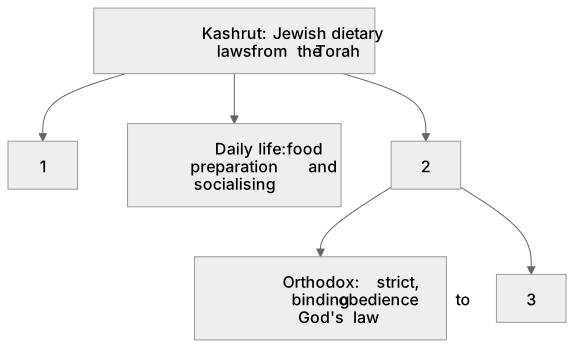
Some boxes have lost their names. Pick the right name for each number.
1Box 1
2Box 2
3Box 3
There is more to this lesson
The full lesson goes on to check your understanding and help you earn the marks. Create a free account to carry on, with your progress saved.
A week of Premium from your first lesson · Then the free plan continues · No card, no charge
Test your understanding of Practices: Dietary laws and their significance, including different Jewish views about their importance.
Active recall beats re-reading. Take an instant quiz now to test what you’ve learned and lock it into long-term memory.
A week of Premium from your first lesson · Then the free plan continues · No card, no charge