AQA · GCSE · Religious Studies
Course version: 8062 · Version from Sept 2018
Belief in the oneness of humanity and in the equality of all, including…
Full specification wording
Sikhism - 3.1.7.1 Beliefs and teachings: Belief in the oneness of humanity and in the equality of all, including complete equality of women with men.
Sikhism teaches that Waheguru (God) created everyone, meaning all human beings possess the same divine spark.
Checked against the AQA 8062 specification (opens in a new tab) on .
- Point 11 of 16
- 3 key terms
Study notes
From the checked teaching notes for this specification point.
The idea
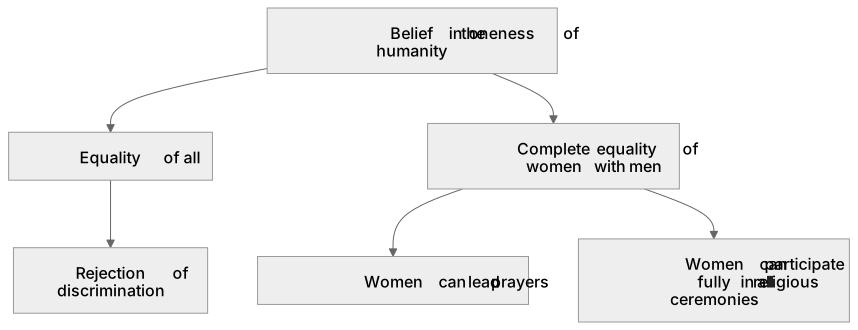
Sikhism teaches that Waheguru (God) created everyone, meaning all human beings possess the same divine spark. This fundamental belief in the oneness of humanity eradicates distinctions based on caste, race, or social status, establishing the absolute equality of all people. A crucial aspect of this teaching is the complete equality of women with men, a revolutionary concept introduced by Guru Nanak in the fifteenth century. He taught that women are essential to the continuation of life and deserve the utmost respect, allowing them to lead prayers and participate fully in all religious ceremonies. This theological foundation drives Sikhs to actively oppose discrimination and promote universal brotherhood in their daily lives.
What earns the marks
- Explain that the belief in the oneness of humanity stems from the Sikh teaching that the same divine light (jot) exists within everyone.
- Identify that Guru Nanak explicitly rejected the caste system, teaching that social divisions are meaningless to God.
- Describe how the complete equality of women with men is demonstrated through women's ability to lead worship and read from the Guru Granth Sahib.
- Reference Guru Nanak's teachings on women, specifically his statement asking how one can call women inferior when they give birth to kings.
Common mistakes and how to put them right
Claiming that Sikhism supports the caste system.
Put it right by stating that Sikh Gurus actively dismantled caste distinctions to promote absolute equality.
Stating that women have restricted roles in the Gurdwara.
Put it right by explaining that women have complete equality and can perform all religious duties, including acting as a Granthi.
Confusing cultural practices with religious teachings.
Put it right by distinguishing between Punjabi cultural norms, which may sometimes show gender bias, and strict Sikh theology, which demands complete equality.
Exam tips
- Use the specific term 'oneness of humanity' when explaining why Sikhs reject discrimination based on race or background.
- Memorise Guru Nanak's quote about women giving birth to kings to support answers evaluating gender equality.
- Link the theological belief in equality to practical actions, such as the langar, to demonstrate a comprehensive understanding of Sikh principles.
Try the lesson
The start of the Sikhism - 3.1.7.1 Beliefs and teachings: Belief in the oneness of humanity and in the equality of all, including complete equality of women with men. lesson, made from checked teaching notes for this specification point.
Have a go first
Which of the following best describes the Sikh teaching on the status of women compared to men?
Listen
Sikhism teaches that Waheguru (God) created everyone, meaning all human beings possess the same divine spark. This fundamental belief in the oneness of humanity eradicates distinctions based on caste, race, or social status, establishing the absolute equality of all people. A crucial aspect of this teaching is the complete equality of women with men, a revolutionary concept introduced by Guru Nanak in the fifteenth century. He taught that women are essential to the continuation of life and deserve the utmost respect, allowing them to lead prayers and participate fully in all religious ceremonies. This theological foundation drives Sikhs to actively oppose discrimination and promote universal brotherhood in their daily lives. A strong answer earns marks for these points. Explain that the belief in the oneness of humanity stems from the Sikh teaching that the same divine light (jot) exists within everyone. Identify that Guru Nanak explicitly rejected the caste system, teaching that social divisions are meaningless to God. Describe how the complete equality of women with men is demonstrated through women's ability to lead worship and read from the Guru Granth Sahib. Reference Guru Nanak's teachings on women, specifically his statement asking how one can call women inferior when they give birth to kings. A common slip: Claiming that Sikhism supports the caste system. Instead, stating that Sikh Gurus actively dismantled caste distinctions to promote absolute equality. Exam tip: Use the specific term 'oneness of humanity' when explaining why Sikhs reject discrimination based on race or background.
See it
Key words
Say what each word means before you turn the card.
Oneness of humanity
Try answering aloud or in your head before turning the card.
Equality
Try answering aloud or in your head before turning the card.
Divine spark (jot)
Try answering aloud or in your head before turning the card.
See every definition
- Oneness of humanity
- Belief that Waheguru created everyone, so all human beings possess the same divine spark, eradicating distinctions based on caste, race or social status.
- Equality
- The absolute equality of all people, including the complete equality of women with men, which Sikhs are driven to uphold by opposing discrimination.
- Divine spark (jot)
- The same divine light that exists within everyone, which is the basis of the belief in the oneness of humanity.
Label the diagram
Some boxes have lost their names. Pick the right name for each number.
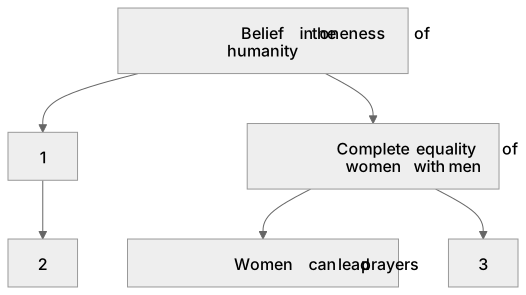
1Box 1
2Box 2
3Box 3
There is more to this lesson
The full lesson goes on to check your understanding and help you earn the marks. Create a free account to carry on, with your progress saved.
A week of Premium from your first lesson · Then the free plan continues · No card, no charge
Test your understanding of Sikhism - 3.1.7.1 Beliefs and teachings: Belief in the oneness of humanity and in the equality of all, including complete equality of women with men.
Active recall beats re-reading. Take an instant quiz now to test what you’ve learned and lock it into long-term memory.
A week of Premium from your first lesson · Then the free plan continues · No card, no charge