AQA · GCSE · Religious Studies
Course version: 8062 · Version from Sept 2018
Beliefs about the nature of human life
Full specification wording
Sikhism - 3.1.7.1 Beliefs and teachings: Beliefs about the nature of human life
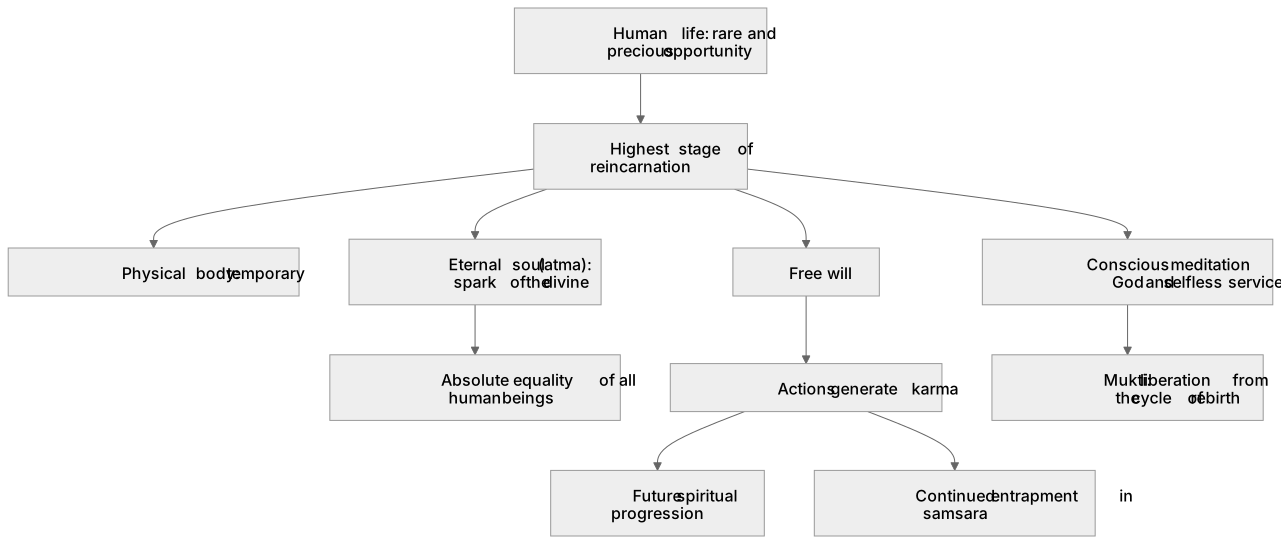
Sikhism teaches that human life is a rare and precious opportunity, representing the highest stage of reincarnation.
Checked against the AQA 8062 specification (opens in a new tab) on .
- Point 10 of 16
- 4 key terms
Study notes
From the checked teaching notes for this specification point.
The idea
Sikhism teaches that human life is a rare and precious opportunity, representing the highest stage of reincarnation. It is the only life form in which a soul can consciously meditate on God, perform selfless service, and achieve mukti (liberation from the cycle of rebirth). The nature of human life is dual: humans possess a physical body, which is temporary, and an eternal soul (atma) containing a spark of the divine. Because the divine spark exists within everyone, Sikhism asserts the absolute equality of all human beings, regardless of gender, caste, or race. Humans are endowed with free will, meaning their actions generate karma, which determines their future spiritual progression or continued entrapment in the cycle of samsara.
What earns the marks
- Identify human life as a unique and rare opportunity to achieve mukti (spiritual liberation).
- Explain the belief that the human soul (atma) contains a spark of God, making all human life sacred.
- Discuss the principle of universal human equality, stemming from the belief that God resides equally in everyone.
- Describe the role of free will and karma in human life, where actions dictate the soul's future journey.
Common mistakes and how to put them right
Claiming humans only have one life.
Put it right by explaining the Sikh belief in reincarnation and the cycle of samsara.
Stating that the physical body is inherently sinful.
Put it right: Correct this to show the body is a vehicle for spiritual growth and serving others.
Ignoring the concept of equality when discussing human nature.
Put it right: Mention that the divine spark makes all humans fundamentally equal.
Exam tips
- Connect the nature of human life to the ultimate goal of Sikhism: achieving mukti and reuniting with God.
- Use the concept of the divine spark to explain Sikh practices of equality, such as the langar (free kitchen).
- When asked about human life, contrast the temporary nature of the physical body with the eternal nature of the soul.
Try the lesson
The start of the Sikhism - 3.1.7.1 Beliefs and teachings: Beliefs about the nature of human life lesson, made from checked teaching notes for this specification point.
Have a go first
In Sikhism, what is considered the ultimate purpose of human life?
Listen
Sikhism teaches that human life is a rare and precious opportunity, representing the highest stage of reincarnation. It is the only life form in which a soul can consciously meditate on God, perform selfless service, and achieve mukti (liberation from the cycle of rebirth). The nature of human life is dual: humans possess a physical body, which is temporary, and an eternal soul (atma) containing a spark of the divine. Because the divine spark exists within everyone, Sikhism asserts the absolute equality of all human beings, regardless of gender, caste, or race. Humans are endowed with free will, meaning their actions generate karma, which determines their future spiritual progression or continued entrapment in the cycle of samsara. A strong answer earns marks for these points. Identify human life as a unique and rare opportunity to achieve mukti (spiritual liberation). Explain the belief that the human soul (atma) contains a spark of God, making all human life sacred. Discuss the principle of universal human equality, stemming from the belief that God resides equally in everyone. Describe the role of free will and karma in human life, where actions dictate the soul's future journey. A common slip: Claiming humans only have one life. Instead, explaining the Sikh belief in reincarnation and the cycle of samsara. Exam tip: Connect the nature of human life to the ultimate goal of Sikhism: achieving mukti and reuniting with God.
See it
Key words
Say what each word means before you turn the card.
Reincarnation and karma
Try answering aloud or in your head before turning the card.
Equality and the divine spark
Try answering aloud or in your head before turning the card.
Purpose of life
Try answering aloud or in your head before turning the card.
Free will
Try answering aloud or in your head before turning the card.
See every definition
- Reincarnation and karma
- Human life is the highest stage of reincarnation, and actions generate karma, which determines future spiritual progression or continued entrapment in the cycle of samsara.
- Equality and the divine spark
- Because the divine spark exists within everyone, Sikhism asserts the absolute equality of all human beings, regardless of gender, caste, or race.
- Purpose of life
- Human life is a rare and precious opportunity, the only life form in which a soul can consciously meditate on God, perform selfless service, and achieve mukti.
- Free will
- Humans are endowed with free will, meaning their actions generate karma, which determines their future spiritual progression or continued entrapment in the cycle of samsara.
Label the diagram
Some boxes have lost their names. Pick the right name for each number.
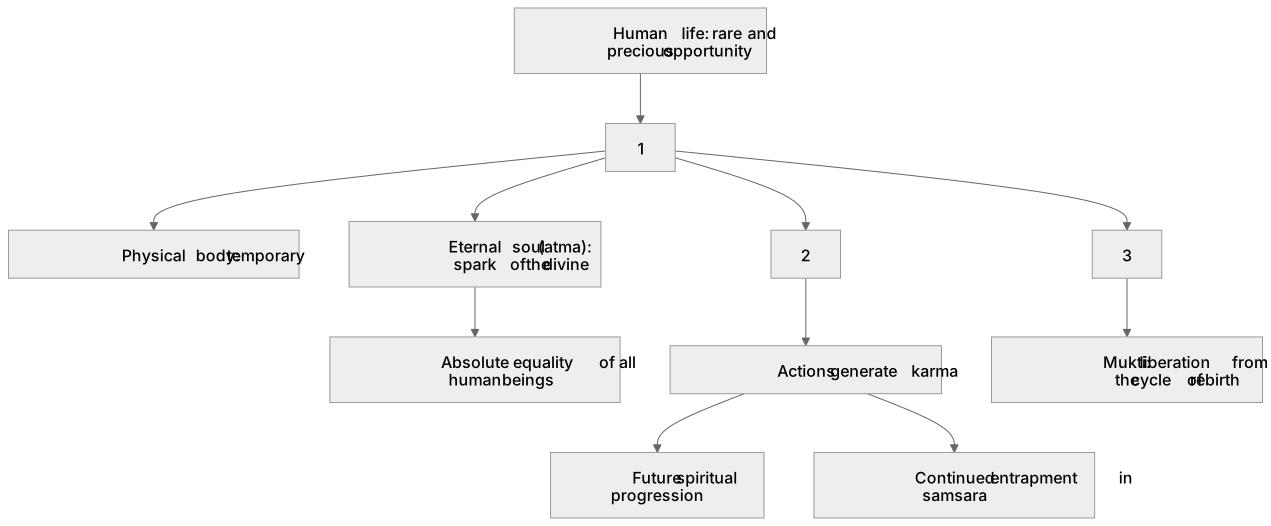
1Box 1
2Box 2
3Box 3
There is more to this lesson
The full lesson goes on to check your understanding and help you earn the marks. Create a free account to carry on, with your progress saved.
A week of Premium from your first lesson · Then the free plan continues · No card, no charge
Test your understanding of Sikhism - 3.1.7.1 Beliefs and teachings: Beliefs about the nature of human life
Active recall beats re-reading. Take an instant quiz now to test what you’ve learned and lock it into long-term memory.
A week of Premium from your first lesson · Then the free plan continues · No card, no charge