AQA · GCSE · Religious Studies
Course version: 8062 · Version from Sept 2018
Beliefs in karma and rebirth, and the aim of mukti; the meaning of mukti,…
Full specification wording
Sikhism - 3.1.7.1 Beliefs and teachings: Beliefs in karma and rebirth, and the aim of mukti; the meaning of mukti, including the different aspects of mukti – positive and negative.
In Sikhism, karma is the law of cause and effect where a person's actions determine their future, including their next life.
Checked against the AQA 8062 specification (opens in a new tab) on .
- Point 7 of 16
- 4 key terms
Study notes
From the checked teaching notes for this specification point.
The idea
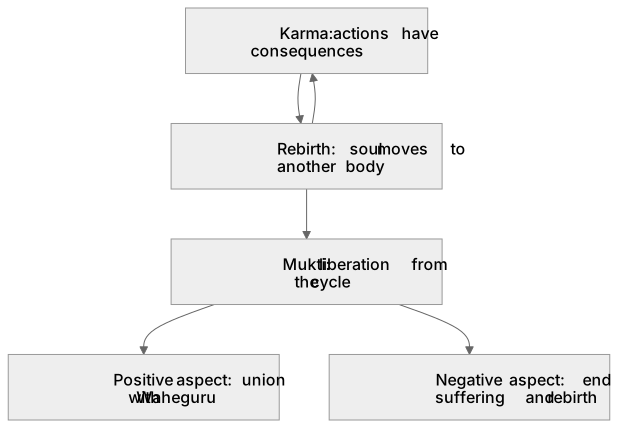
In Sikhism, karma is the law of cause and effect where a person's actions determine their future, including their next life. Rebirth (transmigration) is the cycle of the soul moving from one body to another after death. The ultimate aim for Sikhs is mukti, which means liberation or salvation from this continuous cycle of birth, death, and rebirth. Mukti has both positive and negative aspects. The positive aspect is the soul's blissful reunion with God (Waheguru), experiencing eternal peace and divine love, much like a drop of water merging back into the ocean. The negative aspect refers to what is left behind: the cessation of suffering, the end of the painful cycle of reincarnation, and the eradication of ego (haumai).
What earns the marks
- Karma is the principle that every action has a consequence, influencing the soul's journey and future rebirths.
- Rebirth is the continuous cycle of the soul taking new physical forms based on accumulated karma.
- Mukti is the ultimate spiritual goal in Sikhism, representing liberation from the cycle of transmigration.
- The positive aspect of mukti involves achieving a state of eternal bliss and complete union with Waheguru.
- The negative aspect of mukti focuses on the escape from earthly suffering and the breaking of the cycle of rebirth.
Common mistakes and how to put them right
Confusing the negative aspect of mukti with something bad.
Put it right: 'negative' here means the removal or absence of suffering and rebirth, not a harmful experience.
Assuming karma only affects the current life.
Put it right: Karma directly determines the form the soul will take in its subsequent rebirth.
Believing mukti is only achieved after death.
Put it right: Jivan mukti is the state of liberation achieved while still alive through God's grace and righteous living.
Exam tips
- Use the analogy of a water drop merging with the ocean to explain the positive aspect of mukti (union with God).
- Clearly distinguish between the positive (what is gained) and negative (what is removed) aspects of mukti in evaluation questions.
- Link the concept of karma directly to rebirth to demonstrate a cohesive understanding of the cycle of transmigration.
Try the lesson
The start of the Sikhism - 3.1.7.1 Beliefs and teachings: Beliefs in karma and rebirth, and the aim of mukti; the meaning of mukti, including the different aspects of mukti – positive and negative. lesson, made from checked teaching notes for this specification point.
Have a go first
What is the ultimate aim of a Sikh's life, which involves liberation from the cycle of rebirth?
Listen
In Sikhism, karma is the law of cause and effect where a person's actions determine their future, including their next life. Rebirth (transmigration) is the cycle of the soul moving from one body to another after death. The ultimate aim for Sikhs is mukti, which means liberation or salvation from this continuous cycle of birth, death, and rebirth. Mukti has both positive and negative aspects. The positive aspect is the soul's blissful reunion with God (Waheguru), experiencing eternal peace and divine love, much like a drop of water merging back into the ocean. The negative aspect refers to what is left behind: the cessation of suffering, the end of the painful cycle of reincarnation, and the eradication of ego (haumai). A strong answer earns marks for these points. Karma is the principle that every action has a consequence, influencing the soul's journey and future rebirths. Rebirth is the continuous cycle of the soul taking new physical forms based on accumulated karma. Mukti is the ultimate spiritual goal in Sikhism, representing liberation from the cycle of transmigration. The positive aspect of mukti involves achieving a state of eternal bliss and complete union with Waheguru. A common slip: Confusing the negative aspect of mukti with something bad. Instead, 'negative' here means the removal or absence of suffering and rebirth, not a harmful experience. Exam tip: Use the analogy of a water drop merging with the ocean to explain the positive aspect of mukti (union with God).
See it
Key words
Say what each word means before you turn the card.
Karma
Try answering aloud or in your head before turning the card.
Rebirth
Try answering aloud or in your head before turning the card.
Mukti
Try answering aloud or in your head before turning the card.
Haumai
Try answering aloud or in your head before turning the card.
See every definition
- Karma
- The law of cause and effect where a person's actions determine their future, including their next life.
- Rebirth
- The cycle of the soul moving from one body to another after death.
- Mukti
- Liberation or salvation from the continuous cycle of birth, death, and rebirth.
- Haumai
- Ego, which is eradicated as part of the negative aspect of mukti.
Label the diagram
Some boxes have lost their names. Pick the right name for each number.
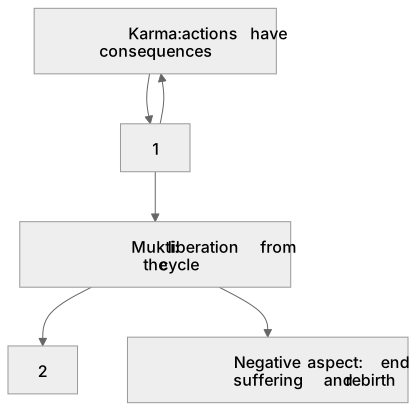
1Box 1
2Box 2
There is more to this lesson
The full lesson goes on to check your understanding and help you earn the marks. Create a free account to carry on, with your progress saved.
A week of Premium from your first lesson · Then the free plan continues · No card, no charge
Test your understanding of Sikhism - 3.1.7.1 Beliefs and teachings: Beliefs in karma and rebirth, and the aim of mukti; the meaning of mukti, including the different aspects of mukti – positive and negative.
Active recall beats re-reading. Take an instant quiz now to test what you’ve learned and lock it into long-term memory.
A week of Premium from your first lesson · Then the free plan continues · No card, no charge