AQA · GCSE · Religious Studies
Course version: 8062 · Version from Sept 2018
The five stages of liberation (five khands) and barriers to mukti…
Full specification wording
Sikhism - 3.1.7.1 Beliefs and teachings: The five stages of liberation (five khands) and barriers to mukti (illusion, self-centredness, lust, anger, greed, worldly attachment, pride).
Sikhs believe spiritual progress towards liberation occurs through five stages or realms, known as the Five Khands.
Checked against the AQA 8062 specification (opens in a new tab) on .
- Point 8 of 16
- 4 key terms
Study notes
From the checked teaching notes for this specification point.
The idea
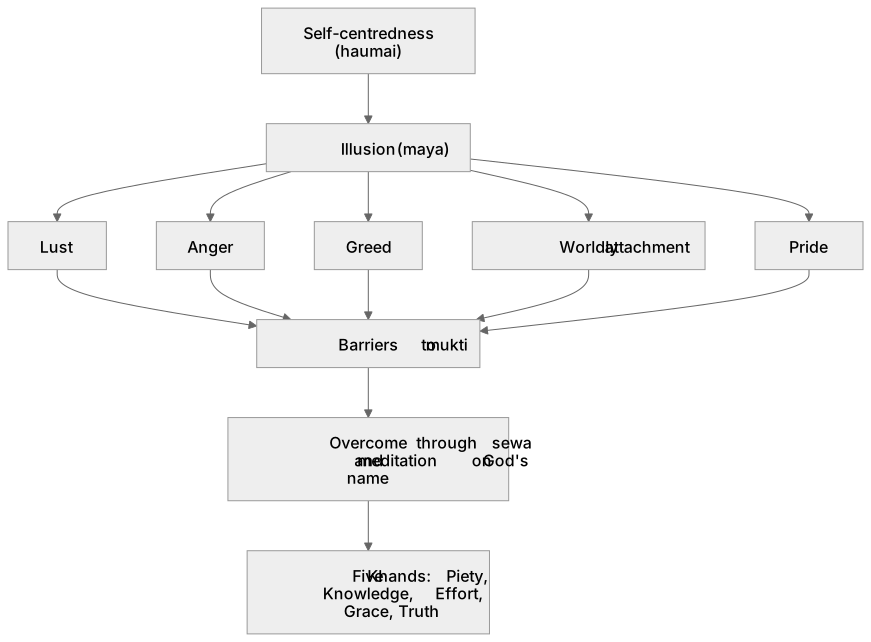
Sikhs believe spiritual progress towards liberation occurs through five stages or realms, known as the Five Khands. These are Piety (Dharam Khand), Knowledge (Gyan Khand), Effort (Saram Khand), Grace (Karam Khand), and Truth (Sach Khand), where the soul finally unites with God. To progress through these stages, Sikhs must overcome significant barriers to mukti. The primary obstacle is self-centredness (haumai), which traps individuals in illusion (maya), making them value the temporary material world over God. This ego breeds five specific evils: lust, anger, greed, worldly attachment, and pride. By practicing sewa (selfless service) and meditating on God's name, Sikhs conquer these barriers and advance through the Khands.
What earns the marks
- The Five Khands represent the spiritual journey of the soul through stages of piety, knowledge, effort, grace, and ultimate truth.
- Self-centredness (haumai) is the root barrier to mukti, causing humans to rely on themselves rather than God.
- Illusion (maya) prevents liberation by tricking individuals into believing temporary, material wealth is of ultimate importance.
- The five evils—lust, anger, greed, worldly attachment, and pride—are direct manifestations of ego that block spiritual progression.
- Overcoming these barriers requires conscious effort, such as selfless service and devotion, to move through the stages of liberation.
Common mistakes and how to put them right
Listing the five evils but forgetting illusion (maya) and self-centredness (haumai).
Put it right: Explicitly state that haumai and maya are the foundational barriers that give rise to the five evils.
Confusing the Five Khands with the Five Ks.
Put it right: The Five Khands are spiritual stages of liberation, whereas the Five Ks are physical articles of faith worn by Khalsa Sikhs.
Assuming the stages of liberation only happen after death.
Put it right: The spiritual journey through the Khands occurs during a Sikh's lifetime through devotion and righteous action.
Exam tips
- Memorise the English translations of the Five Khands (Piety, Knowledge, Effort, Grace, Truth) if you struggle with the Punjabi terms.
- When discussing barriers to mukti, explain how one specific evil, such as greed or pride, directly distracts a person from focusing on God.
- Link the overcoming of self-centredness (haumai) to the practice of sewa (selfless service) in longer essay answers.
Try the lesson
The start of the Sikhism - 3.1.7.1 Beliefs and teachings: The five stages of liberation (five khands) and barriers to mukti (illusion, self-centredness, lust, anger, greed, worldly attachment, pride). lesson, made from checked teaching notes for this specification point.
Have a go first
Which of the following is considered a barrier to achieving mukti in Sikhism?
Listen
Sikhs believe spiritual progress towards liberation occurs through five stages or realms, known as the Five Khands. These are Piety (Dharam Khand), Knowledge (Gyan Khand), Effort (Saram Khand), Grace (Karam Khand), and Truth (Sach Khand), where the soul finally unites with God. To progress through these stages, Sikhs must overcome significant barriers to mukti. The primary obstacle is self-centredness (haumai), which traps individuals in illusion (maya), making them value the temporary material world over God. This ego breeds five specific evils: lust, anger, greed, worldly attachment, and pride. By practicing sewa (selfless service) and meditating on God's name, Sikhs conquer these barriers and advance through the Khands. A strong answer earns marks for these points. The Five Khands represent the spiritual journey of the soul through stages of piety, knowledge, effort, grace, and ultimate truth. Self-centredness (haumai) is the root barrier to mukti, causing humans to rely on themselves rather than God. Illusion (maya) prevents liberation by tricking individuals into believing temporary, material wealth is of ultimate importance. The five evils—lust, anger, greed, worldly attachment, and pride—are direct manifestations of ego that block spiritual progression. A common slip: Listing the five evils but forgetting illusion (maya) and self-centredness (haumai). Instead, explicitly state that haumai and maya are the foundational barriers that give rise to the five evils. Exam tip: Memorise the English translations of the Five Khands (Piety, Knowledge, Effort, Grace, Truth) if you struggle with the Punjabi terms.
See it
Key words
Say what each word means before you turn the card.
Five Khands
Try answering aloud or in your head before turning the card.
Self-centredness (haumai)
Try answering aloud or in your head before turning the card.
Illusion (maya)
Try answering aloud or in your head before turning the card.
Five evils
Try answering aloud or in your head before turning the card.
See every definition
- Five Khands
- The five stages or realms through which spiritual progress towards liberation occurs, namely Piety, Knowledge, Effort, Grace and Truth.
- Self-centredness (haumai)
- The primary obstacle to mukti, which traps individuals in illusion and makes them rely on themselves rather than God.
- Illusion (maya)
- A barrier that prevents liberation by making individuals value the temporary material world over God.
- Five evils
- Lust, anger, greed, worldly attachment and pride, which are direct manifestations of ego that block spiritual progression.
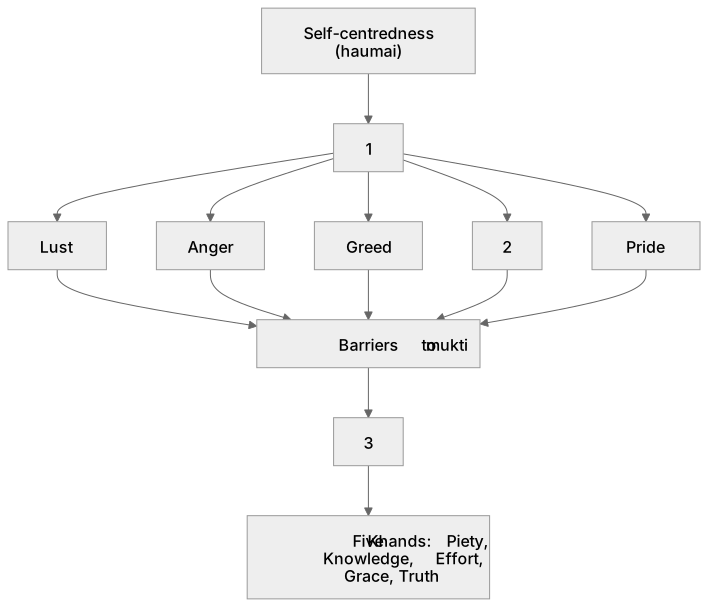
Label the diagram
Some boxes have lost their names. Pick the right name for each number.
1Box 1
2Box 2
3Box 3
There is more to this lesson
The full lesson goes on to check your understanding and help you earn the marks. Create a free account to carry on, with your progress saved.
A week of Premium from your first lesson · Then the free plan continues · No card, no charge
Test your understanding of Sikhism - 3.1.7.1 Beliefs and teachings: The five stages of liberation (five khands) and barriers to mukti (illusion, self-centredness, lust, anger, greed, worldly attachment, pride).
Active recall beats re-reading. Take an instant quiz now to test what you’ve learned and lock it into long-term memory.
A week of Premium from your first lesson · Then the free plan continues · No card, no charge