AQA · GCSE · Religious Studies
Theme F: Religion, human rights and social justice
Explore the profound relationship between religious teachings, human rights, and social justice. This essential guide covers key debates on prejudice, equality, and the ethical use of wealth, providing the knowledge and evaluation skills needed to excel in your GCSE Religious Studies exam.
- 5 min read
- 3 worked examples
- 2 practice questions
- 6 key terms
Study Notes

Overview
Theme F: Religion, Human Rights and Social Justice explores some of the most pressing ethical and social issues in the modern world. It asks fundamental questions about human dignity, the nature of equality, and our responsibilities towards others. For the exam, you are required to understand these issues from the perspective of the main religious tradition in Britain (Christianity) and at least one other religious tradition (in this guide, we focus on Islam).
Examiners are not just looking for descriptive accounts of what religious people do; they expect you to explain why they do it using specific sources of wisdom and authority. You must be able to construct balanced arguments evaluating different religious and non-religious responses to prejudice, discrimination, the status of women, and the ethical use of wealth. Understanding the tension between human rights and human responsibilities is crucial for achieving top marks in evaluation questions.
Listen to the companion podcast to consolidate your understanding of these core concepts:
Key Concepts: Prejudice and Discrimination

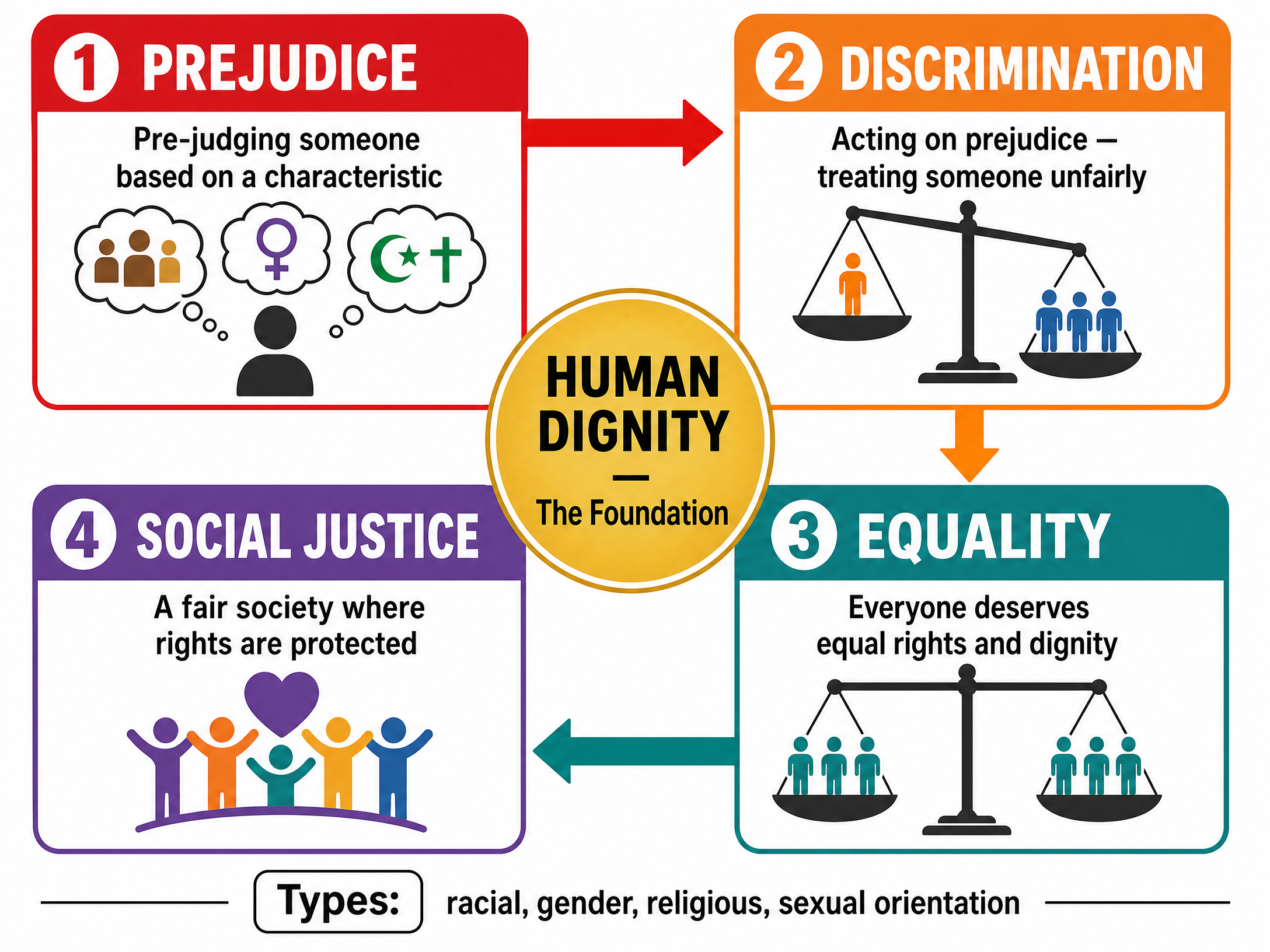
Prejudice
Definition: Holding a negative attitude or pre-judgement about a person or group based on a characteristic (e.g., race, gender, religion) without knowing them.
Exam Relevance: You must be able to explain why religious teachings generally oppose prejudice, linking it to the concept of human dignity (Imago Dei in Christianity, Khalifah in Islam).
Discrimination
Definition: Acting on prejudice by treating a person or group unfairly.
Exam Relevance: Examiners often ask you to evaluate religious responses to specific types of discrimination, such as racism or sexism.
Equality
Definition: The belief that all people have the same intrinsic value and should have the same rights and opportunities.
Exam Relevance: You need to explain contrasting views within religions regarding equality, particularly concerning the roles of men and women.
The Status of Women in Religion
Christianity: Contrasting Views
Traditional/Complementarian View: Many conservative Christians and the Roman Catholic Church teach that men and women are equal in value but have different, complementary roles. This is often used to justify why only men can be ordained as priests, citing Jesus' choice of twelve male apostles.
Egalitarian View: Many Protestant denominations, including the Church of England, argue for full equality in all roles, including leadership. They often cite Galatians 3:28: "There is neither Jew nor Gentile, neither slave nor free, nor is there male and female, for you are all one in Christ Jesus."
Islam: Contrasting Views
Traditional View: Men and women are spiritually equal before Allah but have distinct roles. Men are traditionally seen as providers (maintainers) and protectors, while women have primary responsibility for the home and raising children.
Modern/Reformist View: Many Muslims emphasize that Islam granted women unprecedented rights in the 7th century (e.g., property ownership, inheritance). They argue that cultural practices, rather than true Islamic teaching, have often restricted women's roles, and advocate for full participation in all spheres of life.
Rights and Responsibilities
The Balance
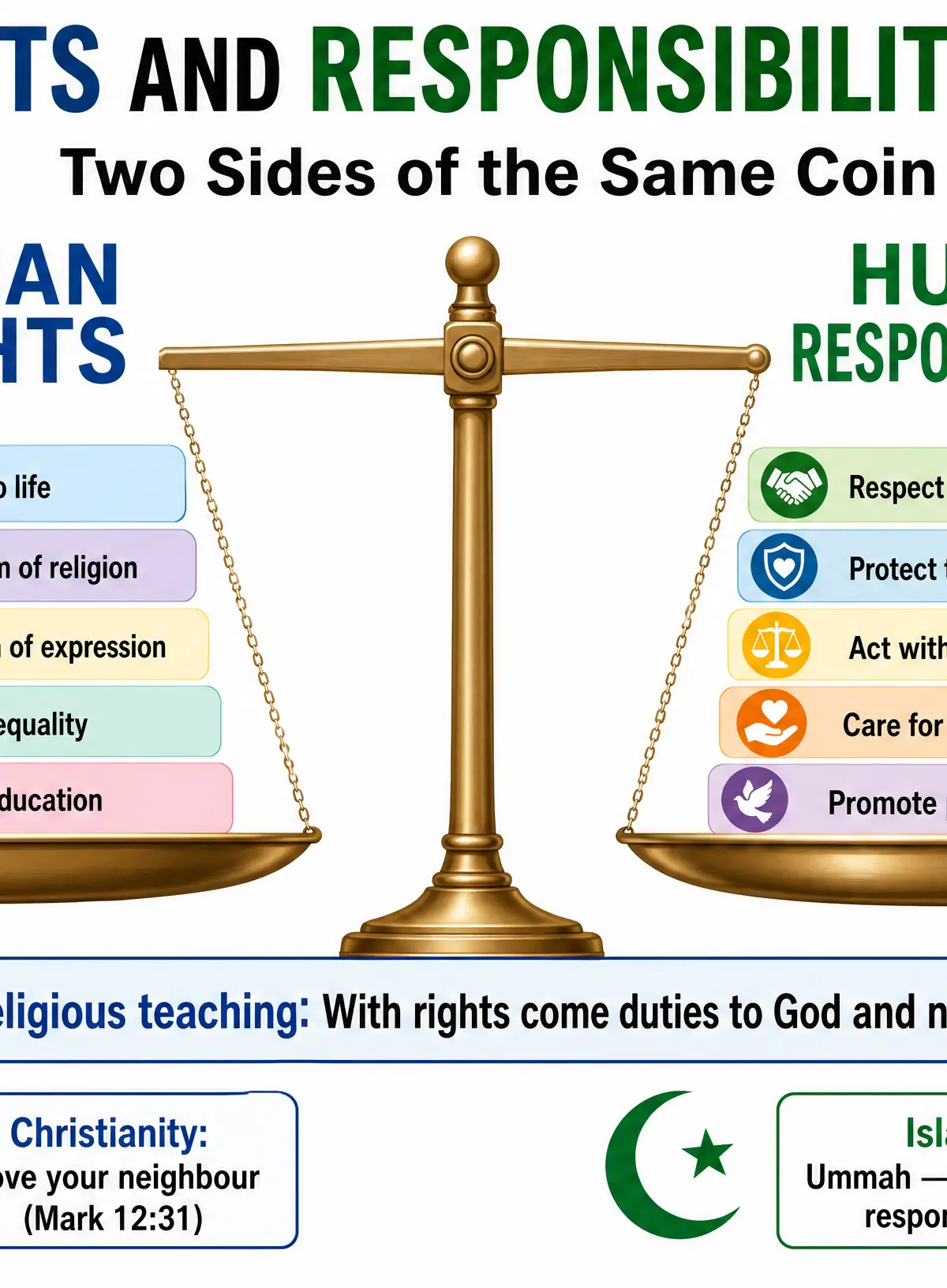
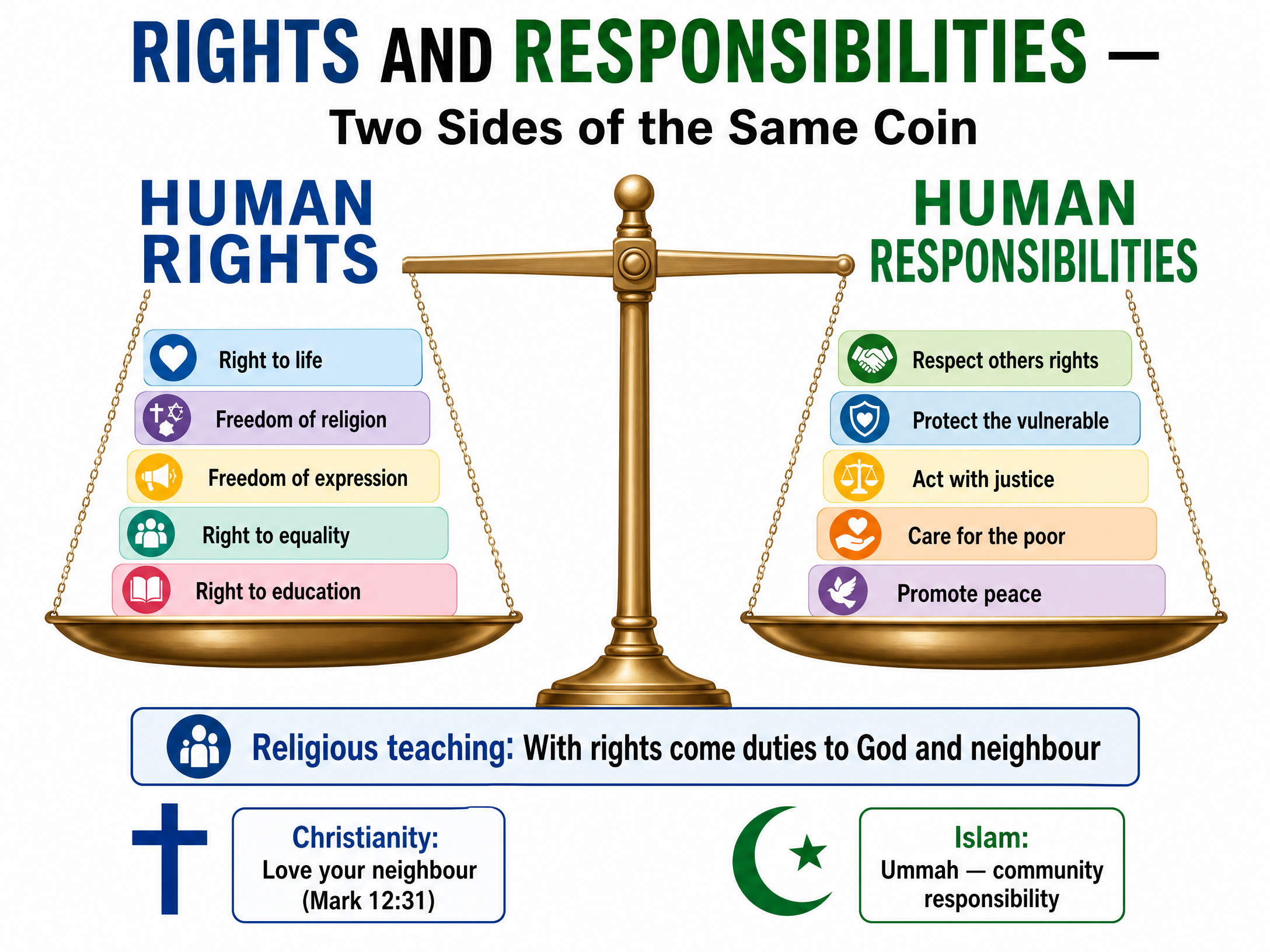
Human rights are the basic entitlements and freedoms that belong to every person in the world, from birth until death (e.g., right to life, freedom of religion). However, religious traditions emphasize that these rights are inextricably linked to human responsibilities. If individuals claim rights but do not fulfill their duty to respect the rights of others, society cannot function justly.
Religious Perspectives
Christianity: Rights are given by God, but Christians have a responsibility to love their neighbour (Mark 12:31) and protect the vulnerable.
Islam: Humans are created as stewards (Khalifah) and have a duty to build a just society (Ummah) where the rights of all, especially the poor and marginalized, are protected.
Wealth, Poverty, and Social Justice

The Ethical Use of Wealth
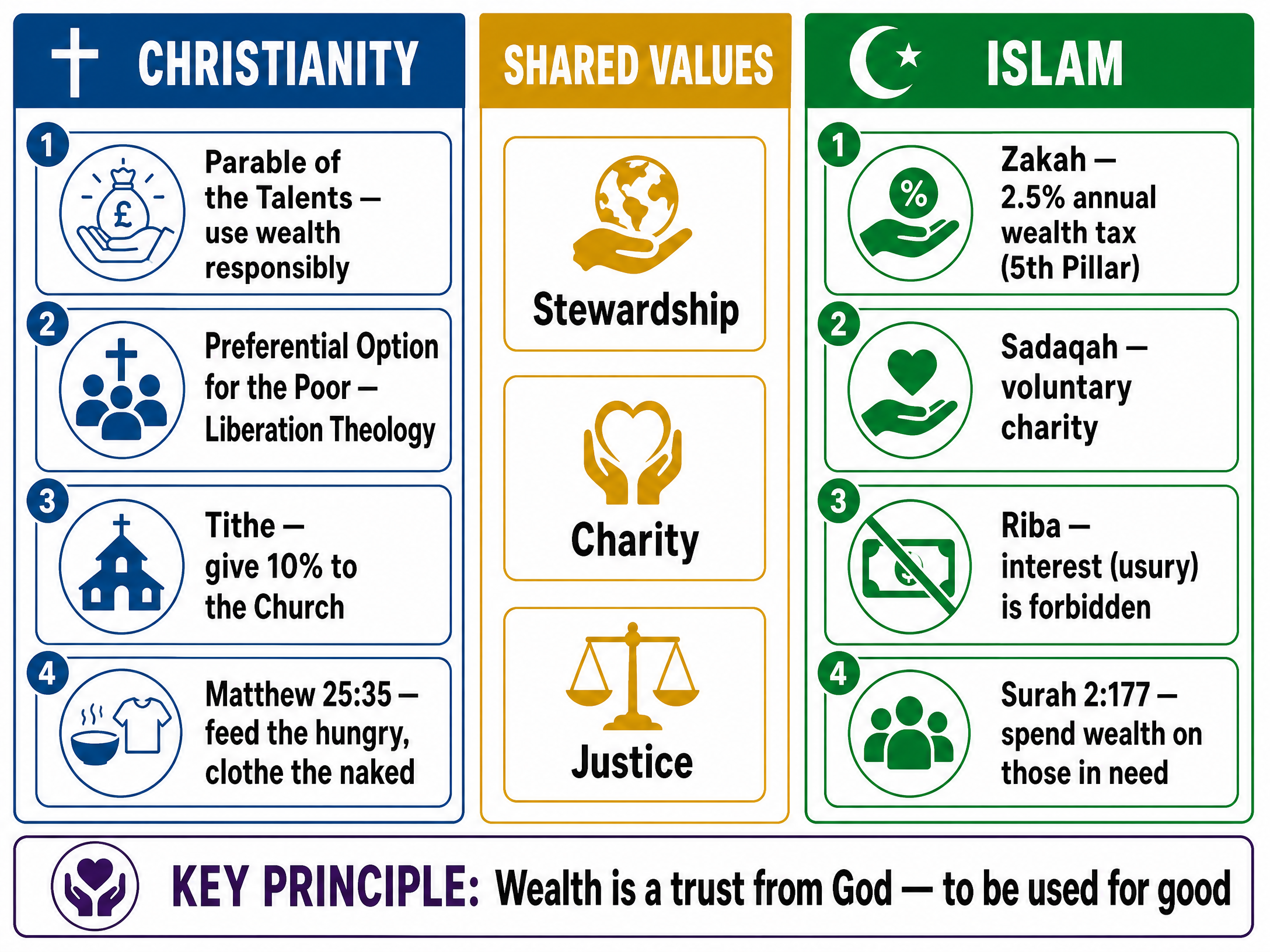
Neither Christianity nor Islam teaches that wealth is inherently evil, but both stress that it is a test and a responsibility.
Christianity: The concept of Stewardship teaches that wealth ultimately belongs to God. The Parable of the Rich Man and Lazarus (Luke 16) warns against ignoring the poor. Many Christians give a tithe (10% of income) to charity.
Islam: Wealth is a blessing from Allah to be shared. Zakah (the 3rd Pillar) is a compulsory payment of 2.5% of accumulated wealth to the poor. Sadaqah is voluntary charity. Islam strictly forbids Riba (usury/charging interest), viewing it as exploitative.
Religious Charities Tackling Poverty
Christian Aid: Works globally to eradicate poverty, providing emergency relief and long-term development, inspired by the teaching to "love your neighbour."
Islamic Relief: A Muslim humanitarian organization providing disaster response and development programs, guided by the Islamic values of compassion and social justice.
Visual Resources
3 diagrams and illustrations
Interactive Diagrams
1 interactive diagram to visualise key concepts
Conceptual Flow Outline
Flowchart showing the connection between Human Dignity, Rights, and Responsibilities.
Worked Examples
3 worked examples — open one to explore the question and available guidance.
Practice Questions
Test your understanding — click to reveal model answers
Explain two religious teachings about prejudice and discrimination. (4 marks)
Hint: Think about fundamental beliefs regarding how humans were created, and use specific terms like Imago Dei.
'Those who have wealth have a duty to give to the poor.' Evaluate this statement. (12 marks)
Hint: Consider both religious obligations (like Zakah) and non-religious arguments (like individual freedom or the role of the state).