AQA · GCSE · Religious Studies
Course version: 8062 · Version from Sept 2018
Religion, human rights and social justice: Ethical arguments related to…
Full specification wording
Theme F: Religion, human rights and social justice: Ethical arguments related to racial discrimination (including positive discrimination), including those based on the ideals of equality and justice.
Racial discrimination involves treating individuals unfairly based on their race, which directly violates the ethical ideals of equality and justice.
- Point 13 of 23
- 4 key terms
Study notes
From the teaching notes for this specification point.
The idea
Racial discrimination involves treating individuals unfairly based on their race, which directly violates the ethical ideals of equality and justice. Equality asserts that all humans possess the same intrinsic worth, often supported by religious teachings such as humans being created in the image of God (imago Dei). Justice demands fair treatment and the correction of systemic wrongs. To address historical inequalities, some advocate for positive discrimination, such as reserving university places or jobs for marginalised racial groups. While supporters argue this promotes long-term justice and levels the playing field, critics contend it replaces one form of discrimination with another, compromising strict equality of opportunity.
What earns the marks
- Define racial discrimination as prejudiced actions or unfair treatment based on a person's race or ethnicity.
- Explain positive discrimination as favouring individuals from historically disadvantaged groups to promote equal representation.
- Apply the concept of equality to argue against racial discrimination, using religious principles like 'imago Dei' or universal human rights.
- Evaluate how the ideal of justice can be used both to support positive discrimination (restorative justice) and to oppose it (merit-based fairness).
Common mistakes and how to put them right
Confusing positive discrimination with positive action.
Put it right: Positive discrimination involves preferential treatment regardless of merit, whereas positive action encourages disadvantaged groups to apply.
Assuming all religious believers support positive discrimination.
Put it right by noting that some argue it violates the principle of treating everyone exactly the same based on merit.
Using equality and justice interchangeably.
Put it right: Equality refers to equal status and worth, while justice refers to fairness and righting wrongs, which sometimes requires unequal treatment.
Exam tips
- Use specific religious teachings, such as the Parable of the Good Samaritan, to illustrate the ideals of equality and justice in action.
- When evaluating positive discrimination, ensure you present strong ethical arguments on both sides before reaching a justified conclusion.
- Clearly distinguish between prejudice (a thought or attitude) and discrimination (an action) when defining key terms in your answers.
Try the lesson
The start of the Theme F: Religion, human rights and social justice: Ethical arguments related to racial discrimination (including positive discrimination), including those based on the ideals of equality and justice. lesson, made from teaching notes for this specification point.
Have a go first
What is meant by the term 'positive discrimination' in the context of racial equality?
Listen
Racial discrimination involves treating individuals unfairly based on their race, which directly violates the ethical ideals of equality and justice. Equality asserts that all humans possess the same intrinsic worth, often supported by religious teachings such as humans being created in the image of God (imago Dei). Justice demands fair treatment and the correction of systemic wrongs. To address historical inequalities, some advocate for positive discrimination, such as reserving university places or jobs for marginalised racial groups. While supporters argue this promotes long-term justice and levels the playing field, critics contend it replaces one form of discrimination with another, compromising strict equality of opportunity. A strong answer earns marks for these points. Define racial discrimination as prejudiced actions or unfair treatment based on a person's race or ethnicity. Explain positive discrimination as favouring individuals from historically disadvantaged groups to promote equal representation. Apply the concept of equality to argue against racial discrimination, using religious principles like 'imago Dei' or universal human rights. Evaluate how the ideal of justice can be used both to support positive discrimination (restorative justice) and to oppose it (merit-based fairness). A common slip: Assuming all religious believers support positive discrimination. Instead, noting that some argue it violates the principle of treating everyone exactly the same based on merit. Exam tip: Use specific religious teachings, such as the Parable of the Good Samaritan, to illustrate the ideals of equality and justice in action.
See it
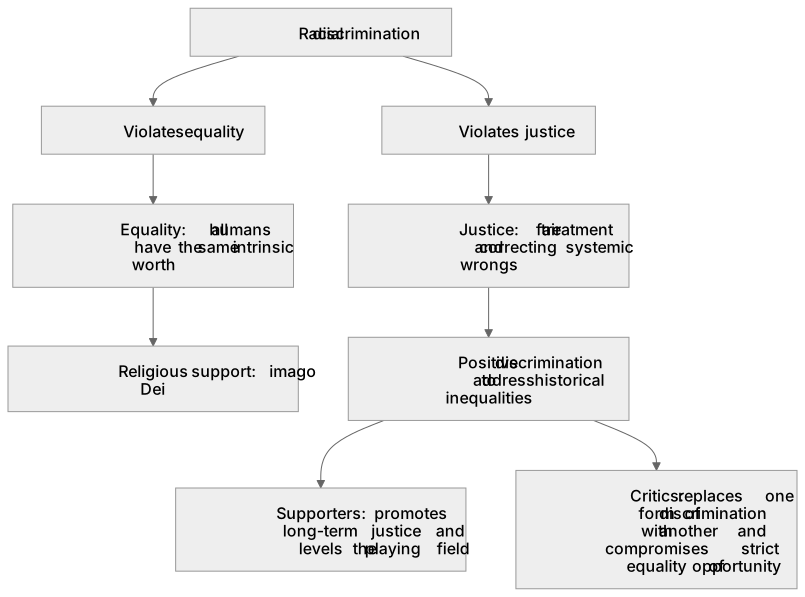
Key words
Say what each word means before you turn the card.
Equality
Try answering aloud or in your head before turning the card.
Justice
Try answering aloud or in your head before turning the card.
Positive discrimination
Try answering aloud or in your head before turning the card.
Racial discrimination
Try answering aloud or in your head before turning the card.
See every definition
- Equality
- The ideal that all humans possess the same intrinsic worth, often supported by religious teachings such as humans being created in the image of God.
- Justice
- The ideal that demands fair treatment and the correction of systemic wrongs.
- Positive discrimination
- Favouring individuals from historically disadvantaged groups to promote equal representation, such as reserving university places or jobs for marginalised racial groups.
- Racial discrimination
- Prejudiced actions or unfair treatment based on a person's race or ethnicity.
Label the diagram
Some boxes have lost their names. Pick the right name for each number.
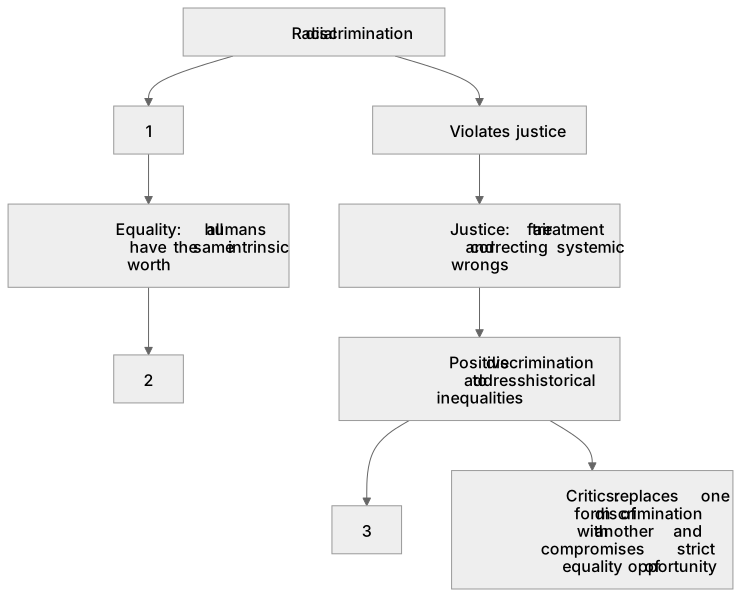
1Box 1
2Box 2
3Box 3
There is more to this lesson
The full lesson goes on to check your understanding and help you earn the marks. Create a free account to carry on, with your progress saved.
A week of Premium from your first lesson · Then the free plan continues · No card, no charge
Test your understanding of Theme F: Religion, human rights and social justice: Ethical arguments related to racial discrimination (including positive discrimination), including those based on the ideals of equality and justice.
Active recall beats re-reading. Take an instant quiz now to test what you’ve learned and lock it into long-term memory.
A week of Premium from your first lesson · Then the free plan continues · No card, no charge