AQA · GCSE · Religious Studies
Course version: 8062 · Version from Sept 2018
Religion, human rights and social justice: They must be able to explain…
Full specification wording
Theme F: Religion, human rights and social justice: They must be able to explain contrasting beliefs on the following three issues with reference to the main religious tradition in Britain (Christianity) and one or more other religious traditions:
The specification explicitly requires reference to Christianity, recognising it as the main religious tradition in Great Britain, alongside at least one other major world religion, such as Islam…
- Point 2 of 23
- 4 key terms
Study notes
From the teaching notes for this specification point.
The idea
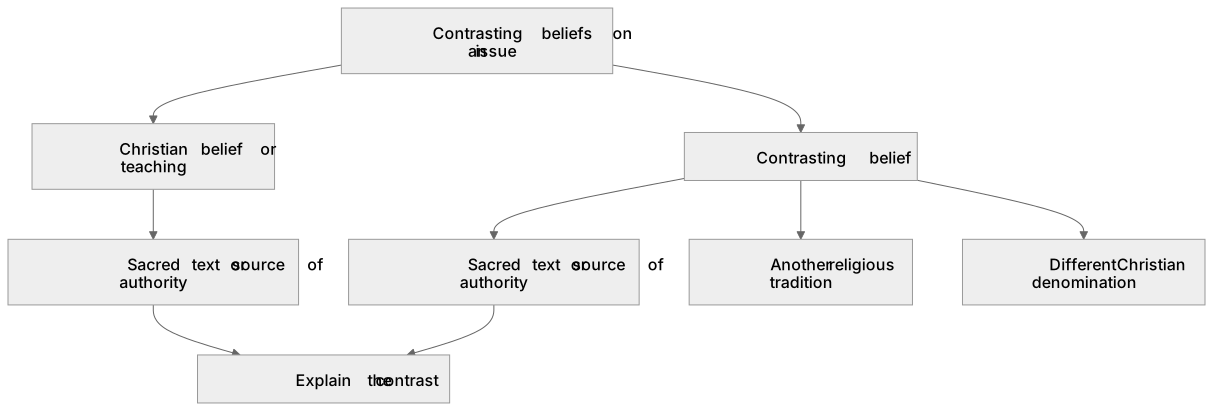
The specification explicitly requires reference to Christianity, recognising it as the main religious tradition in Great Britain, alongside at least one other major world religion, such as Islam or Judaism. 'Contrasting beliefs' can involve comparing views between two different religions, or examining divergent views within a single religion, such as differences between Catholic and Protestant denominations.
What earns the marks
- Identify and explain a specific Christian belief or teaching related to the issue.
- Identify and explain a contrasting belief from another religious tradition (e.g., Islam, Judaism) or a different Christian denomination.
- Use relevant sacred texts or sources of authority to support both perspectives.
- Clearly articulate how the beliefs contrast, highlighting differences in interpretation, practice, or theological emphasis.
Common mistakes and how to put them right
Failing to include Christianity in the comparison.
Put it right: Ensure Christianity is one of the religions discussed as it is the main tradition in Britain.
Treating a religion as entirely uniform.
Put it right by acknowledging that contrasting views often exist within the same religion (e.g., liberal versus conservative interpretations).
Providing generic differences without religious backing.
Put it right by linking the contrast directly to specific religious teachings or scriptures.
Exam tips
- Always prepare to discuss Christianity plus one other religion you have studied in depth for any thematic issue.
- Use clear comparative language, such as 'on the other hand', 'conversely', or 'in contrast', to explicitly show you are addressing the 'contrasting' requirement.
- Remember that contrasting beliefs can be drawn from two different denominations within Christianity if you know them well.
Try the lesson
The start of the Theme F: Religion, human rights and social justice: They must be able to explain contrasting beliefs on the following three issues with reference to the main religious tradition in Britain (Christianity) and one or more other religious traditions: lesson, made from teaching notes for this specification point.
Have a go first
Which statement best explains a contrasting belief within Christianity regarding the uses of wealth?
Listen
The specification explicitly requires reference to Christianity, recognising it as the main religious tradition in Great Britain, alongside at least one other major world religion, such as Islam or Judaism. Contrasting beliefs' can involve comparing views between two different religions, or examining divergent views within a single religion, such as differences between Catholic and Protestant denominations. A strong answer earns marks for these points. Identify and explain a specific Christian belief or teaching related to the issue. Identify and explain a contrasting belief from another religious tradition (e.g., Islam, Judaism) or a different Christian denomination. Use relevant sacred texts or sources of authority to support both perspectives. Clearly articulate how the beliefs contrast, highlighting differences in interpretation, practice, or theological emphasis. A common slip: Treating a religion as entirely uniform. Instead, acknowledging that contrasting views often exist within the same religion (e.g., liberal versus conservative interpretations). Exam tip: Always prepare to discuss Christianity plus one other religion you have studied in depth for any thematic issue.
See it
Key words
Say what each word means before you turn the card.
Contrasting beliefs
Try answering aloud or in your head before turning the card.
Christianity in Britain
Try answering aloud or in your head before turning the card.
Sources of authority
Try answering aloud or in your head before turning the card.
Religious diversity
Try answering aloud or in your head before turning the card.
See every definition
- Contrasting beliefs
- Comparing views between two different religions, or examining divergent views within a single religion, such as differences between Catholic and Protestant denominations.
- Christianity in Britain
- The main religious tradition in Great Britain, which must always be included in the comparison.
- Sources of authority
- Specific teachings, sacred texts, or denominational stances used to illustrate why differences exist and how they influence believers' actions regarding human rights and social justice.
- Religious diversity
- Contrasting views that often exist within the same religion, such as liberal versus conservative interpretations, so a religion is not treated as entirely uniform.
There is more to this lesson
The full lesson goes on to check your understanding and help you earn the marks. Create a free account to carry on, with your progress saved.
A week of Premium from your first lesson · Then the free plan continues · No card, no charge
Test your understanding of Theme F: Religion, human rights and social justice: They must be able to explain contrasting beliefs on the following three issues with reference to the main religious tradition in Britain (Christianity) and one or more other religious traditions:
Active recall beats re-reading. Take an instant quiz now to test what you’ve learned and lock it into long-term memory.
A week of Premium from your first lesson · Then the free plan continues · No card, no charge