Pearson Edexcel · A-Level · Religious Studies
Christianity – Religion and society: Pluralism and diversity, and equality and discrimination
This topic explores how Christianity engages with the modern multicultural world, tackling the tension between holding firm religious convictions and living alongside diverse beliefs. It is a highly evaluative topic where examiners look for your ability to weigh different theological positions, such as particularism versus pluralism, and debate contemporary issues like gender equality in the Church.
- 5 min read
- 3 worked examples
- 2 practice questions
- 6 key terms
Study Notes
Overview
This study guide covers Christianity's response to pluralism, diversity, equality, and discrimination. In a multicultural society, Christians face profound questions about how to interact with other faiths and how to handle diversity within their own tradition. This topic is historically and sociologically significant because it traces the shift from traditional exclusivity towards modern ecumenical dialogue and debates over gender roles. Examiners expect candidates to go beyond simple recall; you must be able to define key theological terms precisely, apply them to modern societal contexts, and evaluate differing viewpoints with specific references to scholars like Karl Rahner and John Hick, as well as biblical texts.
Key Theological Concepts: Responses to Other Religions
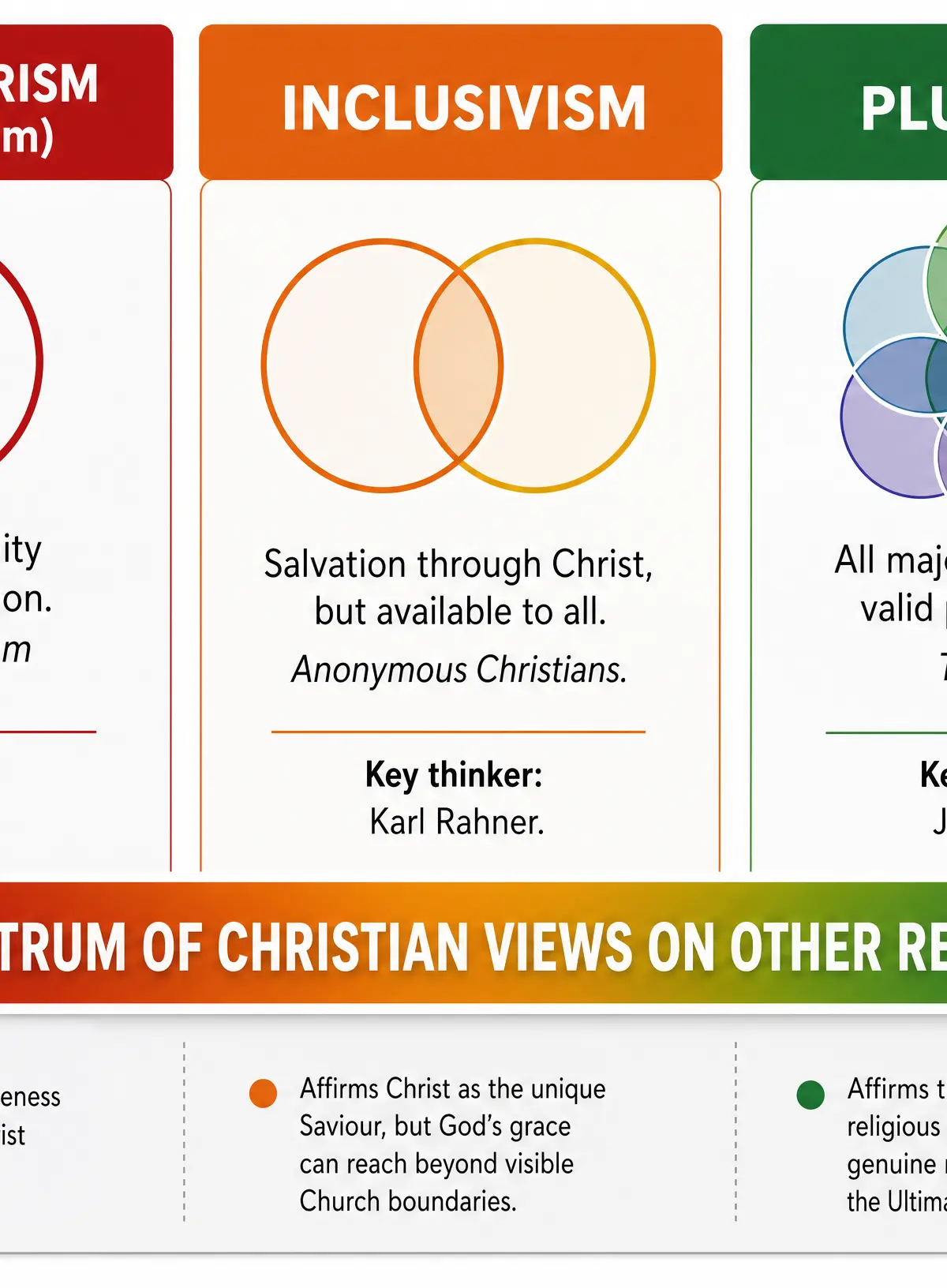
Particularism (Exclusivism)
What it is: The belief that salvation is only available through explicit faith in Jesus Christ. Other religions cannot lead to salvation.
Key Thinker: Karl Barth (20th-century Swiss theologian) argued that God's revelation in Christ is unique and unrepeatable.
Key Phrase: Extra ecclesiam nulla salus (Outside the Church, there is no salvation).
Exam Relevance: Use this as the traditional, conservative anchor in evaluation questions. It provides a strong contrast to pluralism.
Inclusivism
What it is: The belief that while salvation comes uniquely through Jesus Christ, God's grace can reach beyond the visible boundaries of the Christian Church.
Key Thinker: Karl Rahner (20th-century German Catholic theologian).
Key Concept: The 'Anonymous Christian' — someone who has never heard the Gospel but lives a life of genuine love and compassion, thereby responding to Christ's grace without knowing it.
Exam Relevance: Often presented as the 'middle ground'. Excellent for showing nuance in 'How far do you agree?' questions.
Pluralism
What it is: The belief that all major world religions are equally valid paths to the same ultimate divine reality.
Key Thinker: John Hick (20th-century British philosopher).
Key Concept: The 'Copernican Revolution' in theology — shifting the centre from Christianity to 'The Real' (God), with all religions orbiting as different human responses.
Exam Relevance: Use this to argue for maximum compatibility with modern multicultural society.
The Ecumenical Movement
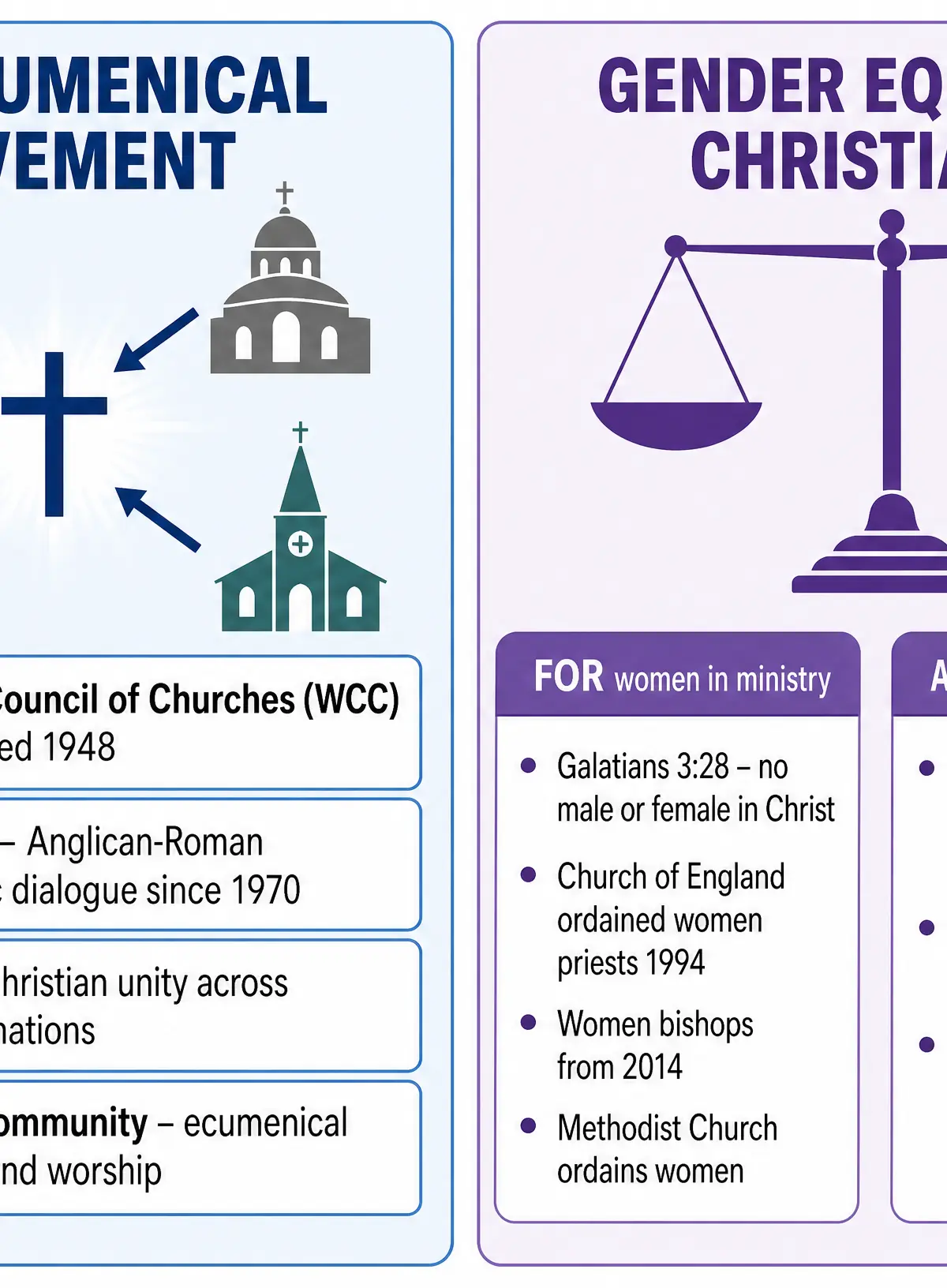
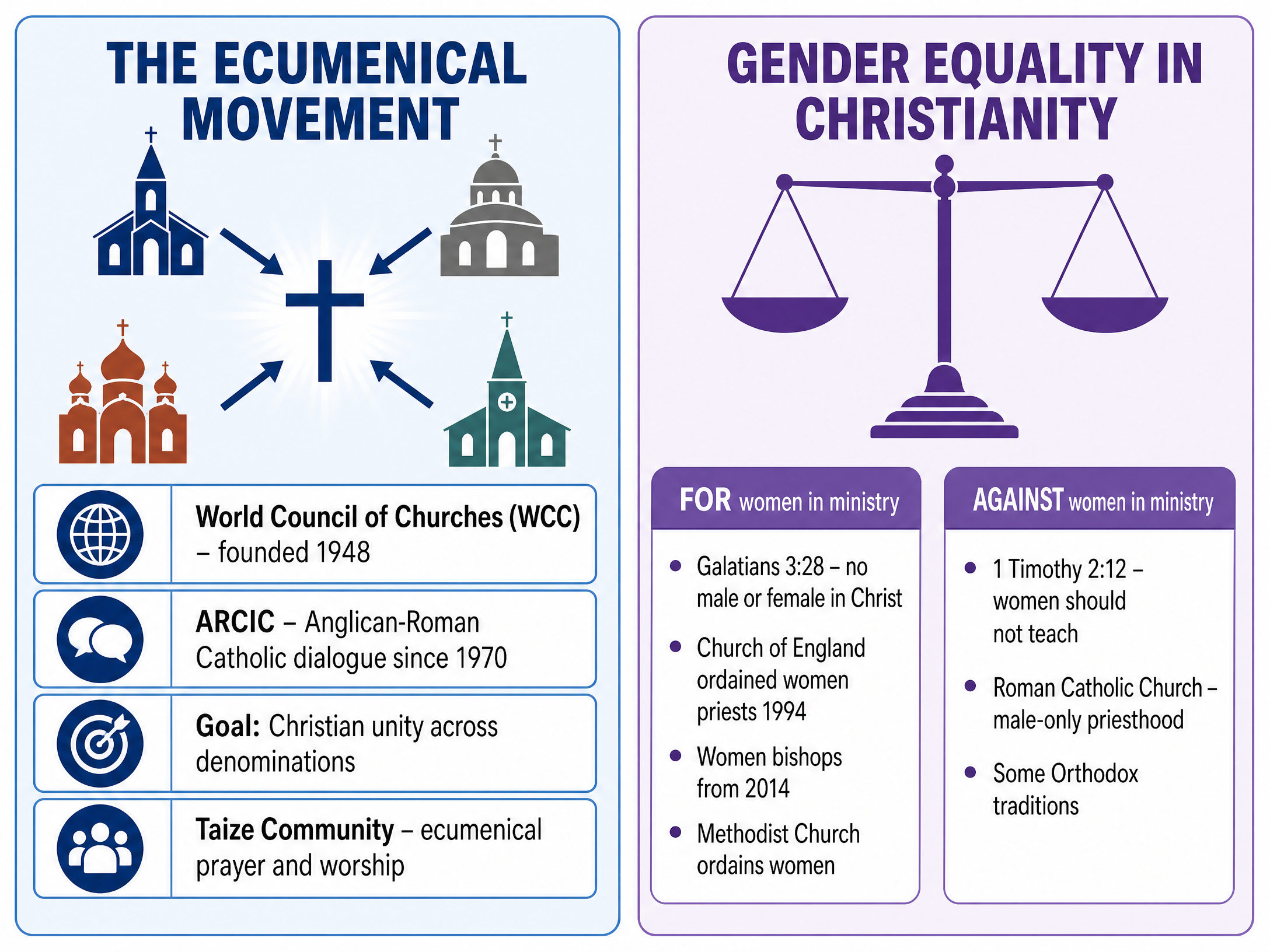
World Council of Churches (WCC)
Founded: 1948 in Amsterdam.
What it is: A fellowship of over 350 member denominations worldwide.
Why it matters: It represents the largest organized effort for Christian unity, focusing on dialogue, social justice, and peace.
ARCIC (Anglican-Roman Catholic International Commission)
Founded: 1970.
What it is: Formal theological dialogue between the Church of England and the Roman Catholic Church.
Why it matters: Demonstrates practical efforts to heal historical divisions dating back to the 16th-century Reformation.
The Taizé Community
Founded: 1940 by Brother Roger Schutz in France.
What it is: An ecumenical monastic community.
Why it matters: A lived example of Christians from different traditions worshipping and living together, particularly popular with young people.
Gender Equality in the Church
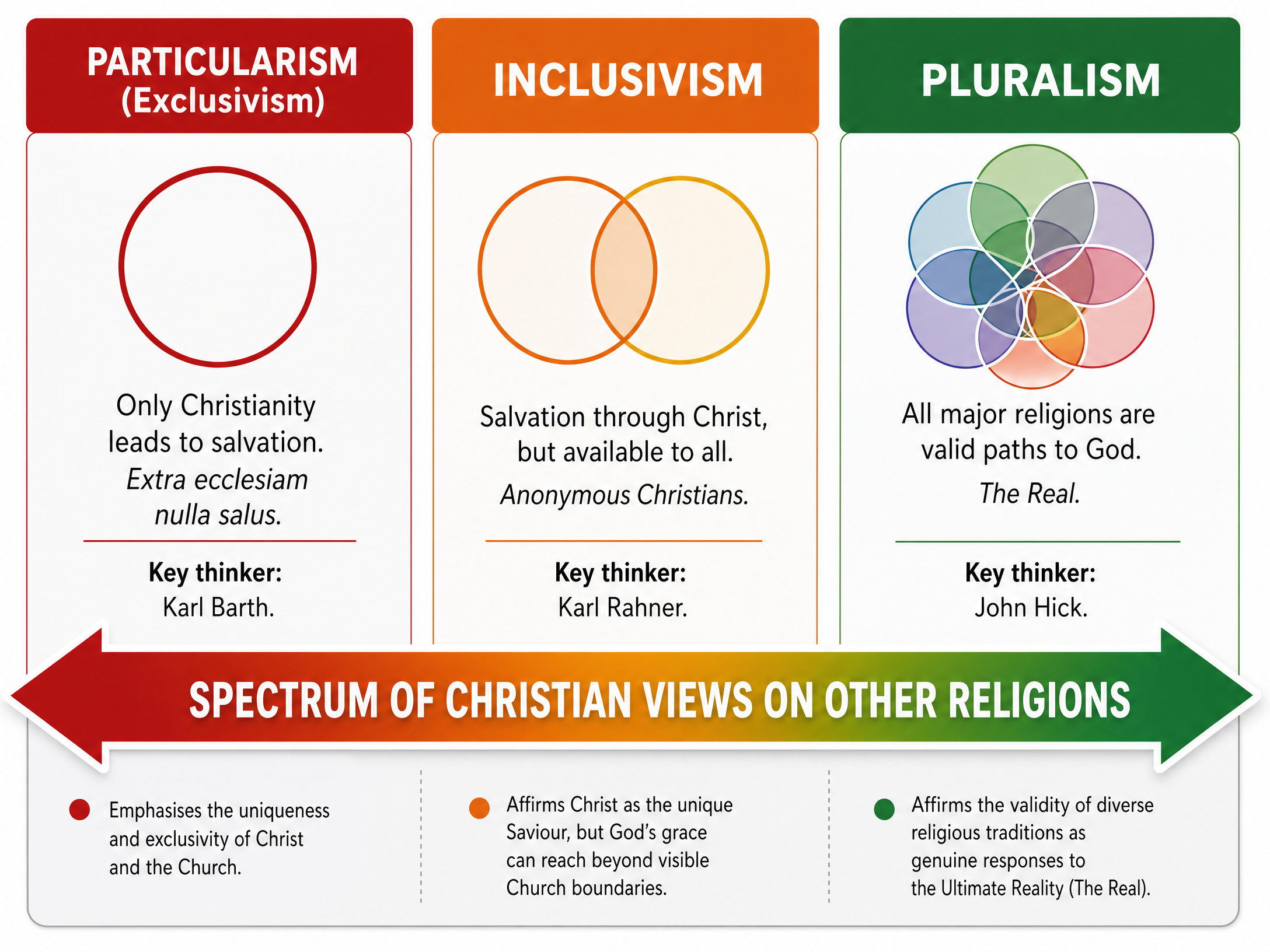
The Egalitarian View (For Women in Ministry)
Biblical Basis: Galatians 3:28 — "There is neither Jew nor Gentile, neither slave nor free, nor is there male and female, for you are all one in Christ Jesus."
Specific Knowledge:
- The Methodist Church has ordained women since 1974.
- The Church of England ordained its first women priests in 1994.
- The Church of England approved women bishops in 2014 (Libby Lane became the first in 2015).
The Traditionalist View (Against Women in Ministry)
Biblical Basis: 1 Timothy 2:12 — "I do not permit a woman to teach or to assume authority over a man."
Specific Knowledge:
- The Roman Catholic Church maintains an all-male priesthood, arguing Jesus chose only male apostles.
- The Eastern Orthodox Church also restricts ordination to men.
Audio Revision
Listen to our comprehensive 10-minute podcast covering all these topics, complete with an exam technique breakdown and a quick-fire recall quiz:

Worked Examples
3 worked examples — open one to explore the question and available guidance.
Practice Questions
Test your understanding — click to reveal model answers
'The Ecumenical Movement has been completely successful.' Evaluate this statement. (12 marks)
Hint: Consider what 'success' means. Have churches merged? No. Have they improved dialogue? Yes. Use specific examples like the WCC and ARCIC.
Explain two reasons why some Christians support the ordination of women. (4 marks)
Hint: Use a biblical quote for one reason, and a theological concept (like imago Dei) for the other.