Pearson Edexcel · A-Level · Religious Studies
Sikhism – Social and historical developments: The impact of migration, secularisation and non-Sikh culture on the Sikh Diaspora
This study explores the profound impact of migration on Sikhism, examining how the diaspora negotiates identity, the Panj Kakke, and the Sikh Rehat Maryada in secular, non-Sikh cultures. It is crucial for understanding Sikhism as a dynamic, living faith responding to modern global challenges.
- 7 min read
- 3 worked examples
- 5 practice questions
- 6 key terms
Study Notes
Overview
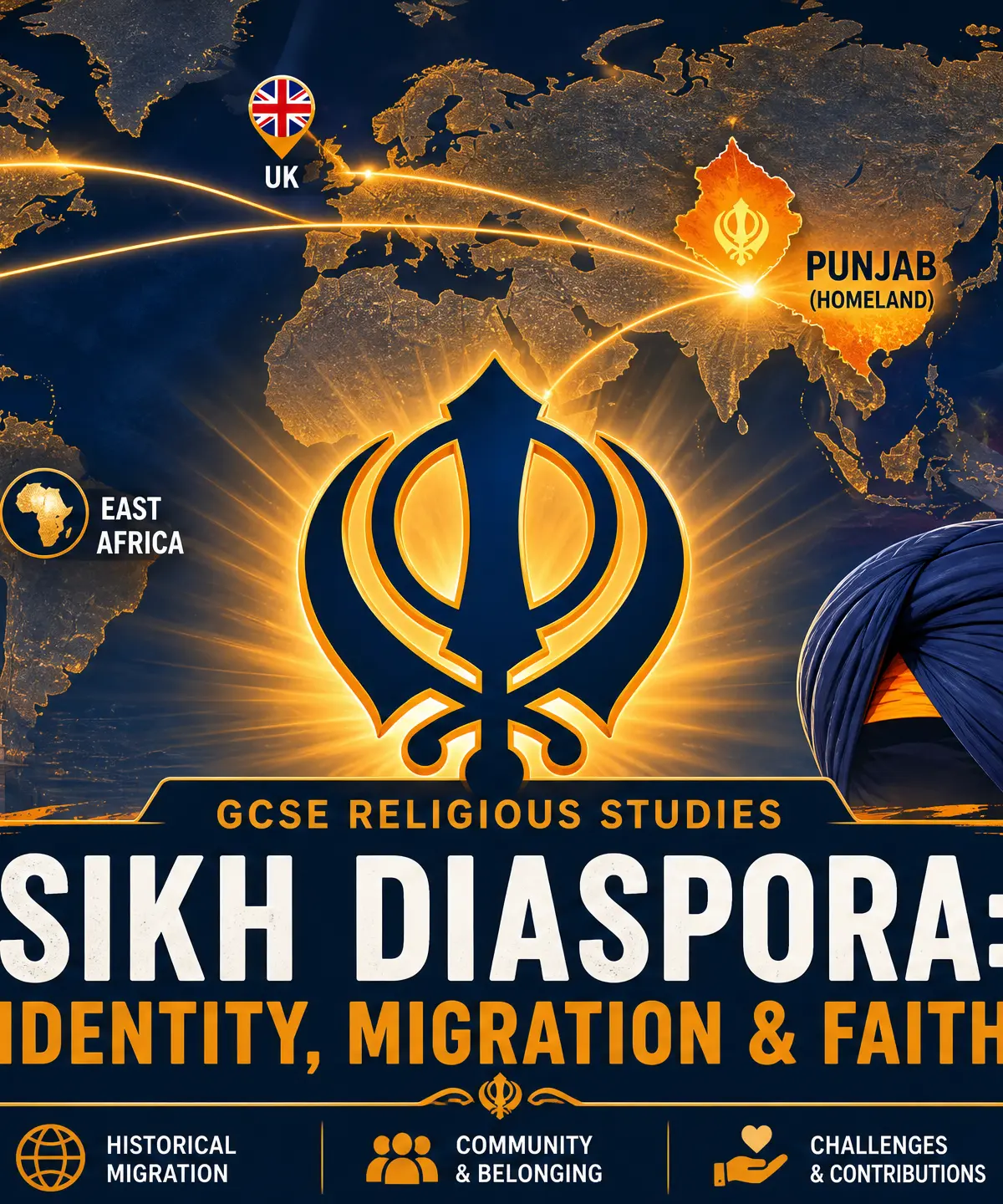
The Sikh Diaspora represents one of the most dynamic and complex aspects of modern Sikhism. This study explores how the scattering of Sikhs from their historical homeland in Punjab to countries like the UK, Canada, the USA, and East Africa has profoundly impacted Sikh identity, beliefs, and practices. For your GCSE Religious Studies exam, examiners expect you to understand that Sikhism is not a static faith; it constantly negotiates its place within secular, non-Sikh cultures. You must be able to analyse the tension between maintaining traditional codes of conduct—specifically the Sikh Rehat Maryada—and the realities of assimilation, secularisation, and modern legal challenges regarding the Panj Kakke.

Key Events & Developments in Migration
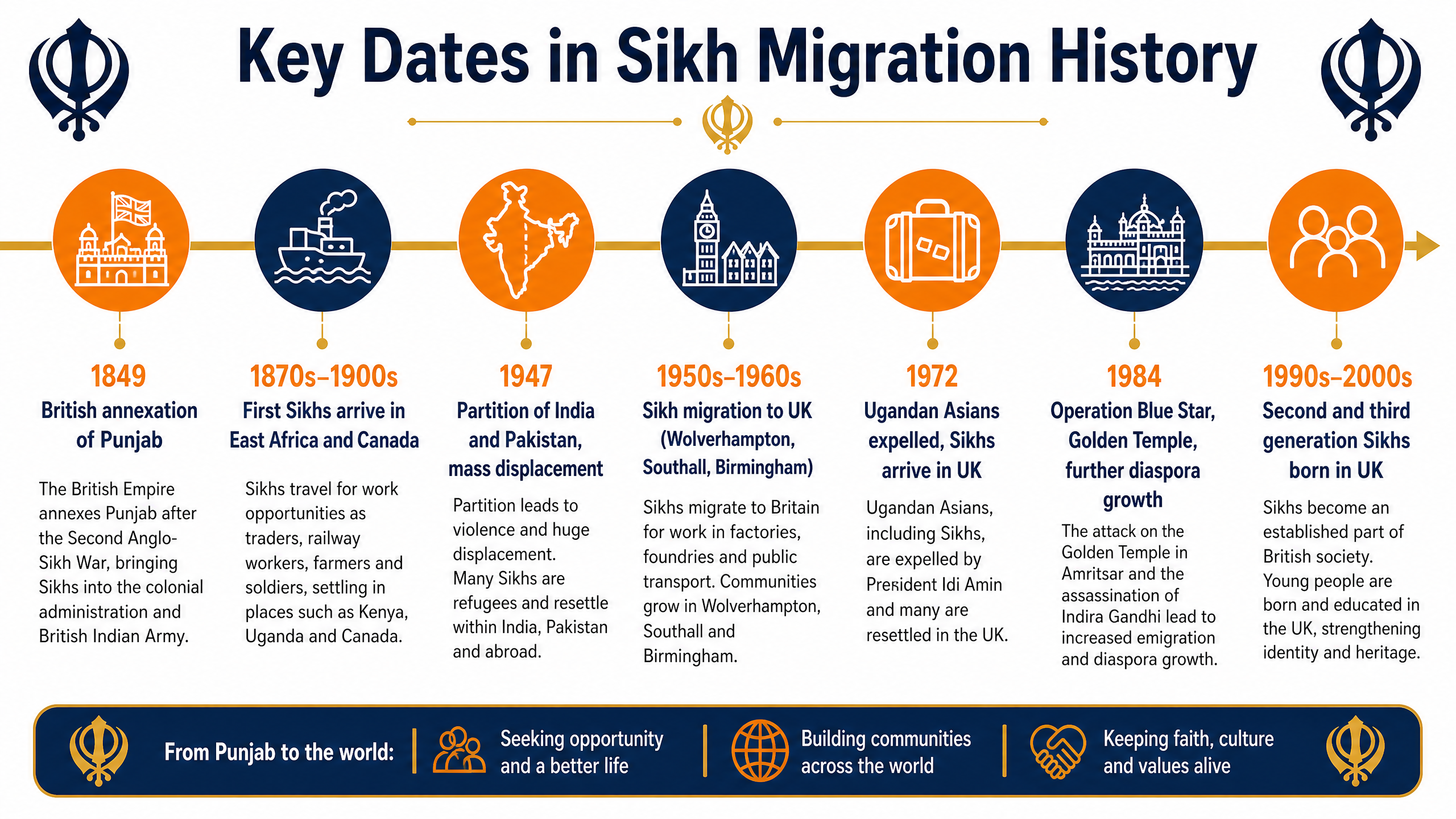
Early Migration to East Africa and Canada
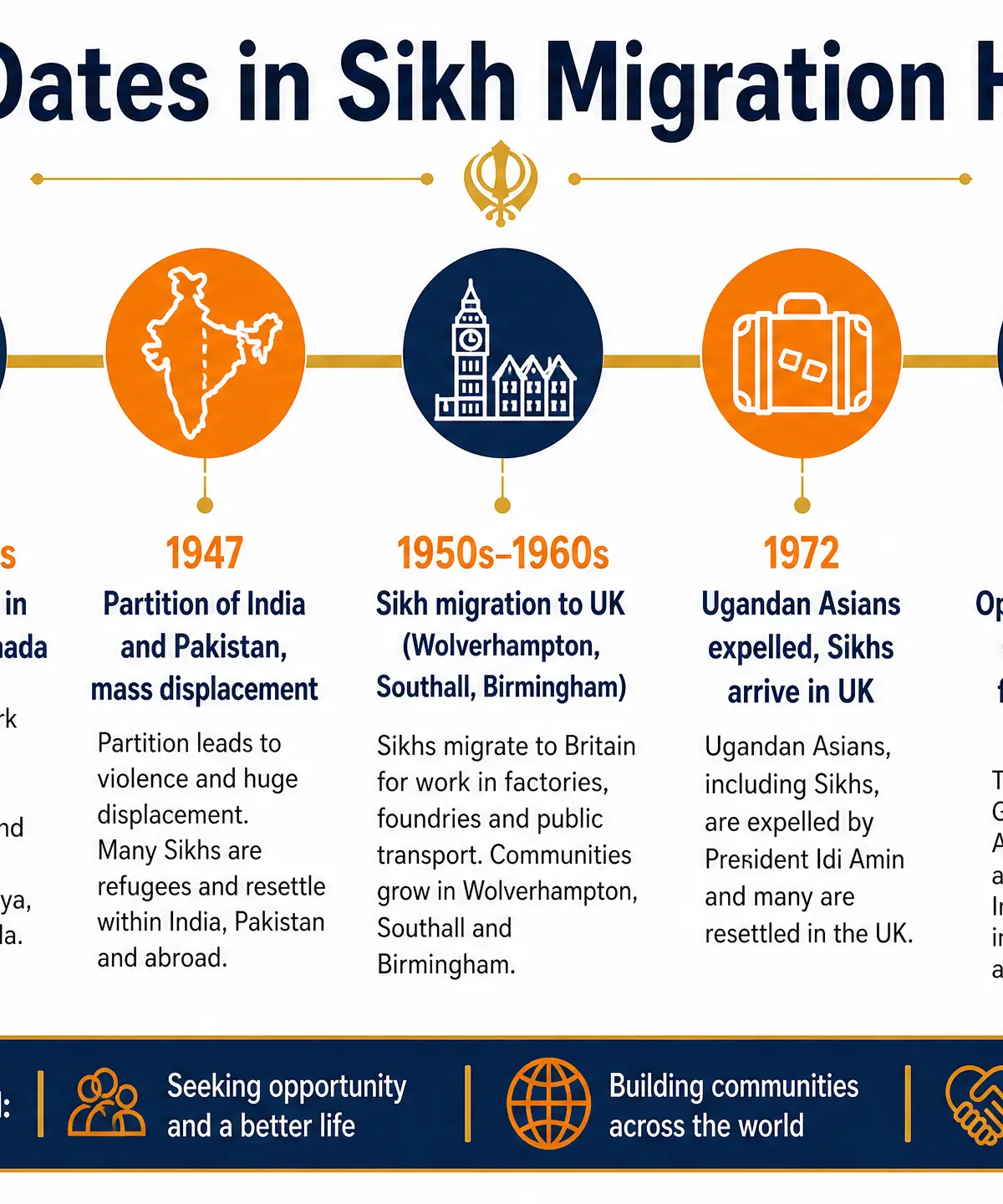
Date(s): 1870s–1900s
What happened: Sikhs left Punjab to work as soldiers, railway builders, and farmers in the British Empire, settling in places like Kenya, Uganda, and British Columbia.
Why it matters: This established the first major Sikh communities outside the Indian subcontinent, marking the beginning of the global diaspora and the initial encounters with non-Sikh administrative systems.
Specific Knowledge: Over 30,000 Indians (many Sikhs) worked on the Uganda Railway; early Canadian settlers faced the discriminatory 1908 Continuous Journey regulation.
Partition of India
Date(s): August 1947
What happened: British India was divided into independent India and Pakistan. Punjab was split, forcing millions of Sikhs to flee from West Punjab (Pakistan) to East Punjab (India) or abroad.
Why it matters: This traumatic displacement uprooted Sikhs from key historical and sacred sites (like Nankana Sahib), fostering a deep sense of loss and reinforcing the necessity of a strong, portable religious identity.
Specific Knowledge: An estimated 14 million people were displaced across the new borders, with massive loss of life.
Post-War Migration to Britain
Date(s): 1950s–1960s
What happened: To fill post-war labour shortages, Sikh men (and later their families) migrated to the UK, settling in industrial hubs like Wolverhampton, Birmingham, and Southall.
Why it matters: This created the foundation of the modern British Sikh community. It led to the establishment of the first UK gurdwaras and sparked early conflicts over identity, such as the right to wear turbans in workplaces (e.g., the 1967 Wolverhampton transport dispute).
Specific Knowledge: By the late 1960s, Southall had become a major centre of Sikh culture in the UK.
Expulsion from Uganda
Date(s): 1972
What happened: President Idi Amin expelled all Asians from Uganda, including a large, established Sikh community.
Why it matters: Many of these 'twice-migrant' Sikhs relocated to the UK. They brought with them experience in business and maintaining religious identity in a diaspora setting, strengthening the UK Sikh infrastructure.
Specific Knowledge: Around 27,000 Ugandan Asians came to the UK following the expulsion order.
Operation Blue Star
Date(s): June 1984
What happened: The Indian military assaulted the Golden Temple complex in Amritsar to remove Sikh separatists.
Why it matters: This event caused profound grief worldwide, deeply politicising the diaspora. It reinforced Darshan Singh Tatla's concept of the "politics of homeland," where distance intensifies emotional and religious attachment to Punjab.
Specific Knowledge: Led to the assassination of Prime Minister Indira Gandhi by her Sikh bodyguards and subsequent anti-Sikh riots.
Key Individuals and Scholars
Darshan Singh Tatla (D. S. Tatla)
Role: Academic scholar of the Sikh Diaspora.
Key Actions: Wrote extensively on how migration shapes Sikh identity.
Impact: Coined the concept of the "politics of homeland," arguing that diaspora Sikhs maintain a strong, sometimes idealised, political and emotional connection to Punjab. Examiners expect you to reference his work when discussing identity.
Gurharpal Singh (G. Singh)
Role: Academic scholar focusing on Sikhism in the West.
Key Actions: Analysed the interaction between Sikh religious requirements and Western secular legal systems.
Impact: Argues that the diaspora experience forces Sikhs to become politically active to defend their rights (e.g., wearing the Panj Kakke), fundamentally altering how the religion operates compared to its practice in Punjab.
Second-Order Concepts
Causation
Migration was caused by a mixture of economic push/pull factors (labour shortages in the UK, poverty in Punjab) and political crises (Partition in 1947, expulsion from Uganda in 1972). The cause of tension in the diaspora is the clash between the Sikh Rehat Maryada (designed for a specific cultural context) and the secular laws of host nations.
Consequence
A major consequence of diaspora life is the diversification of Sikh practice. While some maintain strict adherence to the Panj Kakke, others (Sahajdhari Sikhs) adapt their appearance to assimilate. A long-term consequence is the translation of services into English to engage younger generations.
Change & Continuity
Change: The shift from Punjabi to English as a primary language for youth; the rise of mixed-faith marriages challenging traditional Anand Karaj rules; the need to legally defend religious symbols.
Continuity: The central role of the Gurdwara as a community hub; the continued reverence for the Guru Granth Sahib; the maintenance of langar (free kitchen) as a symbol of equality.
Thematic Issues in the Diaspora
The Panj Kakke and Secular Law
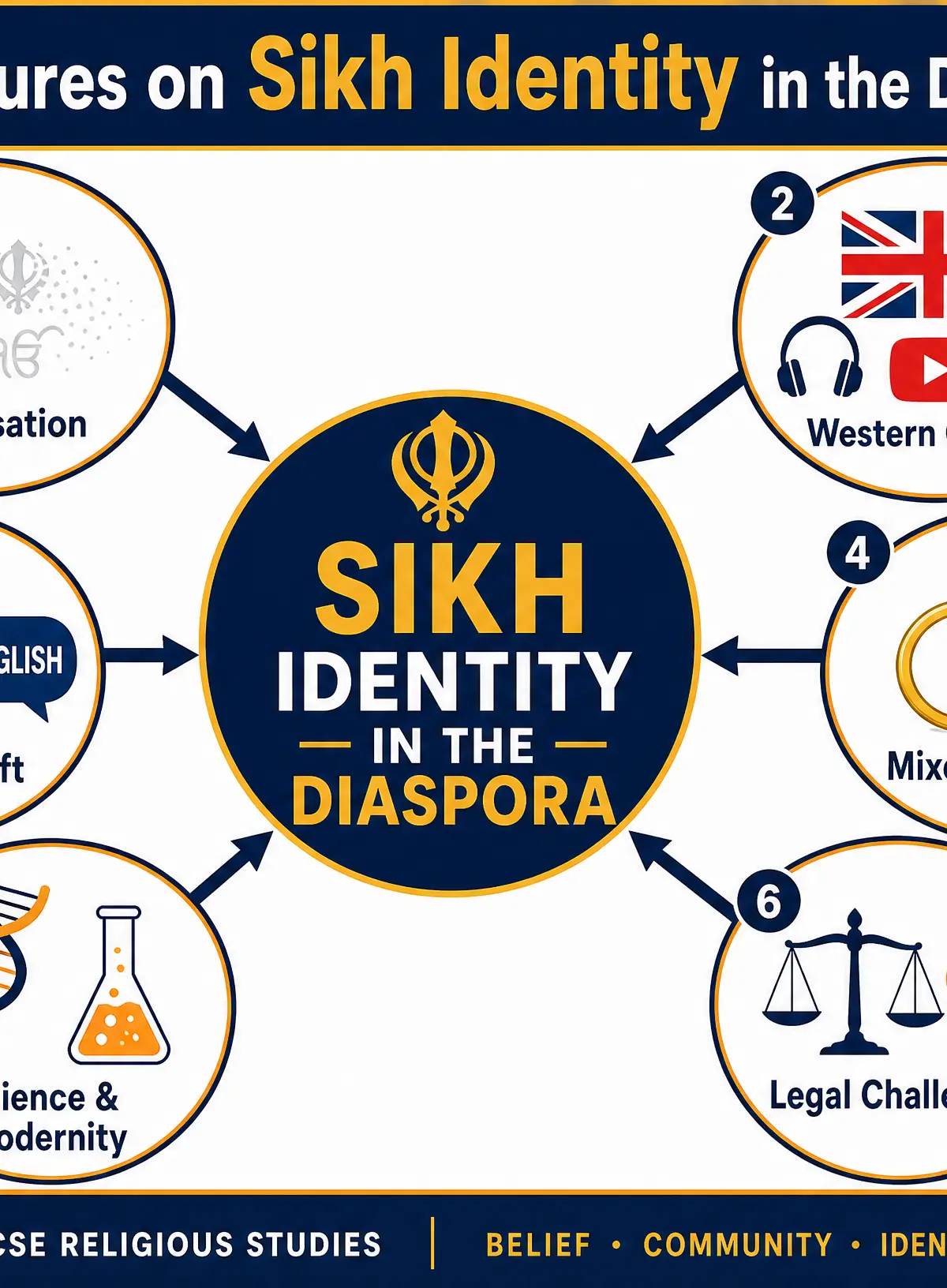
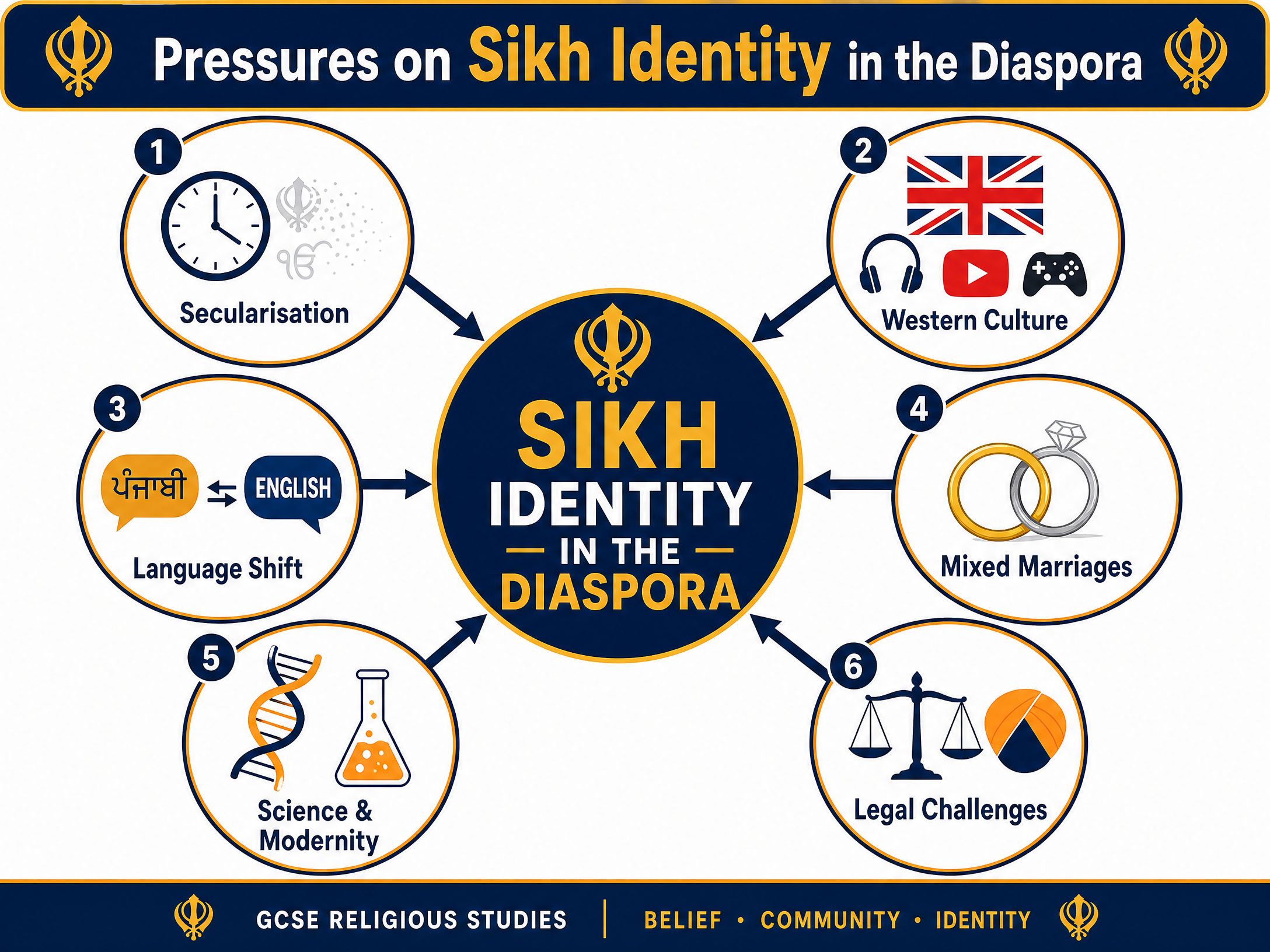
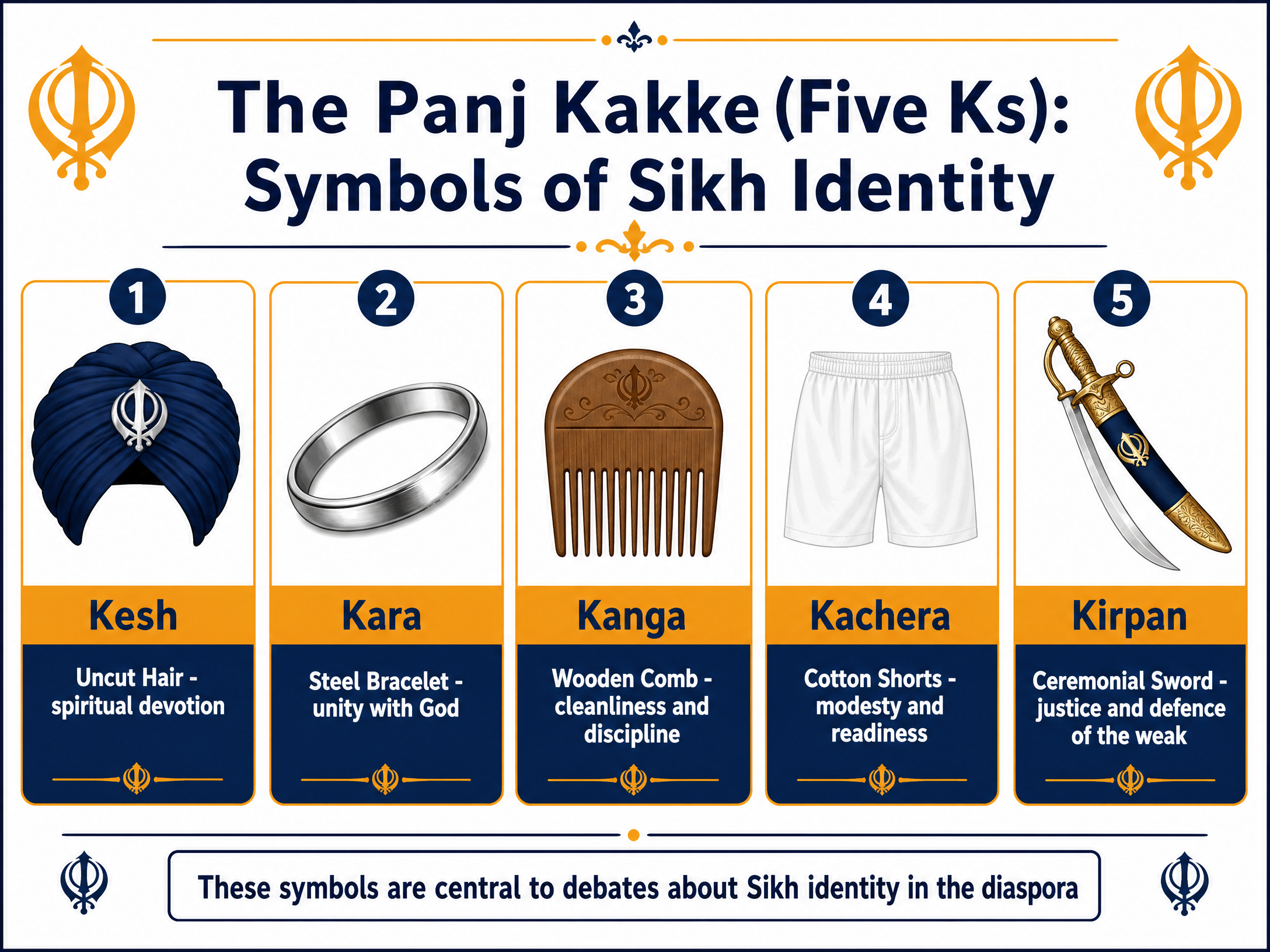
The Five Ks are central to initiated Sikh identity. However, secularisation—the declining influence of religion in public life—has caused friction. In France, laïcité laws banned conspicuous religious symbols in state schools, directly impacting Sikh turbans. In the UK, Sikhs fought and won legal exemptions (e.g., the Motor-Cycle Crash Helmets (Religious Exemption) Act 1976) to wear turbans instead of helmets.

Language and the Gurdwara
The Guru Granth Sahib is written in Gurmukhi. Traditionally, services are entirely in Punjabi. In the diaspora, second and third-generation Sikhs often speak English as their first language. Gurdwaras face a dilemma: insist on Punjabi to preserve heritage, or introduce English to prevent youth from disconnecting from the faith.
Marriage and Assimilation
The Sikh Rehat Maryada states that the Anand Karaj (marriage ceremony) should be between two Sikhs. However, assimilation in the diaspora has led to an increase in mixed-faith marriages. This causes tension regarding whether non-Sikhs can participate fully in the Anand Karaj. Furthermore, debates around same-sex marriage highlight the tension between Sikh principles of universal equality and traditional cultural norms.
Visual Resources
3 diagrams and illustrations
Interactive Diagrams
1 interactive diagram to visualise key concepts
Conceptual Flow Outline
Flowchart showing divergent diaspora responses to the Sikh Rehat Maryada
Worked Examples
3 worked examples — open one to explore the question and available guidance.
Practice Questions
Test your understanding — click to reveal model answers
Explain two ways in which migration has affected Sikh religious practices. (4 marks)
Hint: Think about language in the Gurdwara and the physical appearance of Sikhs (the 5 Ks).
Evaluate the view that the Gurdwara is the most important institution for Sikhs living in the diaspora. (12 marks)
Hint: Consider its role in preserving culture and language, but contrast it with the importance of the family home or personal adherence to the Panj Kakke.
Outline the views of Darshan Singh Tatla regarding the Sikh diaspora. (3 marks)
Hint: Focus on his concept of the 'politics of homeland'.
Explain the controversy surrounding the Anand Karaj ceremony in the diaspora. (5 marks)
Hint: Link the rules of the Rehat Maryada to the reality of mixed marriages in Western societies.
Explain why the year 1984 is significant for the Sikh diaspora. (4 marks)
Hint: Think about Operation Blue Star and its emotional/political impact.