Pearson Edexcel · A-Level · Religious Studies
Philosophical issues and questions: Arguments for the existence of God (Design, Cosmological, Ontological)
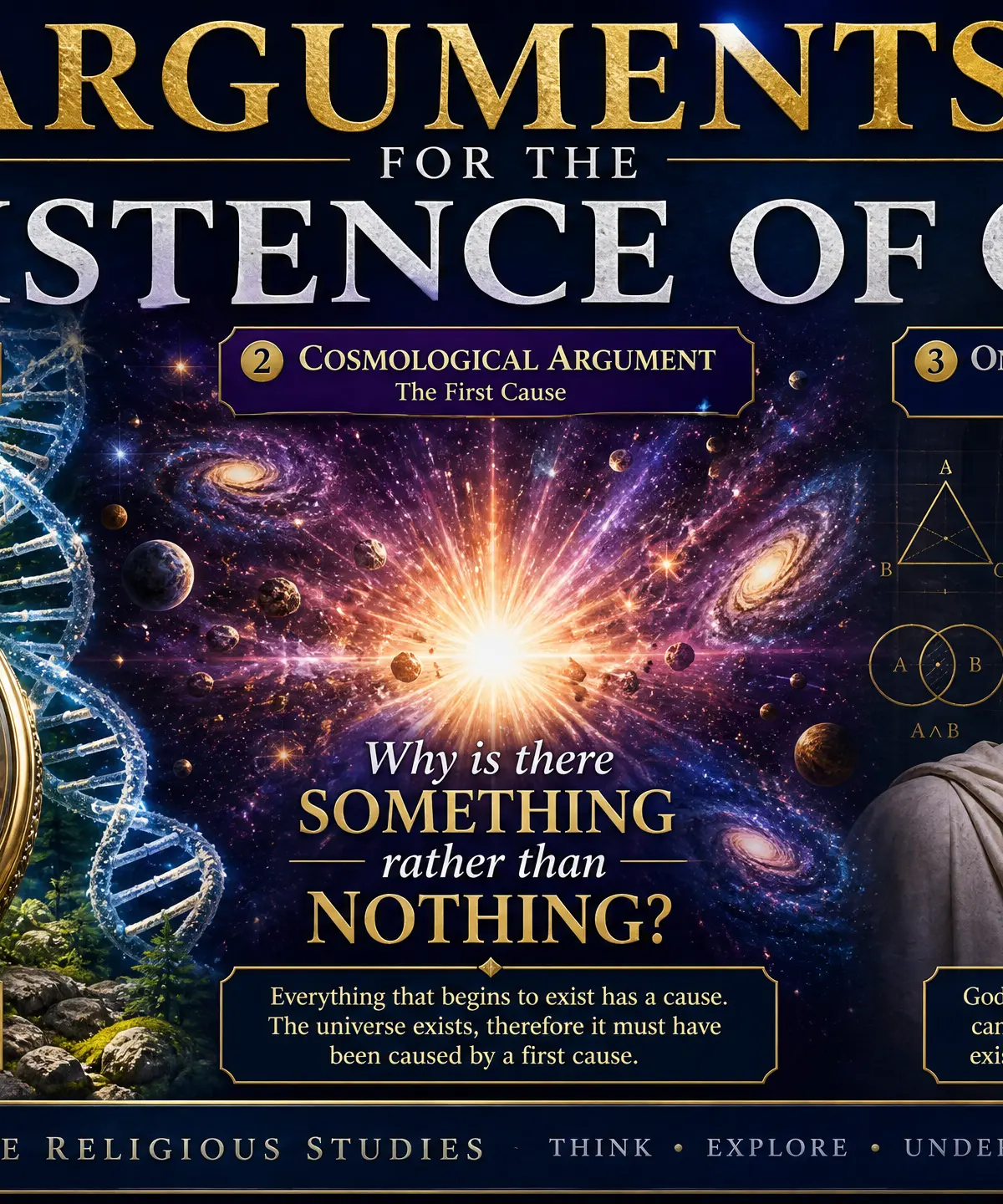
This study explores the most profound philosophical questions humanity has ever asked: Why is there something rather than nothing, and does the universe have a creator? By examining the Design, Cosmological, and Ontological arguments, you will develop the critical thinking skills needed to evaluate the existence of God.
- 6 min read
- 3 worked examples
- 5 practice questions
- 6 key terms
Study Notes
Overview
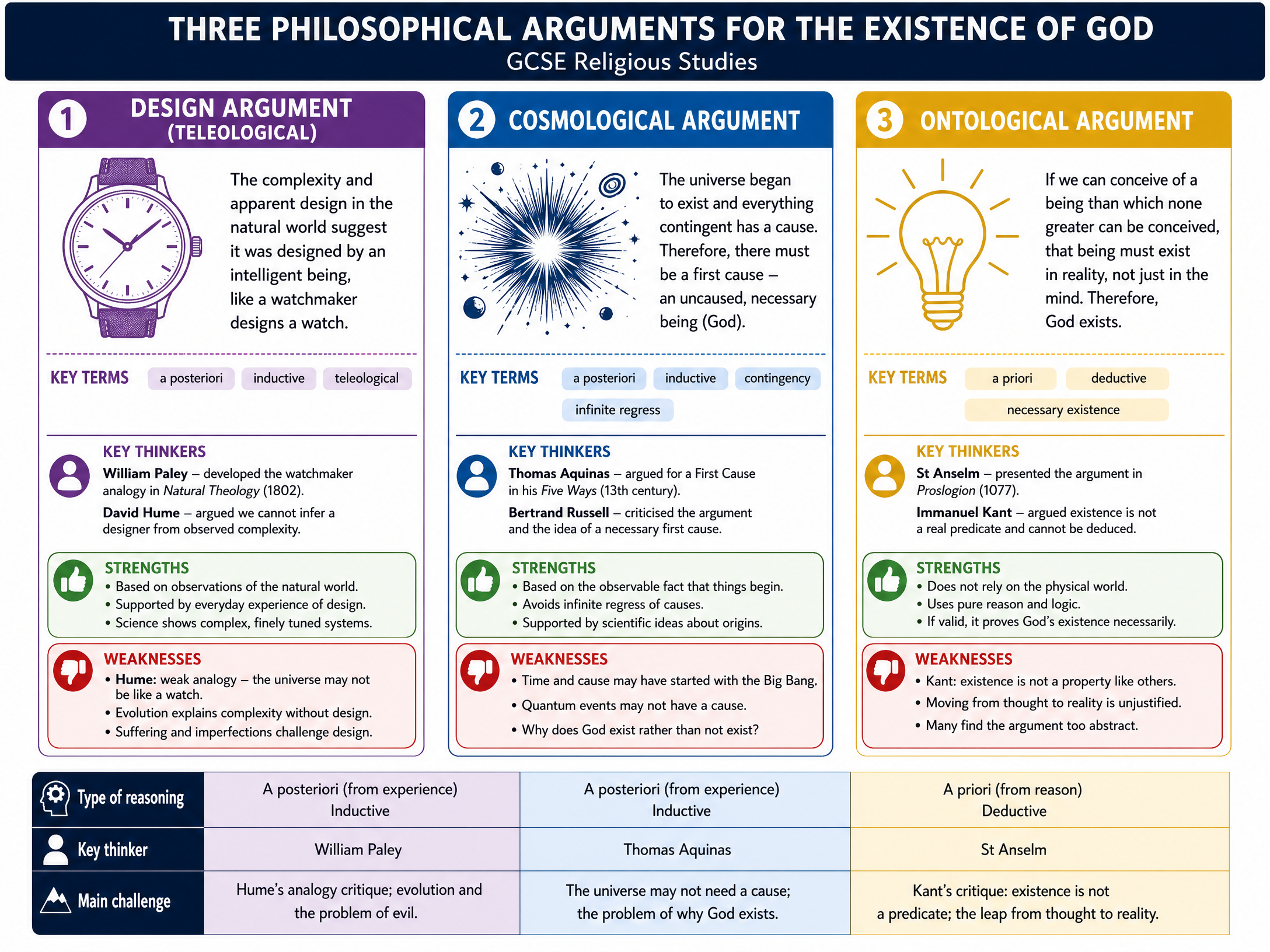
This topic covers the three main philosophical arguments for the existence of God: the Design (Teleological) argument, the Cosmological argument, and the Ontological argument. These are not merely historical debates; they represent fundamental ways humans have tried to make sense of the universe and our place within it. Examiners expect you to understand the logical structure of these arguments, distinguish between a priori and a posteriori reasoning, and critically evaluate their strengths and weaknesses using the ideas of key philosophers like Aquinas, Paley, Anselm, Hume, Kant, and Russell.
Listen to the companion podcast for an in-depth review:

The Design Argument (Teleological)
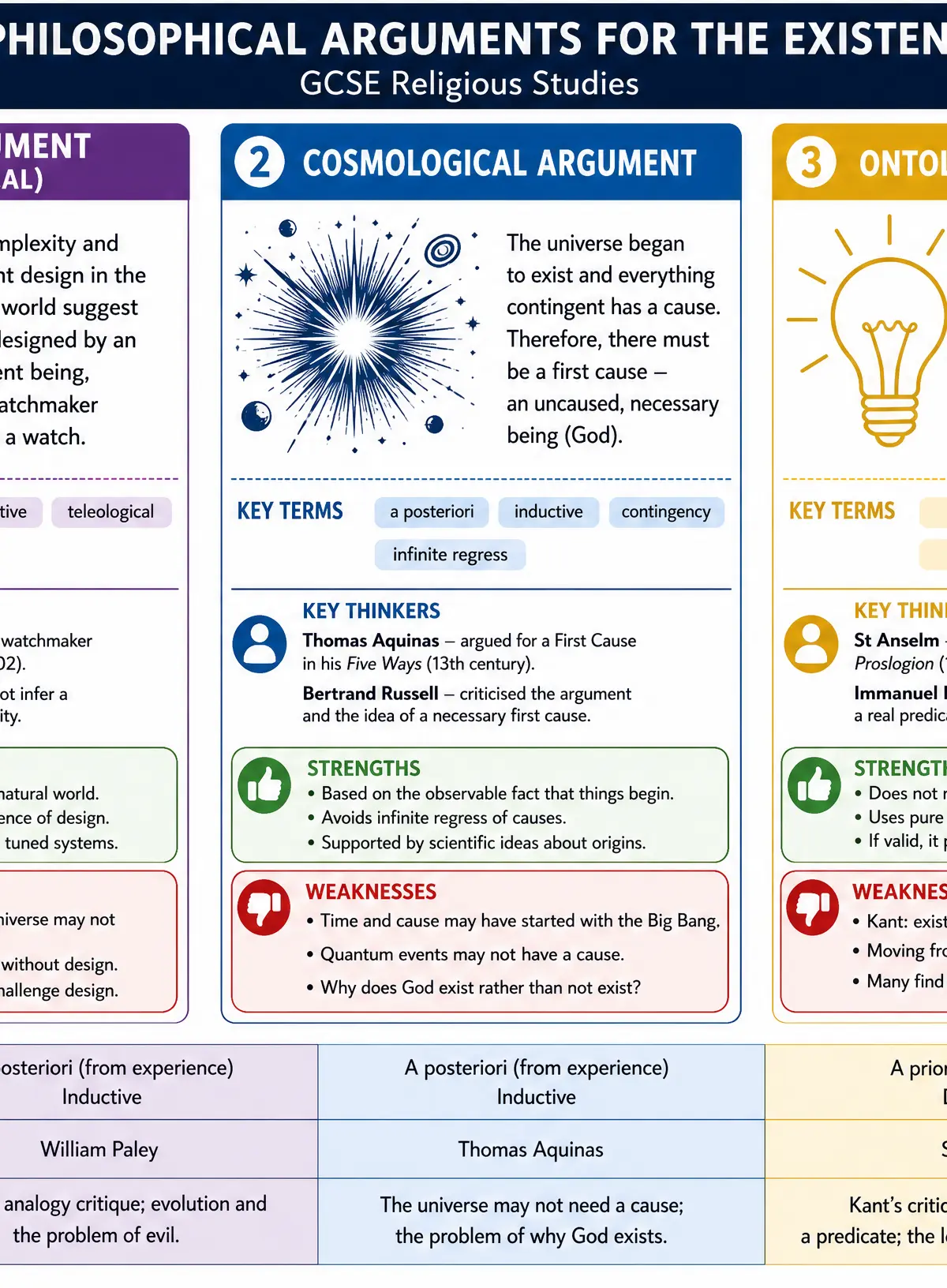
Type of Argument: A posteriori (based on experience) and Inductive (conclusion is probable).
What is it?: The argument that the complexity, order, and purpose observed in the natural world suggest it was designed by an intelligent being (God), rather than occurring by chance.
William Paley's Watchmaker Analogy (1802):
Paley argued that if you found a watch on a heath, its complex parts working together for a purpose (telling time) would lead you to conclude it had a designer. He then compared the watch to the natural world (e.g., the human eye, planetary orbits), arguing that nature is far more complex than a watch and therefore must have a much greater designer: God.
Challenges (David Hume & Evolution):
- Weak Analogy: Hume argued the universe is more like a living organism (a vegetable) than a machine. We cannot assume it was 'made' in the same way.
- Multiple Designers: If we use human analogies, many machines are made by teams. Why not a committee of gods?
- The Problem of Evil: Flaws in design (disease, natural disasters) suggest an incompetent or cruel designer, not the perfect God of classical theism.
- Evolution: Darwin's theory of evolution by natural selection provides a scientific, non-theistic explanation for the apparent 'design' in nature.
The Cosmological Argument (First Cause)
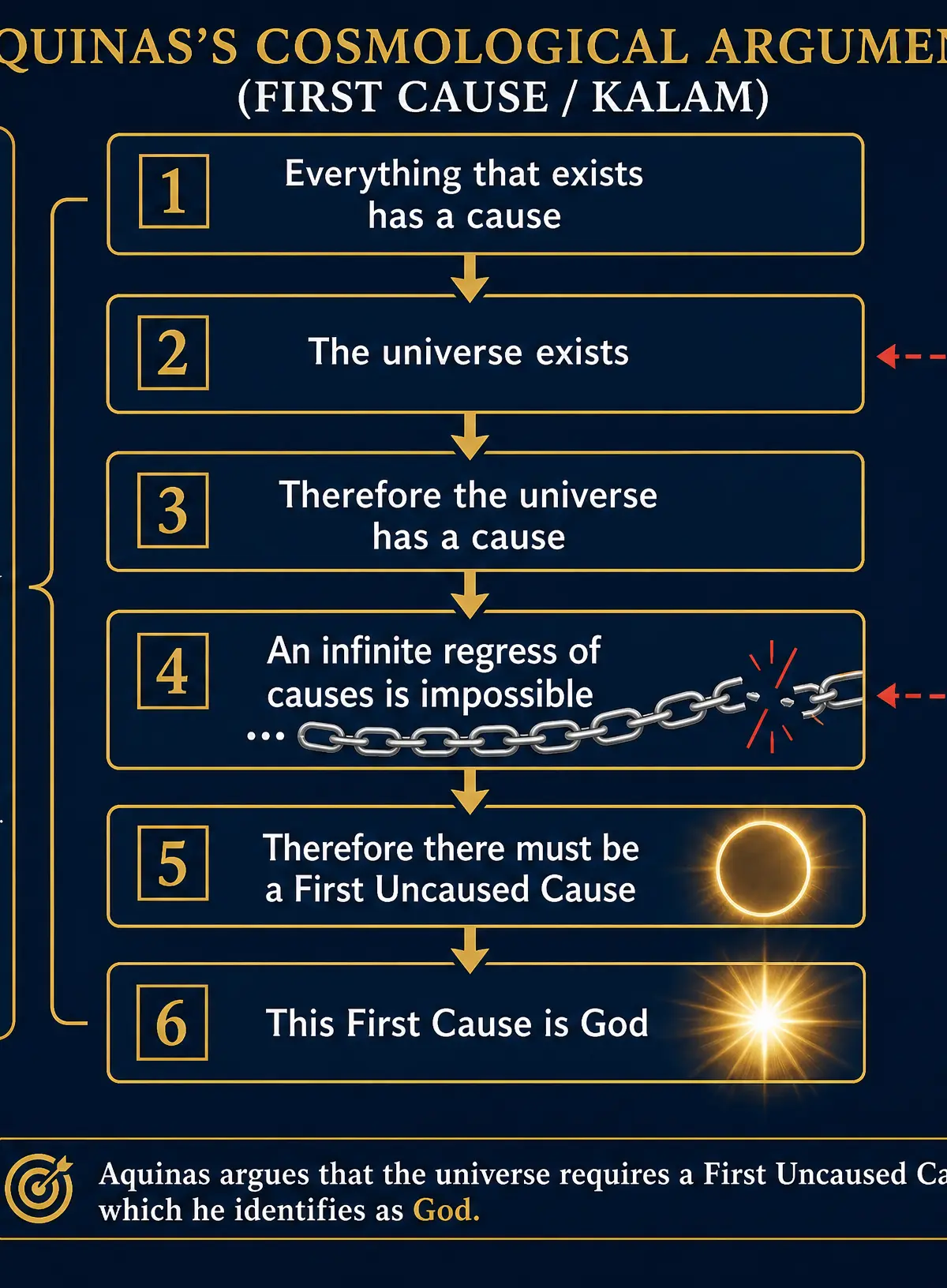
Type of Argument: A posteriori and Inductive.
What is it?: The argument that the universe cannot explain its own existence; it must have a cause outside itself, which is God.
Thomas Aquinas's Five Ways (13th Century):
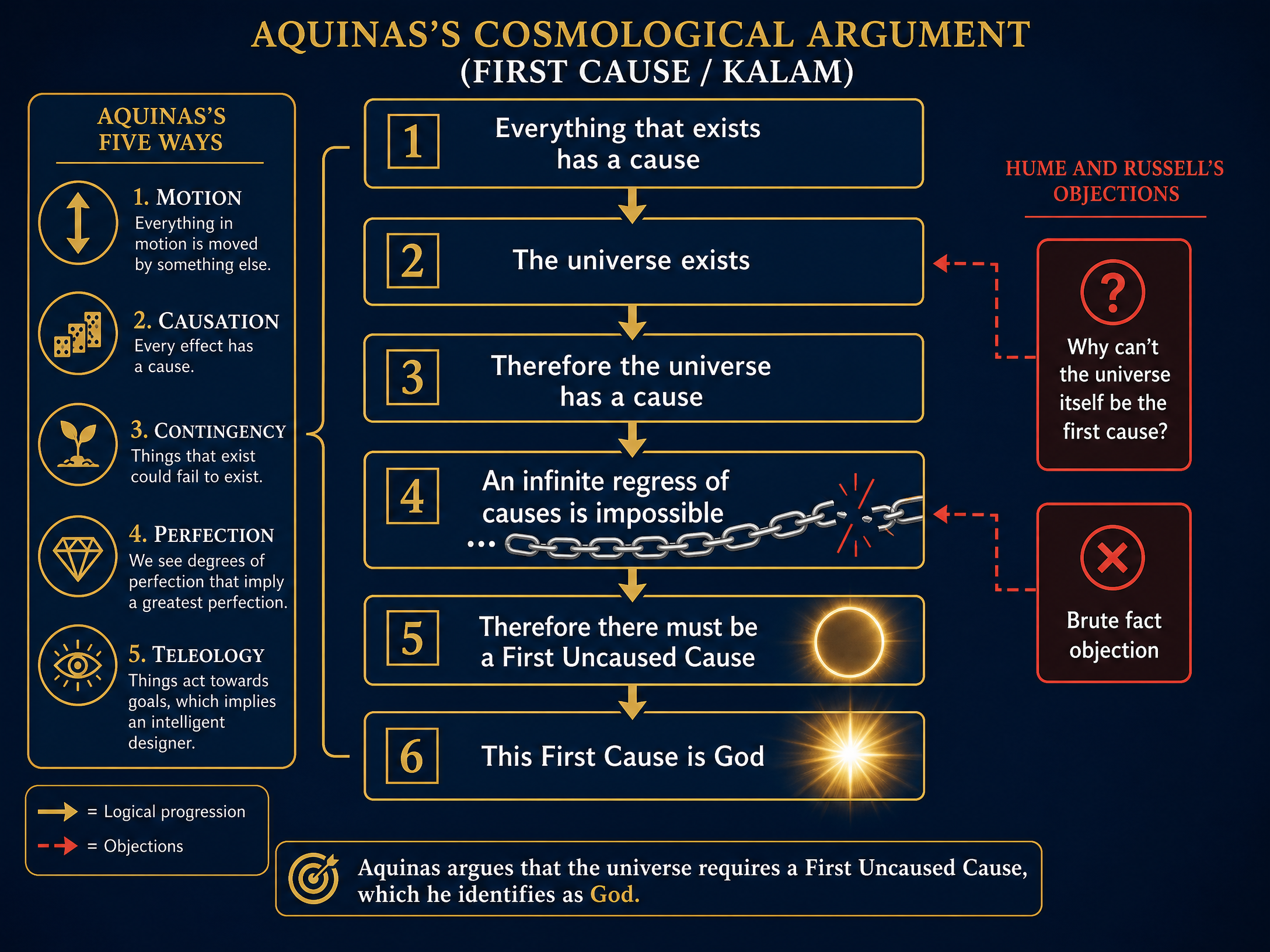
Aquinas argued from motion, causation, and contingency. The core idea is that everything in the universe is contingent (it relies on something else to exist). If everything is contingent, there must have been a time when nothing existed. Therefore, there must be a 'Necessary Being' (a being that cannot not exist) that caused everything else. He also argued that an infinite regress of causes is impossible; there must be a First Uncaused Cause.
The Kalam Cosmological Argument:
- Whatever begins to exist has a cause.
- The universe began to exist.
- Therefore, the universe has a cause (God).
Challenges (Russell & Hume):
- Brute Fact: Bertrand Russell argued the universe just exists, and requires no explanation ("The universe is just there, and that's all").
- Fallacy of Composition: Russell argued that just because every human has a mother doesn't mean the human race has a mother. Just because things in the universe have causes doesn't mean the universe itself has a cause.
- Who caused God?: If everything needs a cause, why is God the exception?
The Ontological Argument
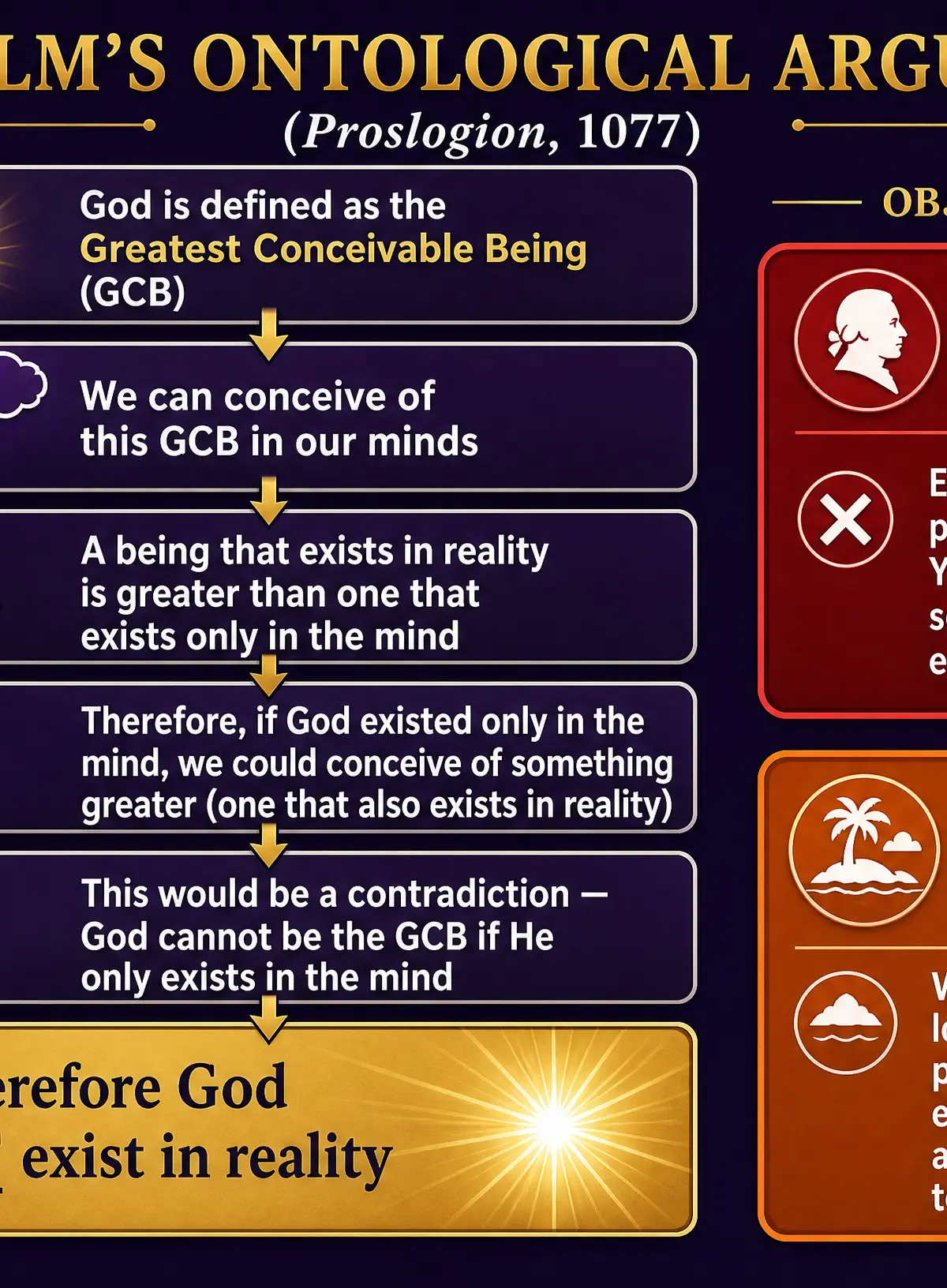
Type of Argument: A priori (based on logic alone) and Deductive (conclusion is certain if premises are true).
What is it?: The argument that God's existence can be proven simply by understanding the definition of the word 'God'.
St Anselm's Argument (1077):
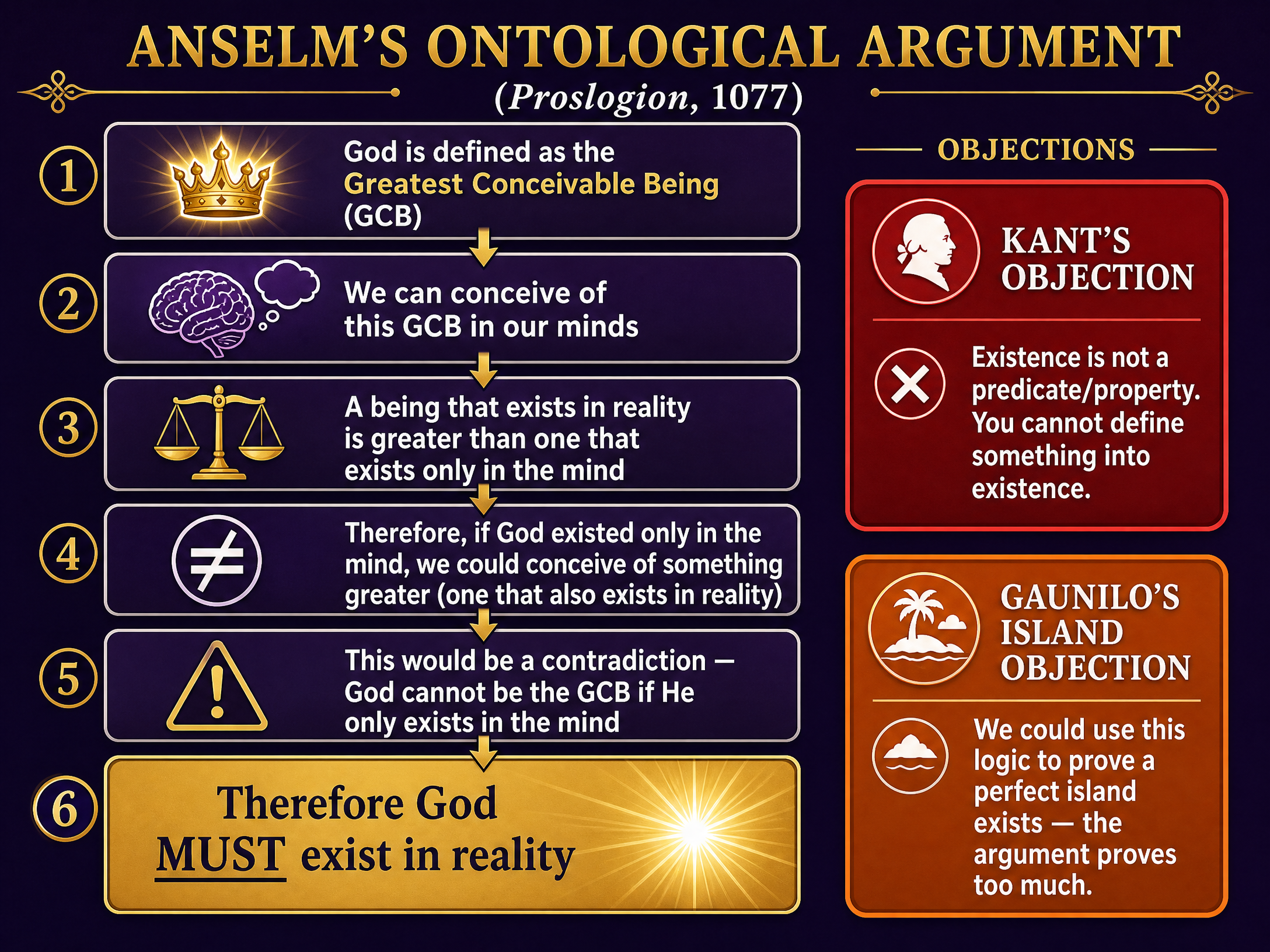
Anselm defined God as "that than which nothing greater can be conceived" (the Greatest Conceivable Being). He argued that a being that exists in reality is greater than a being that exists only in the mind. Therefore, if God is truly the greatest conceivable being, He must exist in reality, otherwise we could conceive of something greater.
Challenges (Kant & Gaunilo):
- Existence is not a predicate: Immanuel Kant argued that saying something 'exists' adds no new information to the concept of it. You cannot define something into existence.
- Gaunilo's Perfect Island: Gaunilo argued that Anselm's logic could be used to prove the existence of a perfect island, which is absurd. The argument 'proves too much'.
Second-Order Concepts
Evaluation and Justification
Examiners want to see you evaluate the strength of these arguments. Are inductive arguments stronger because they rely on evidence, or weaker because they only offer probability? Are deductive arguments stronger because they offer logical certainty, or weaker because they don't engage with the real world?
Change & Continuity
Notice how the arguments have evolved. Aquinas's Cosmological argument relies on medieval physics; the Kalam argument is often used today alongside the Big Bang theory. Paley's Design argument pre-dates Darwin; modern versions often focus on the 'Anthropic Principle' (fine-tuning of the universe).
Visual Resources
3 diagrams and illustrations
Interactive Diagrams
1 interactive diagram to visualise key concepts
Conceptual Flow Outline
Types of Reasoning in Arguments for God
Worked Examples
3 worked examples — open one to explore the question and available guidance.
Practice Questions
Test your understanding — click to reveal model answers
Outline Anselm's Ontological Argument. (5 marks)
Hint: Start with his definition of God, and explain the difference between existing in the mind vs. reality.
Explain two objections to the Cosmological Argument. (4 marks)
Hint: Think of Bertrand Russell and David Hume.
'The Cosmological argument is the strongest argument for the existence of God.' Evaluate this statement. (12 marks)
Hint: Compare its strengths (based on observation, cause and effect) against its weaknesses (Brute fact, who caused God), and briefly compare it to the weaknesses of the other two arguments.
Explain Hume's criticisms of the Design Argument. (5 marks)
Hint: Remember the VEG mnemonic: Vegetable, Evil, Gods.
Explain Kant's objection to the Ontological Argument. (4 marks)
Hint: Focus on the word 'predicate'.