Pearson Edexcel · A-Level · Religious Studies
Islam – Sources of wisdom and authority: The life and work of the Prophet Muhammad, the Hadith and Sunnah, and the Qur'an
This study guide covers the foundational sources of Islamic authority: the life of the Prophet Muhammad, the Qur'an, the Hadith, and the Sunnah. Understanding these elements and their interrelationships is essential for explaining how Islamic law (Shari'ah) and moral principles are applied in Muslim life today.
- 5 min read
- 3 worked examples
- 3 practice questions
- 6 key terms
Study Notes
Overview
This topic explores the core foundations of Islamic belief and practice: the life of the Prophet Muhammad (PBUH), the revelation of the Qur'an, and the guidance provided by the Hadith and Sunnah. Examiners expect candidates to not only recall factual details about Muhammad's life but to critically analyze how these events shaped early Islam within the context of 7th-century Arabia. Furthermore, you must understand the distinct nature of the Qur'an as the direct word of Allah, compared to the Hadith (recorded sayings) and Sunnah (actions) of the Prophet. A strong grasp of how these sources interact to form Shari'ah law is crucial for achieving top marks in evaluation questions.
Key Events in the Life of Muhammad (PBUH)
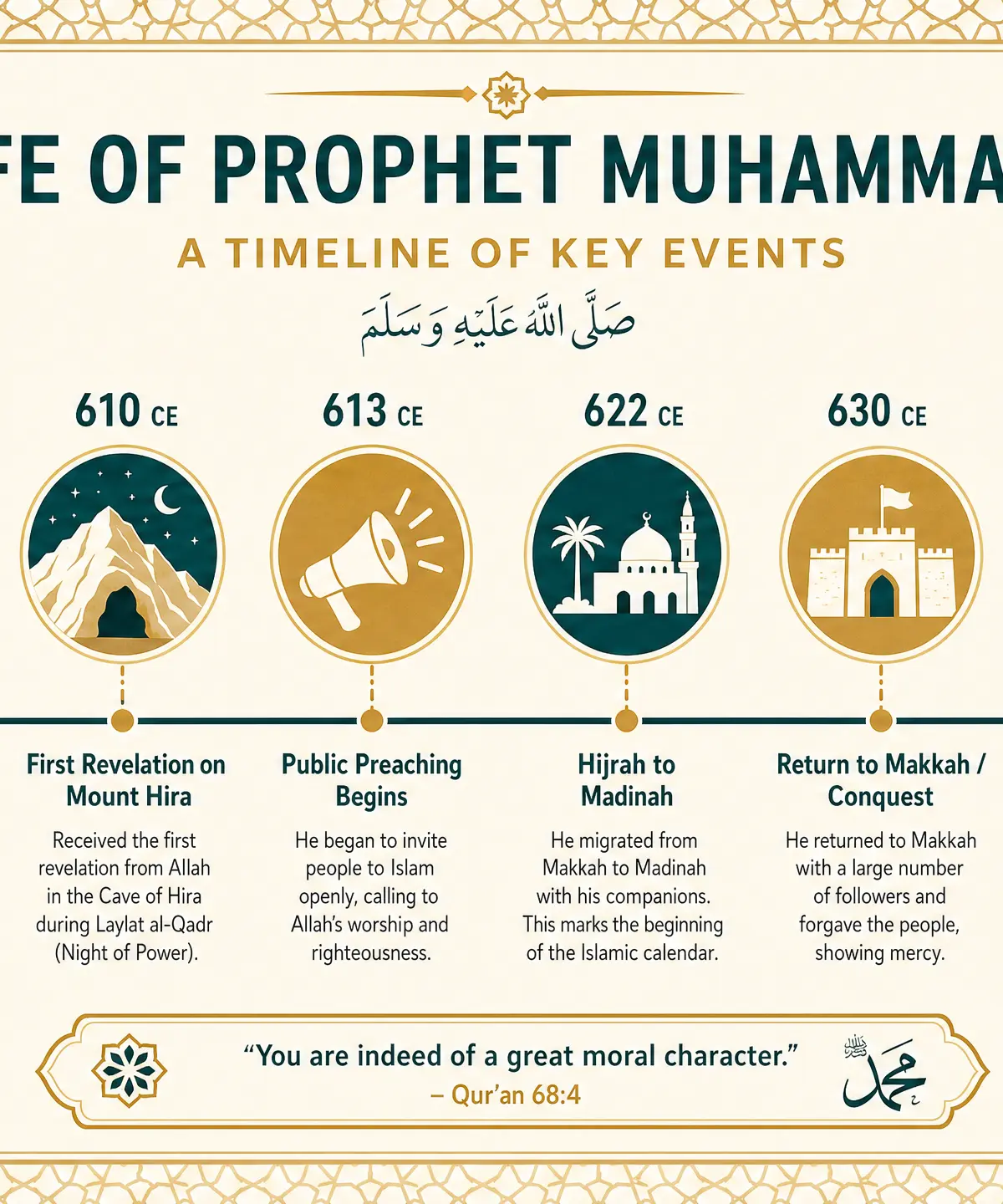
Birth and Early Life (570 CE)
Date(s): 570 CE
What happened: Muhammad was born in Makkah into the Quraysh tribe. Orphaned early, he was raised by his grandfather and later his uncle Abu Talib. He became known as Al-Amin (The Trustworthy).
Why it matters: His early experiences of hardship shaped his profound concern for orphans, the poor, and social justice—themes central to the Qur'an. His reputation for honesty made his later claims of prophethood harder for Makkans to dismiss entirely.
Specific Knowledge: Makkah was a polytheistic centre housing over 360 idols in the Ka'bah; society was deeply tribal and unequal.
The First Revelation (610 CE)
Date(s): 610 CE
What happened: While meditating in the Cave of Hira on Mount Nur, Muhammad was visited by the Angel Jibril, who commanded him to "Read" (Surah 96). This event is known as Laylat al-Qadr (The Night of Power).
Why it matters: This marks the beginning of the Qur'anic revelation and Muhammad's prophethood. It signifies the transition from Jahiliyyah (the age of ignorance) to the era of Islamic monotheism (Tawhid).
Specific Knowledge: The revelations continued for 23 years. Khadijah and her cousin Waraqah ibn Nawfal confirmed his prophethood.
The Hijrah (622 CE)
Date(s): 622 CE
What happened: Facing severe persecution in Makkah, Muhammad and his followers migrated to Yathrib (later renamed Madinah).
Why it matters: This event is so significant that it marks the beginning of the Islamic calendar (AH). It transformed Islam from a persecuted religious group into a structured political and social community (the Ummah).
Specific Knowledge: In Madinah, Muhammad established the Constitution of Madinah, uniting various tribes and defining the rights of non-Muslims.
Return to Makkah and Final Years (630–632 CE)
Date(s): 630–632 CE
What happened: Muhammad returned to Makkah with 10,000 followers, conquering it largely peacefully. He cleansed the Ka'bah of idols. In 632 CE, he delivered his Last Sermon before passing away.
Why it matters: The cleansing of the Ka'bah symbolised the triumph of monotheism. His Last Sermon established lasting principles of human equality, women's rights, and Islamic brotherhood.
Specific Knowledge: He died without a clear male heir or universally accepted successor, leading to the Sunni-Shia split.
Sources of Wisdom and Authority
The Qur'an
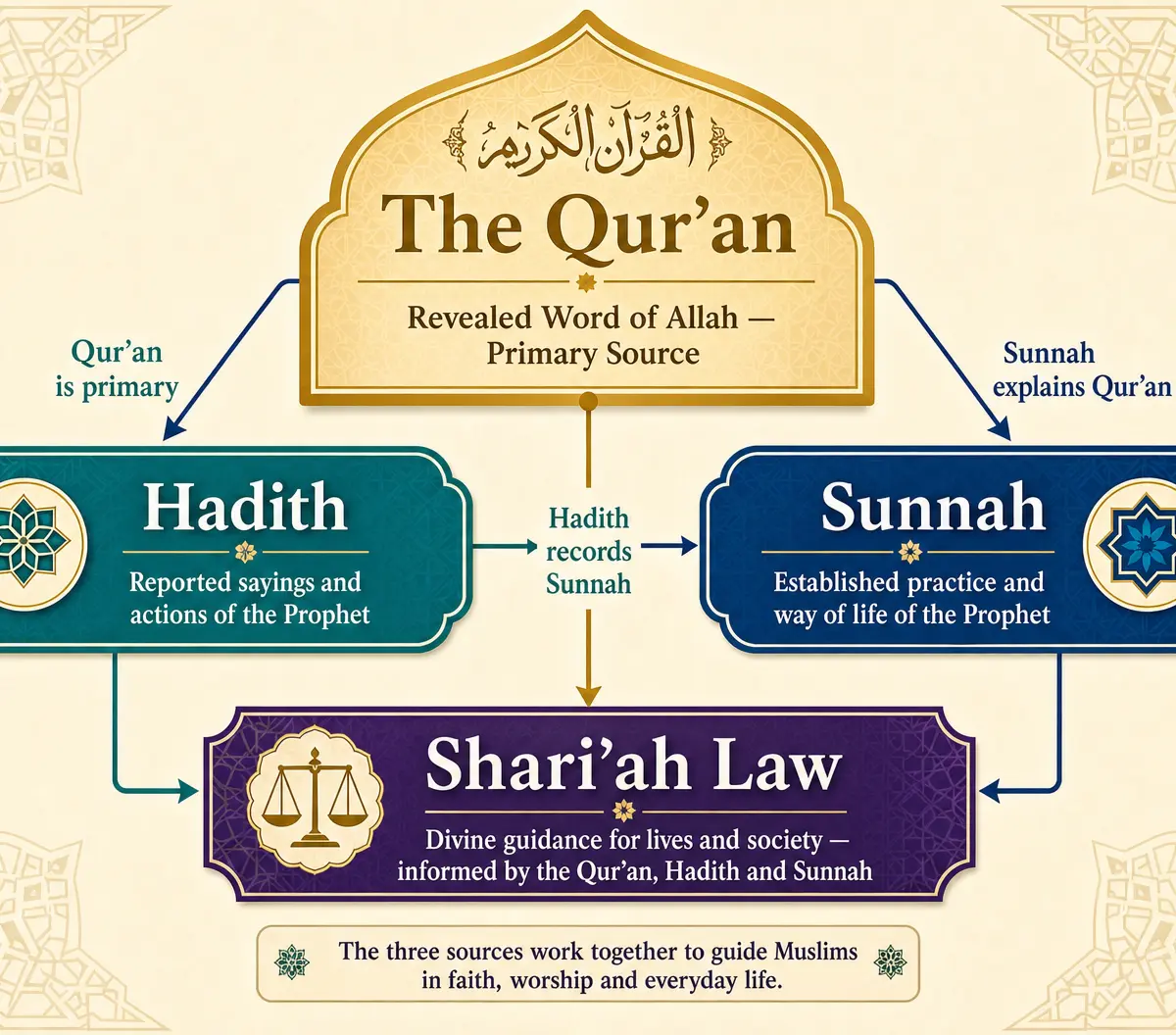
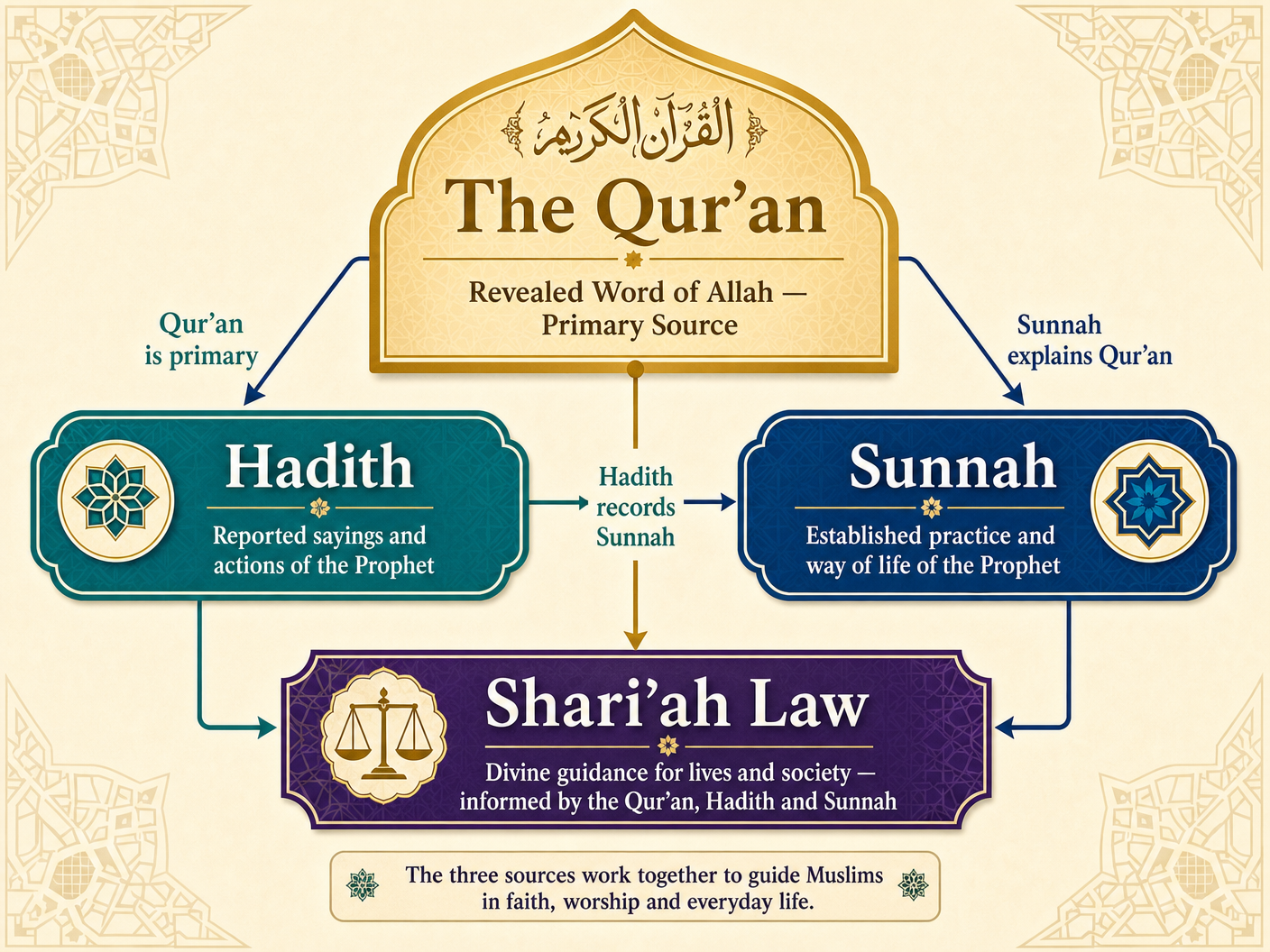
Role: The primary source of authority; the literal, uncorrupted word of Allah revealed to Muhammad.
Key Features: Contains 114 Surahs. Compiled into the definitive Uthmanic codex by the third Caliph.
Impact: It is the absolute foundation of Islamic theology and law. Surah Al-Fatiha (the Opening) summarises its core message of praise and guidance; Surah Al-Baqarah (the Cow) provides extensive legal and moral instruction.
The Sunnah and Hadith
Role: The Sunnah is the established practice of the Prophet; the Hadith are the written records of his sayings and actions.
Key Features: Hadith are verified through a chain of transmission (isnad). Compilations like Sahih al-Bukhari are highly revered by Sunni Muslims.
Impact: They provide practical context for the Qur'an. For example, the Qur'an commands Muslims to pray, but the Sunnah demonstrates how to pray.
Second-Order Concepts
Causation
Why did Islam face opposition in Makkah? The polytheistic Quraysh tribe profited immensely from the pilgrimage trade to the idol-filled Ka'bah. Muhammad's message of strict monotheism (Tawhid) and social equality threatened both their economic dominance and their ancestral traditions.
Consequence
The establishment of Shari'ah law based on the Qur'an and Sunnah created a comprehensive ethical framework governing all aspects of life, from dietary laws (halal/haram) to financial ethics (prohibition of usury) and the humane treatment of animals.
Significance
Muhammad is viewed as the 'Seal of the Prophets' (Khatam an-Nabiyyin) – the final messenger in a line including Ibrahim, Musa, and Isa. His life serves as the ultimate human example (al-Insan al-Kamil) for Muslims to emulate.
Audio Resource: Podcast
Listen to our comprehensive 10-minute revision podcast covering the core concepts, exam tips, and a quick-fire recall quiz.

Visual Resources
2 diagrams and illustrations
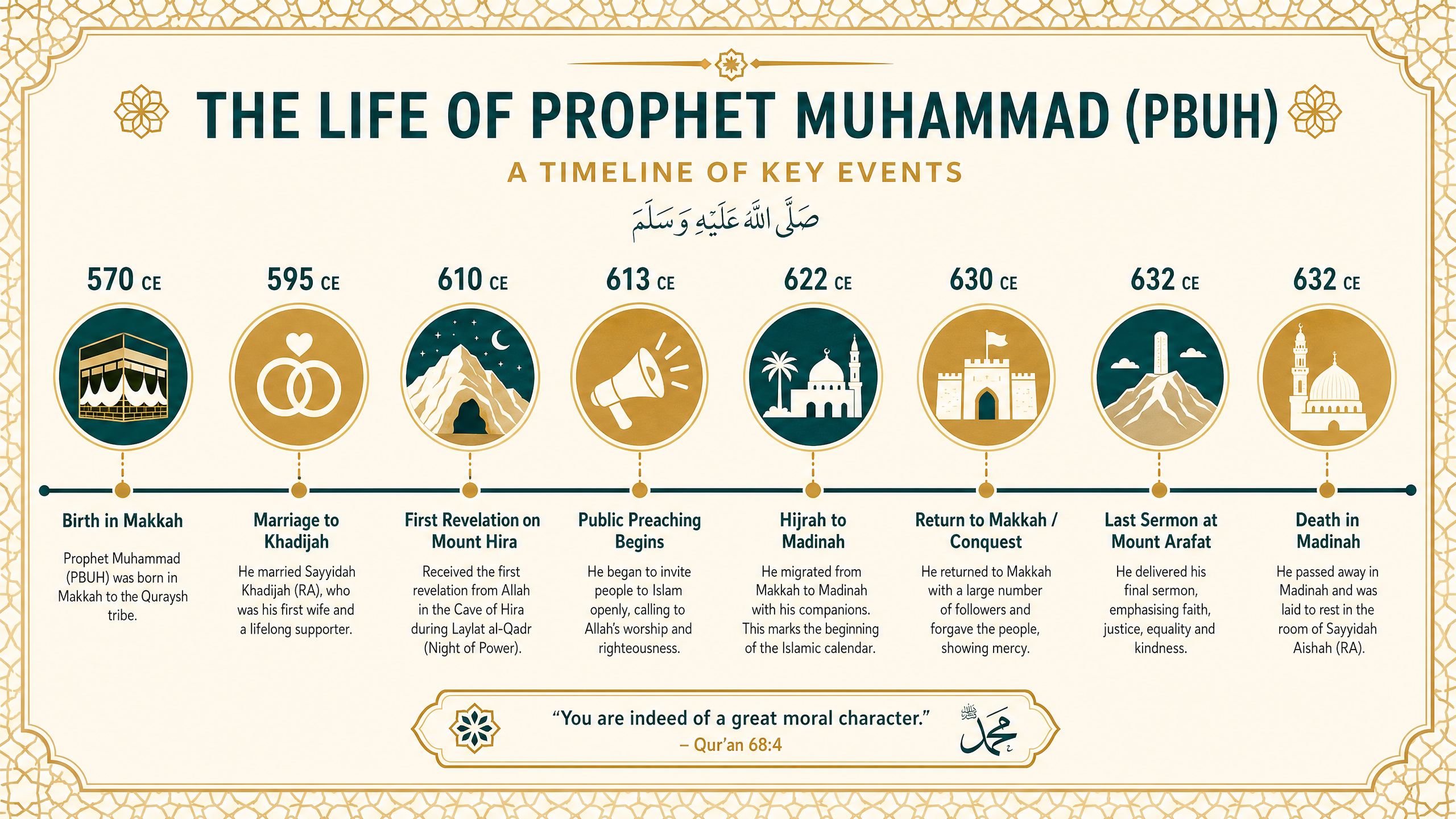
Interactive Diagrams
1 interactive diagram to visualise key concepts
Conceptual Flow Outline
Flow of Authority in Islam
Worked Examples
3 worked examples — open one to explore the question and available guidance.
Practice Questions
Test your understanding — click to reveal model answers
Explain two reasons why the Qur'an is the most important source of authority for Muslims. (4 marks)
Hint: Think about its origin (who spoke it) and its preservation.
Explain the importance of the Prophet Muhammad as an example for Muslims today. (5 marks)
Hint: Use the term 'Sunnah' and give a specific example of how his actions guide modern life.
'The Hadith is an unreliable source of authority.' Evaluate this statement. (12 marks)
Hint: Discuss the 'science of Hadith' (isnad) against the fact that they were compiled by humans.