Pearson Edexcel · A-Level · Religious Studies
Sikhism – Works of scholars: The importance of the feminine principle in Sikh thought (N K Singh and D Jakobsh)
This topic explores the profound debate on the feminine principle in Sikhism, contrasting the egalitarian, feminist teachings found in the Guru Granth Sahib with the historical marginalisation of women in Sikh practice. Mastering the perspectives of N K Singh and Doris Jakobsh will help you critically evaluate how Sikhism navigates gender, history, and religious identity.
- 6 min read
- 2 worked examples
- 3 practice questions
- 6 key terms
Study Notes
Overview
This study guide focuses on a crucial debate in Sikh theology and history: the role and significance of the feminine principle. At its core is the tension between the radical spiritual equality proclaimed by the Sikh Gurus and the patriarchal realities of historical practice. You will explore this through the works of two key scholars: Nikky-Guninder Kaur Singh (N K Singh), who argues that Sikh scripture is inherently feminist, and Doris Jakobsh (D Jakobsh), who contends that Sikh history has systematically marginalised women through "patriarchal revisionism." Examiners expect candidates to critically compare these two scholars, evaluate their methodologies (textual vs. historical), and use specific examples from the Guru Granth Sahib and Sikh history to support arguments.

Key Events & Developments
Foundation of Sikhism and Spiritual Equality
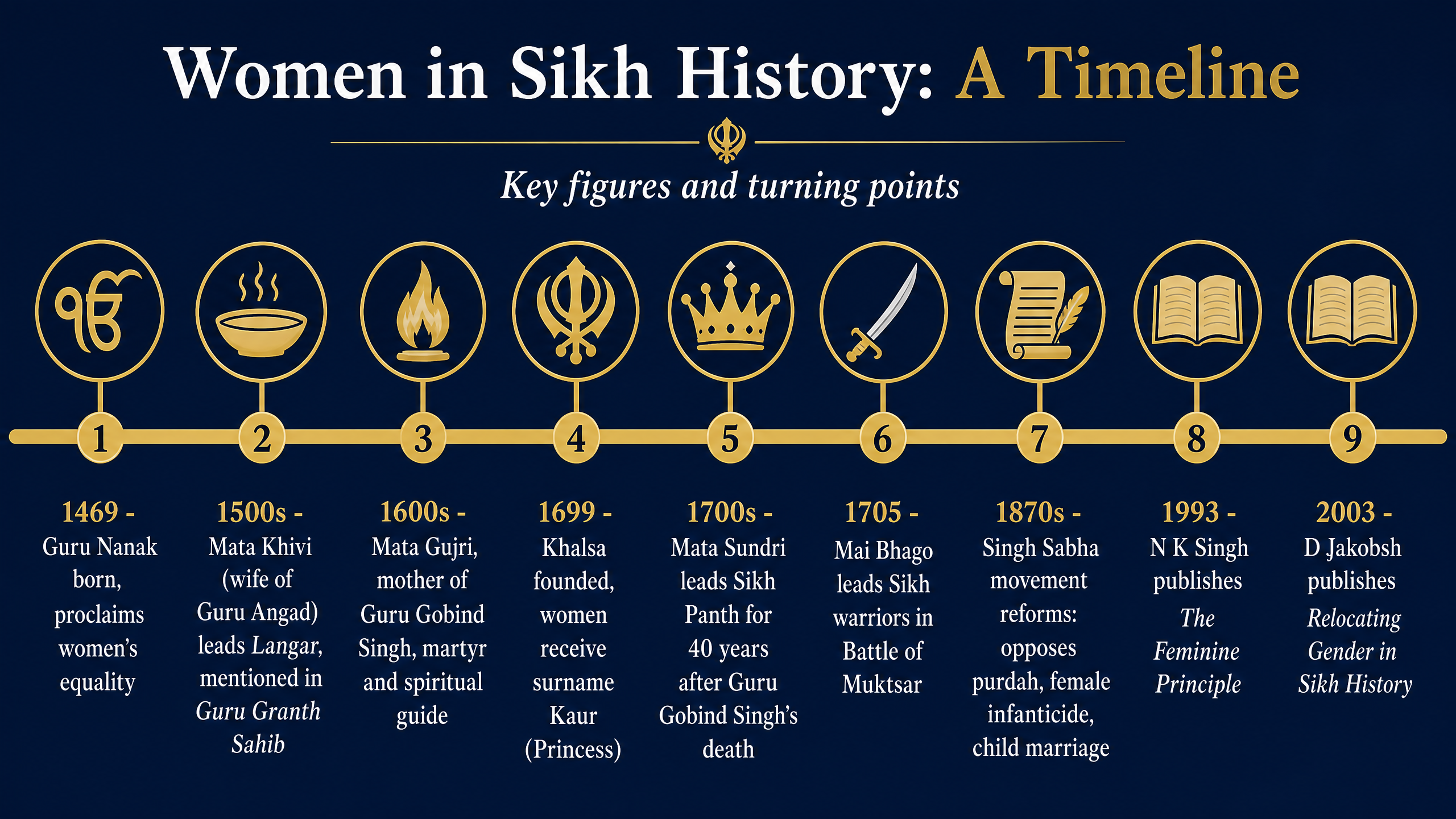
Date(s): 1469 onwards
What happened: Guru Nanak, the founder of Sikhism, rejected the prevailing social and religious norms of 15th-century India that subjugated women. He proclaimed that men and women possess equal souls and an equal right to achieve salvation. He condemned practices like female infanticide, the sati custom, and the notion of sutak (ritual impurity associated with childbirth and menstruation).
Why it matters: This forms the foundation of N K Singh's argument. It demonstrates that equality is not a modern addition to Sikhism but is embedded in its origins. Examiners will reward candidates who recognise this as a radical departure from the context of the time.
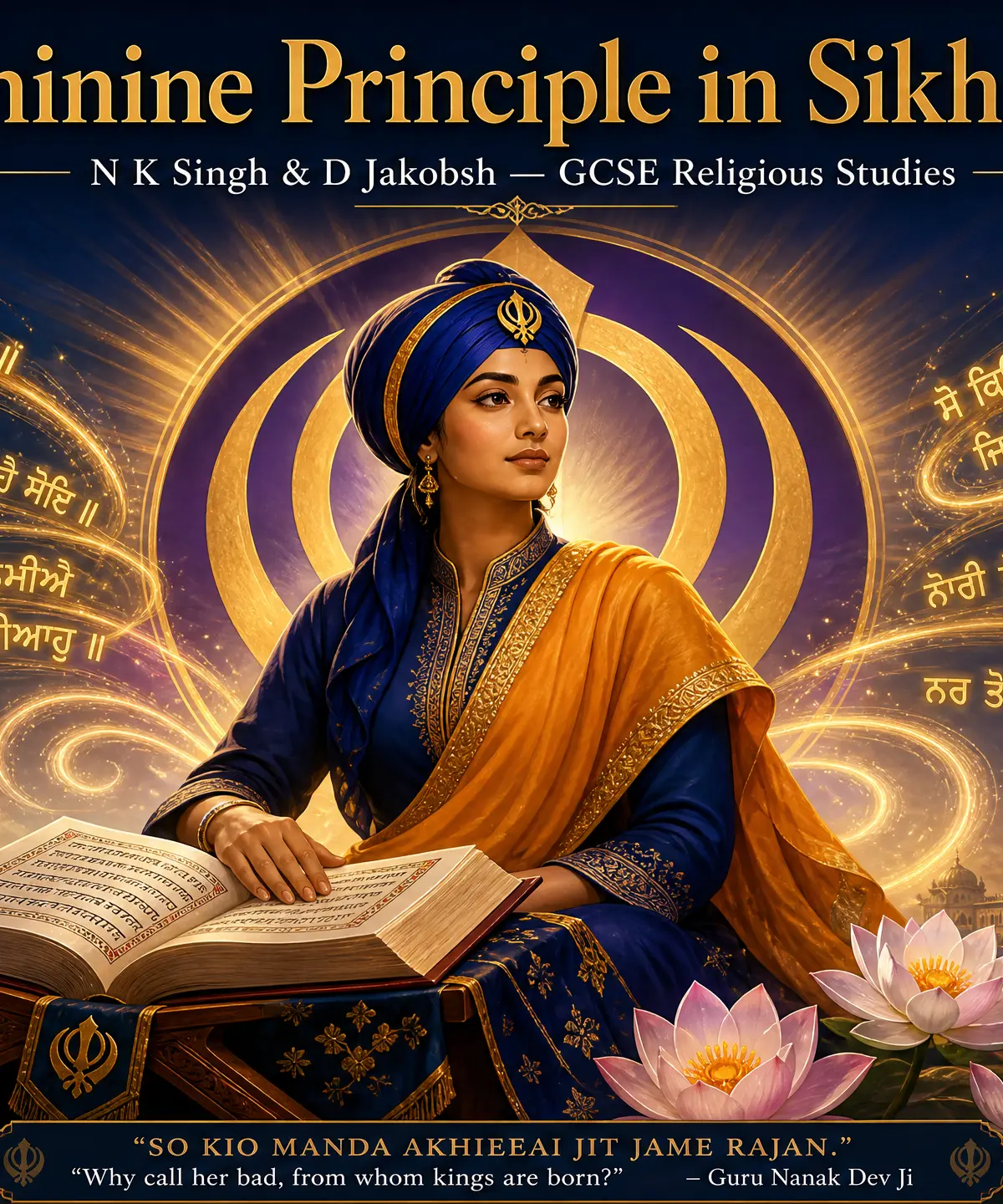
Specific Knowledge: Guru Nanak's defining statement on women: "So kio manda akhiye, jit jamme rajan" (Why call her inferior, from whom kings are born?) found on page 473 of the Guru Granth Sahib.
The Singh Sabha Movement
Date(s): 1870s onwards
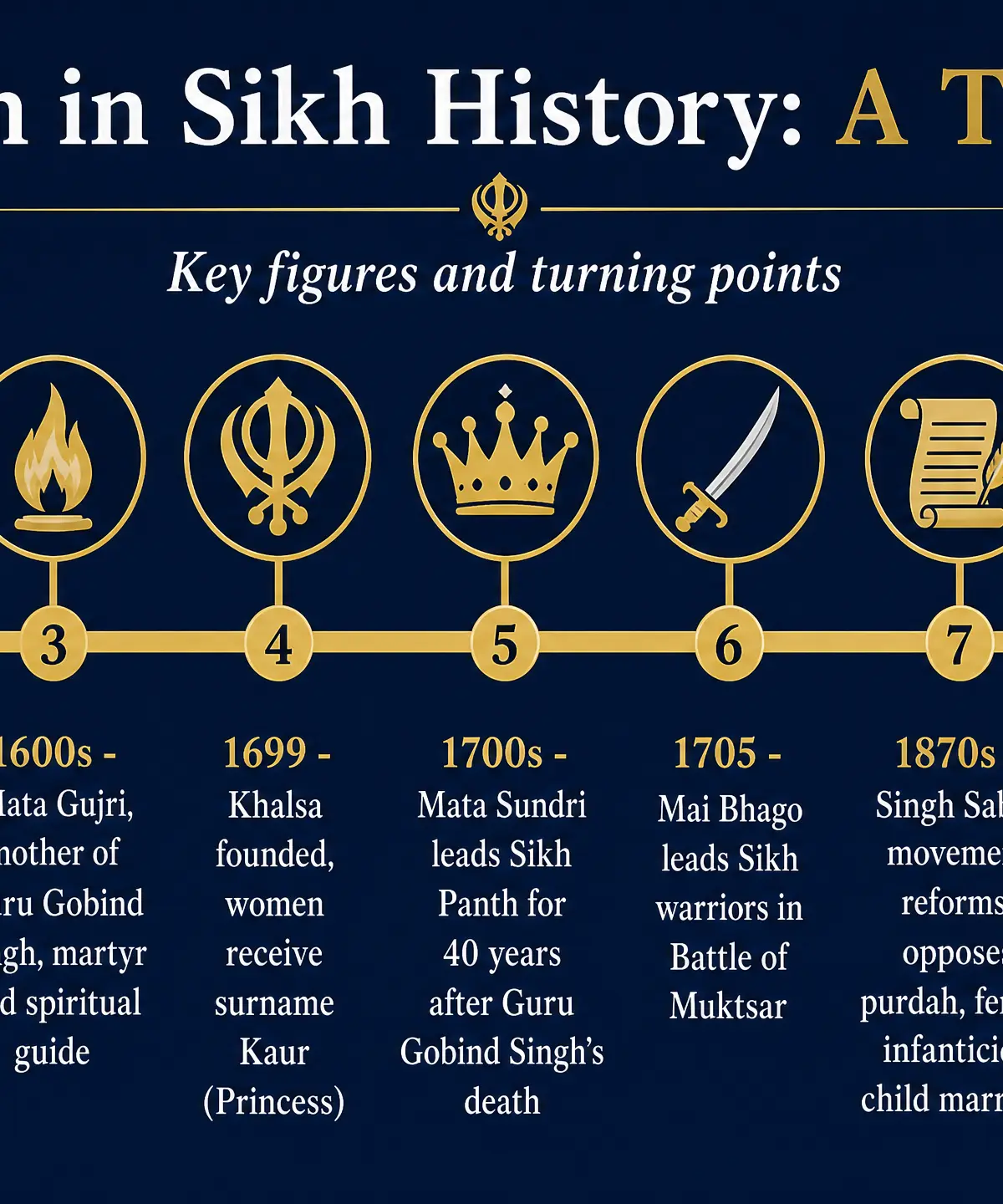
What happened: A major reform movement emerged in Punjab to revive Sikh identity in response to colonial and proselytising pressures. The movement actively campaigned against the purdah system, female infanticide, child marriage, and the poor treatment of widows.
Why it matters: This is a key event for Doris Jakobsh's analysis. While the movement promoted women's education, Jakobsh argues it also represented "accommodation"—reinterpreting Sikh tradition to fit Victorian colonial values of domesticity, rather than true egalitarianism.
Specific Knowledge: The movement established schools for girls, but Jakobsh notes it still framed women primarily as mothers and wives responsible for raising the next generation of Sikh men.
Key Individuals
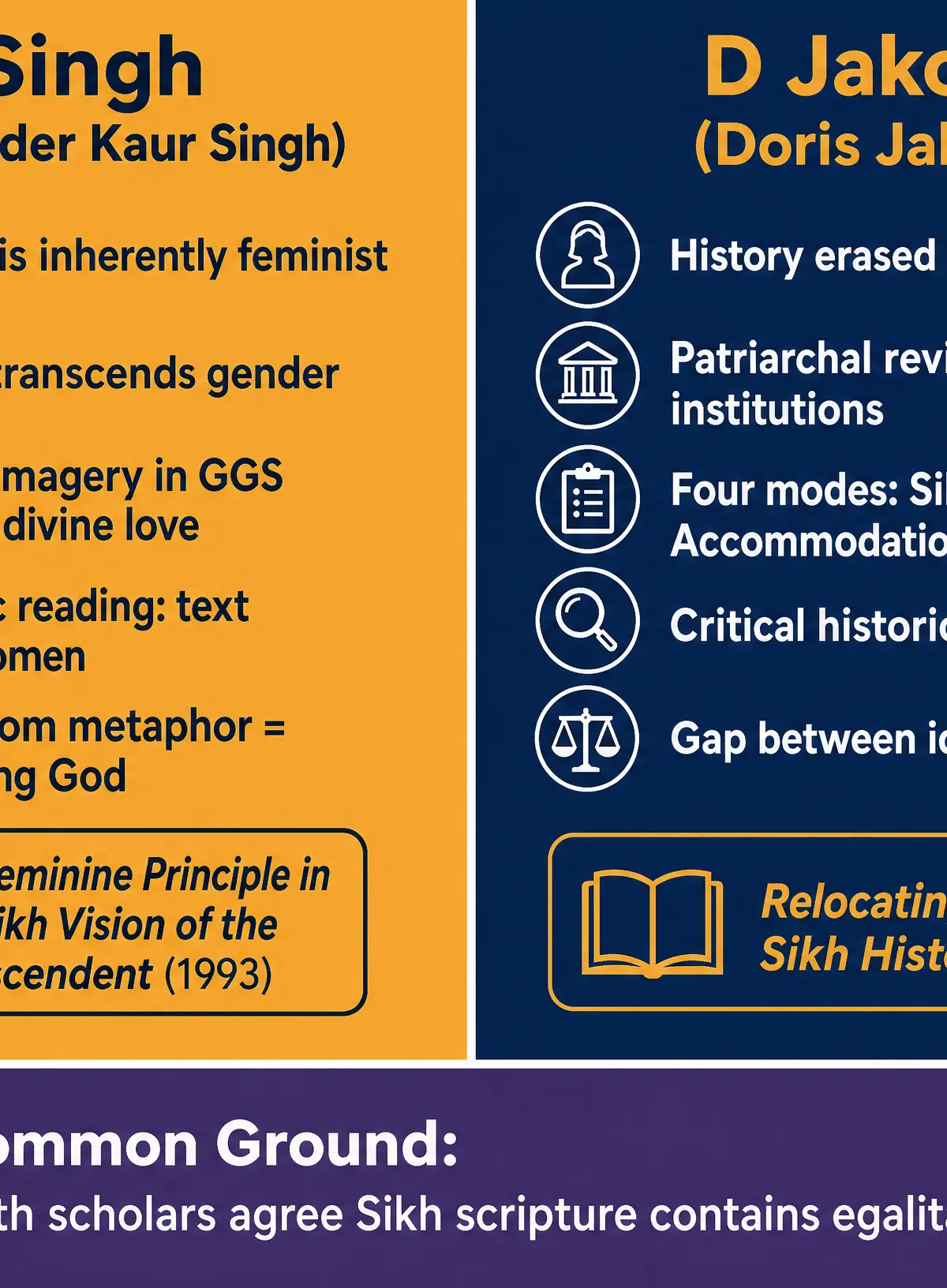
Nikky-Guninder Kaur Singh (N K Singh)
Role: Feminist Sikh scholar and author of The Feminine Principle in the Sikh Vision of the Transcendent (1993).
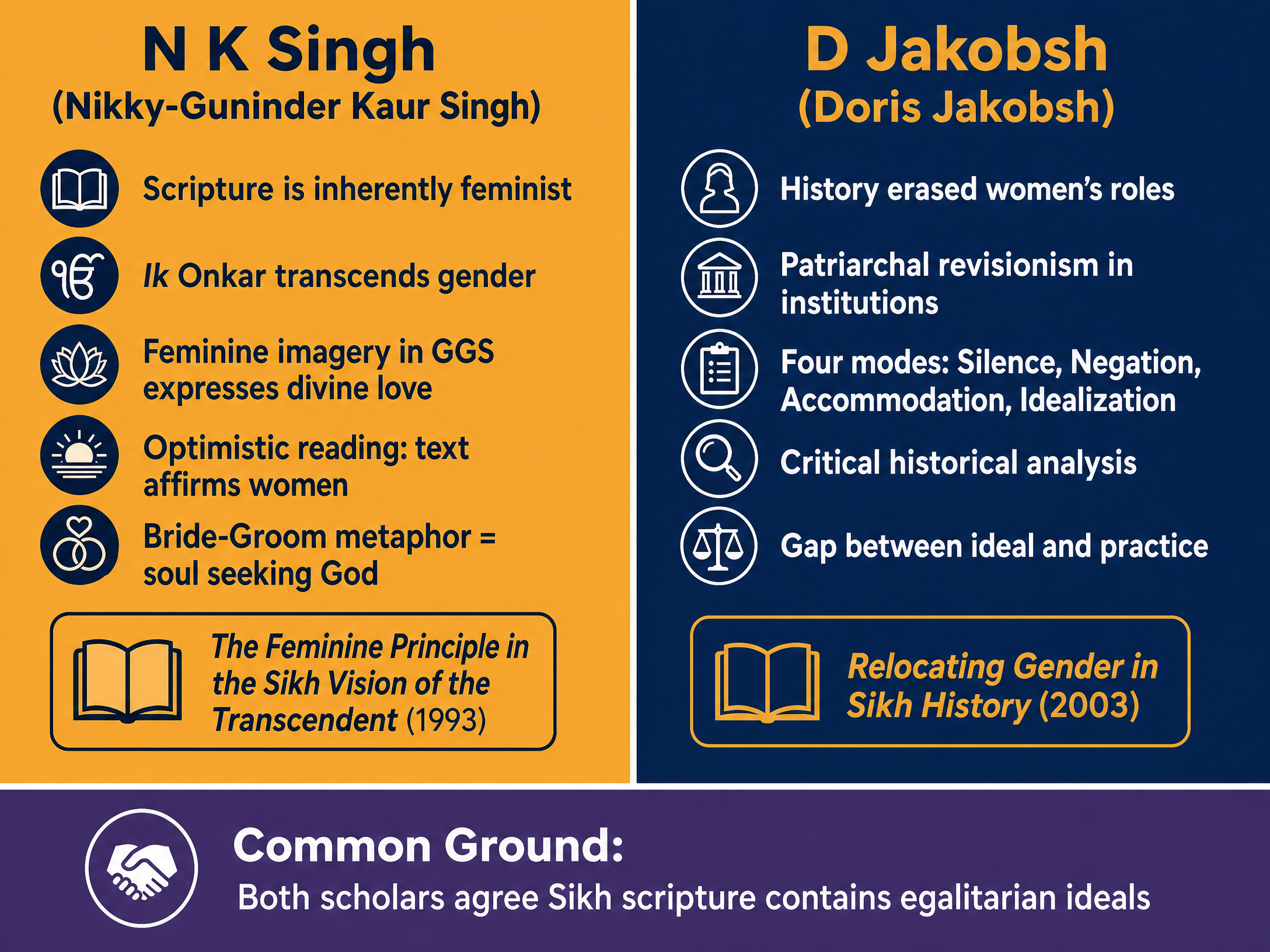
Key Actions: She conducts a "hermeneutics of retrieval," reading the Guru Granth Sahib to uncover its feminist theology. She highlights how the formless divine (Ik Onkar) is described using rich feminine imagery (Mother, Beloved) and how the human soul is universally depicted as a bride seeking the divine groom.
Impact: Singh provides the optimistic, text-based argument that Sikhism is inherently egalitarian and liberating for women.
Doris Jakobsh (D Jakobsh)
Role: Historian and author of Relocating Gender in Sikh History: Transformation, Meaning and Identity (2003).
Key Actions: She critiques mainstream Sikh history for "patriarchal revisionism." She argues that women's roles have been handled through four modes: Silence (ignoring them), Negation (writing out non-conformists), Accommodation (fitting them into patriarchal/colonial norms), and Idealisation (only celebrating exceptional warrior women).
Impact: Jakobsh provides the critical, historical counter-argument, highlighting the gap between scriptural ideals and institutional practice.
Mata Khivi
Role: Wife of Guru Angad (the second Guru).
Key Actions: She was instrumental in establishing and managing the Langar (the free community kitchen), a core Sikh institution representing equality and selfless service (sewa).
Impact: She is one of the very few women explicitly named and praised in the Guru Granth Sahib. Singh uses her to show scriptural affirmation of women; Jakobsh notes her role was still ultimately domestic.
Mata Sundri
Role: Wife of Guru Gobind Singh (the tenth Guru).
Key Actions: Following the Guru's death in 1708, she provided crucial leadership to the Sikh Panth (community) for approximately forty years during a period of intense persecution.
Impact: Jakobsh uses her as a prime example of "silence" in Sikh history—despite her immense leadership role, she is largely overlooked in traditional historical accounts compared to male figures.
Second-Order Concepts
Change & Continuity
While the scriptural ideal of gender equality (continuity) has remained unchanged since Guru Nanak, the historical reality and institutional practice (change) have fluctuated, often reflecting the patriarchal norms of the surrounding Punjabi culture or British colonial influence.
Significance
The debate between Singh and Jakobsh is highly significant because it addresses how modern Sikhs interpret their faith. It asks whether religion is defined primarily by its sacred texts (which Singh argues are feminist) or by its historical institutions (which Jakobsh argues are patriarchal).
Source Skills
When approaching texts on this topic, candidates must evaluate the methodology of the author. Is the source theological (like Singh, focusing on scripture and poetry) or historical/sociological (like Jakobsh, focusing on institutions and power dynamics)? Recognising this difference in approach is key to reaching the highest levels in evaluation questions.
Visual Resources
2 diagrams and illustrations
Interactive Diagrams
1 interactive diagram to visualise key concepts
Conceptual Flow Outline
Flowchart comparing the methodologies and conclusions of Singh and Jakobsh.
Worked Examples
2 worked examples — open one to explore the question and available guidance.
Practice Questions
Test your understanding — click to reveal model answers
Outline Doris Jakobsh's four modes of how gender is treated in Sikh history. (4 marks)
Hint: Remember the acronym S.N.A.I.
Explain how N K Singh uses the Guru Granth Sahib to argue that Sikhism is inherently feminist. (8 marks)
Hint: Discuss the nature of God, feminine imagery, and the rejection of taboos.
'The history of Sikhism shows that the religion failed to achieve gender equality.' Evaluate this statement with reference to the scholars N K Singh and D Jakobsh. (15 marks)
Hint: You must contrast Jakobsh's historical critique with Singh's theological optimism.