Pearson Edexcel · A-Level · Religious Studies
The nature and influence of religious experience
This study guide explores the nature and influence of religious experience, examining whether these profound personal encounters are genuine evidence of God or merely products of the human brain. You'll master the perspectives of key scholars like William James and Richard Swinburne, while evaluating powerful physiological and psychological challenges to secure top marks in your evaluation essays.
- 6 min read
- 3 worked examples
- 5 practice questions
- 6 key terms
Study Notes
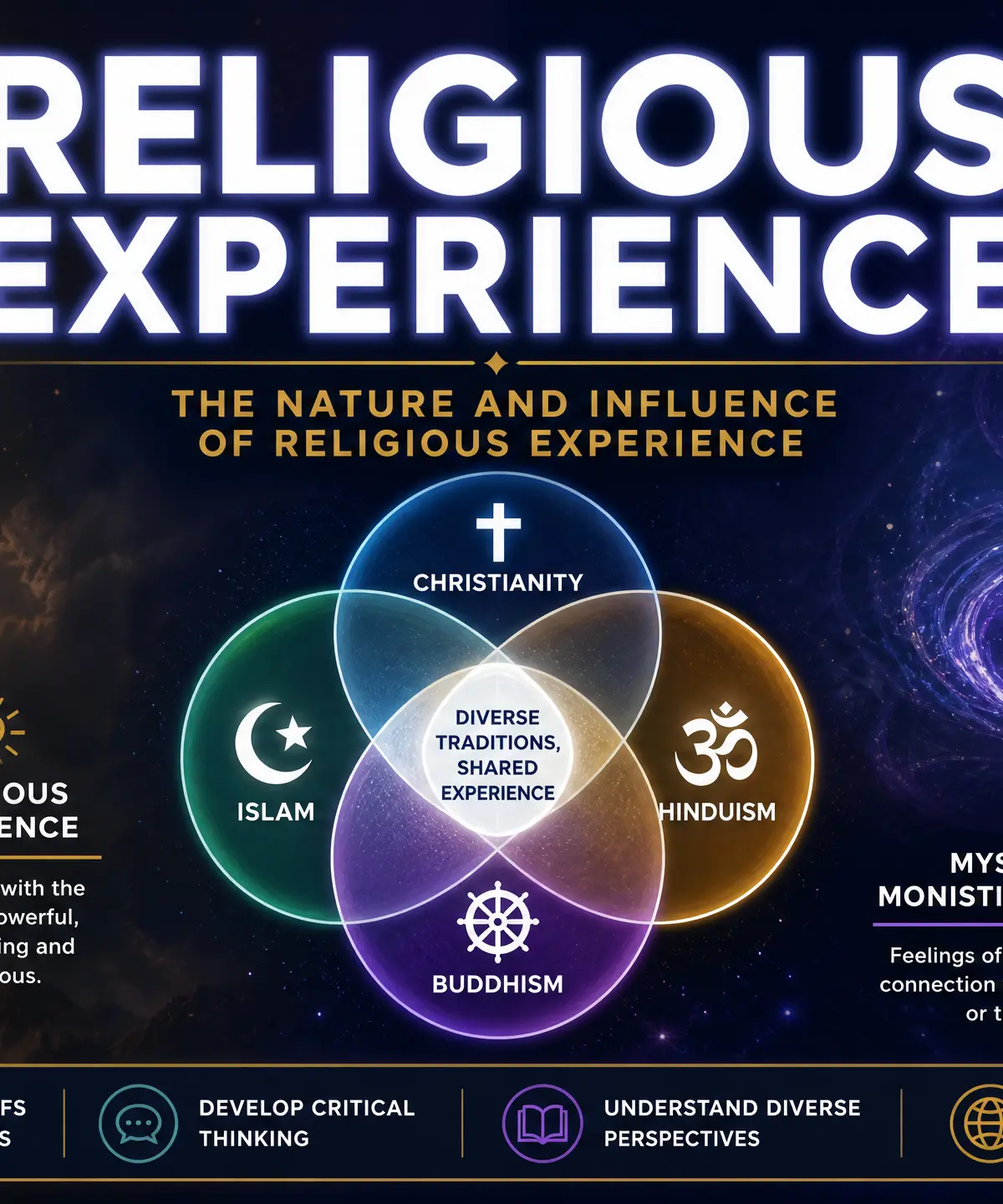
Overview
Religious experience is one of the most fascinating and philosophically rich topics on the GCSE Religious Studies specification. At its core, a religious experience is a personal, subjective encounter that a person believes to be with something divine, sacred, or transcendent. It's not just feeling moved by a beautiful sunset — it's an event that the experiencer interprets as direct contact with ultimate reality.
Examiners expect you to understand the different types of religious experience (such as conversion, mysticism, and the numinous) and to accurately distinguish between theistic and monistic interpretations. More importantly, you must be able to evaluate religious experience as an argument for the existence of God. This requires engaging with the philosophical defences offered by scholars like William James and Richard Swinburne, and weighing them against naturalistic, physiological, and psychological challenges from figures like Richard Dawkins, Michael Persinger, and Sigmund Freud.
Audio Resource
Listen to the comprehensive revision podcast for this topic:

Key Scholars & Perspectives
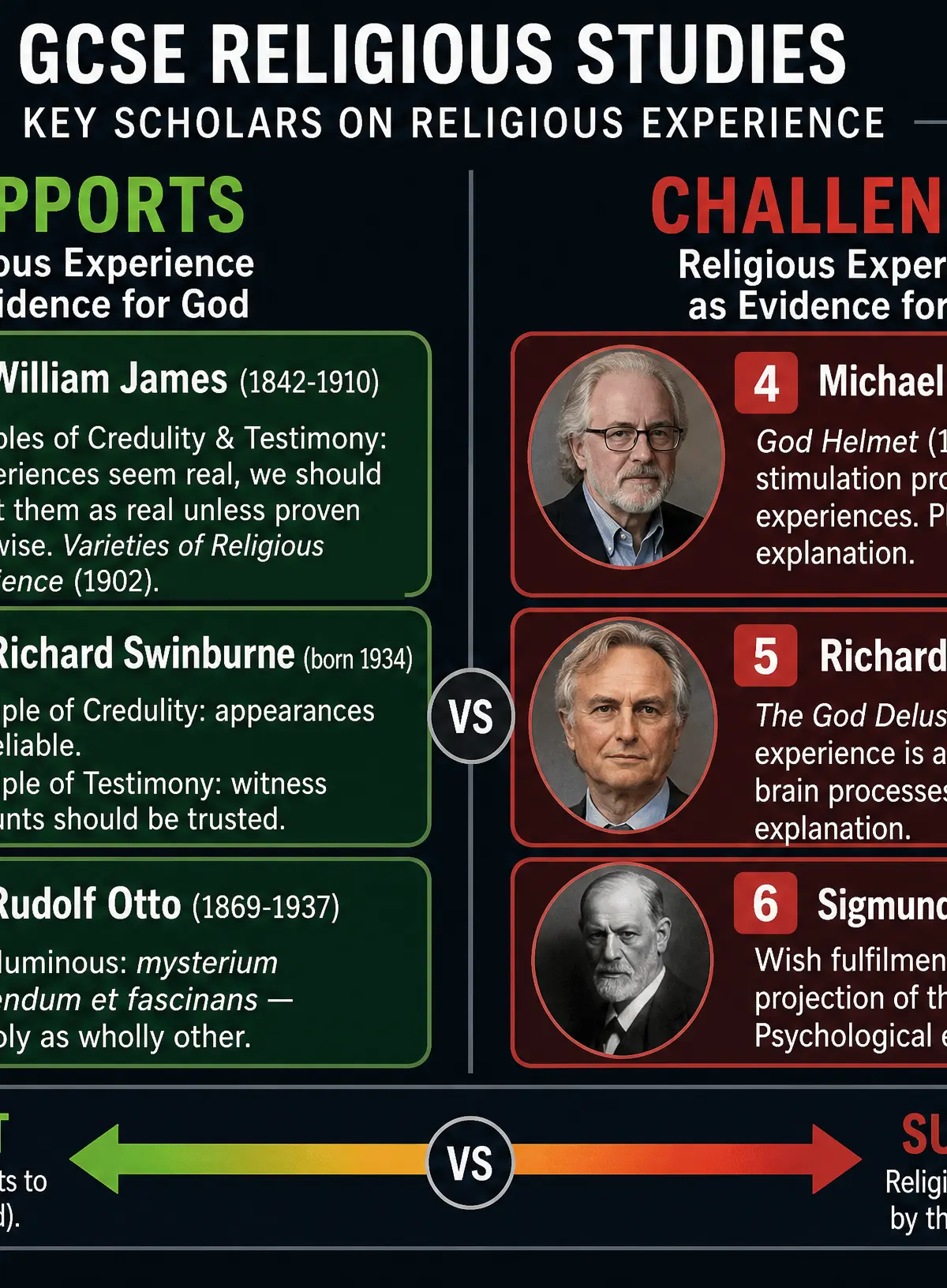
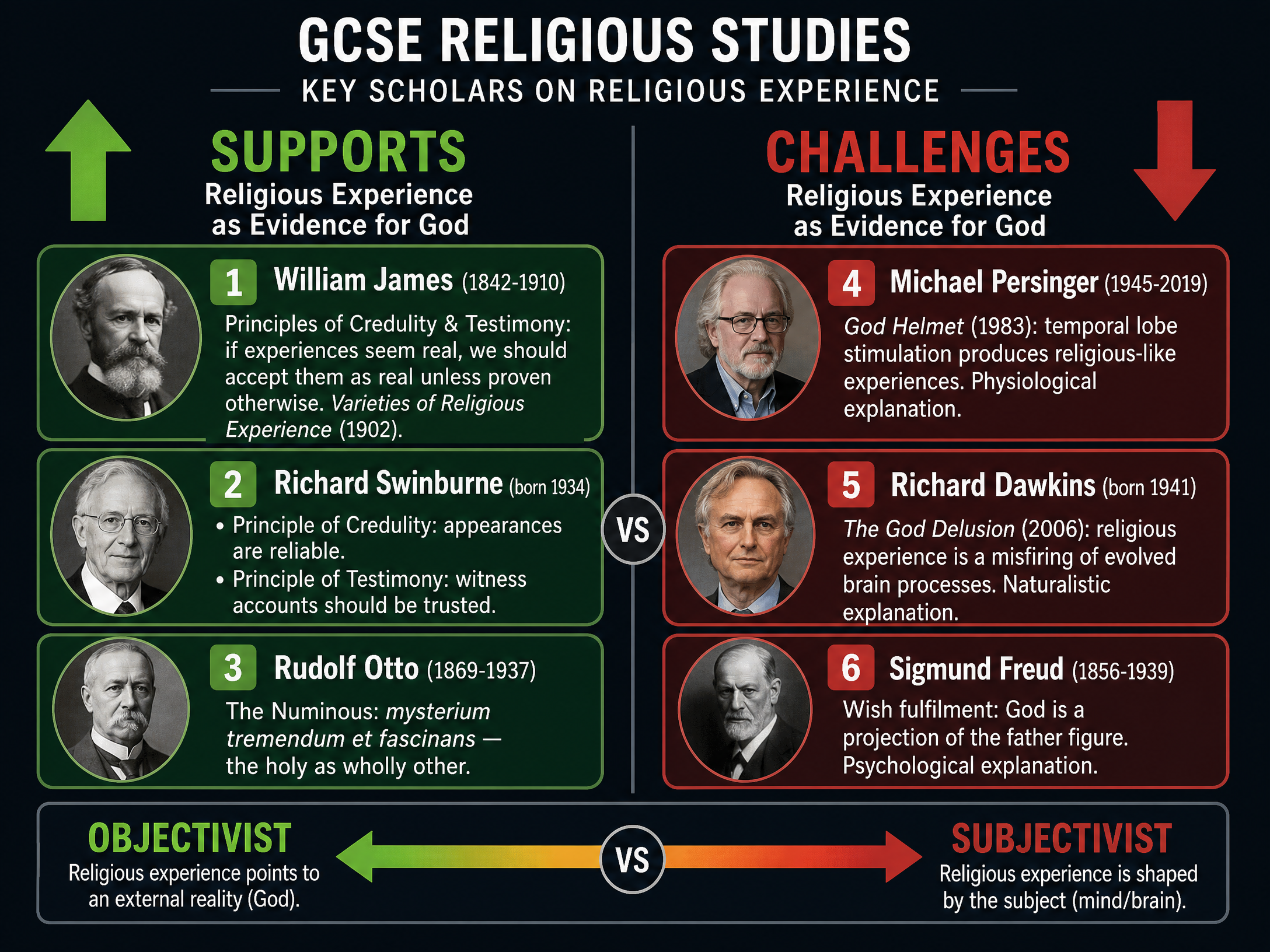
William James (1842–1910)
Role: American philosopher and psychologist; author of The Varieties of Religious Experience (1902).
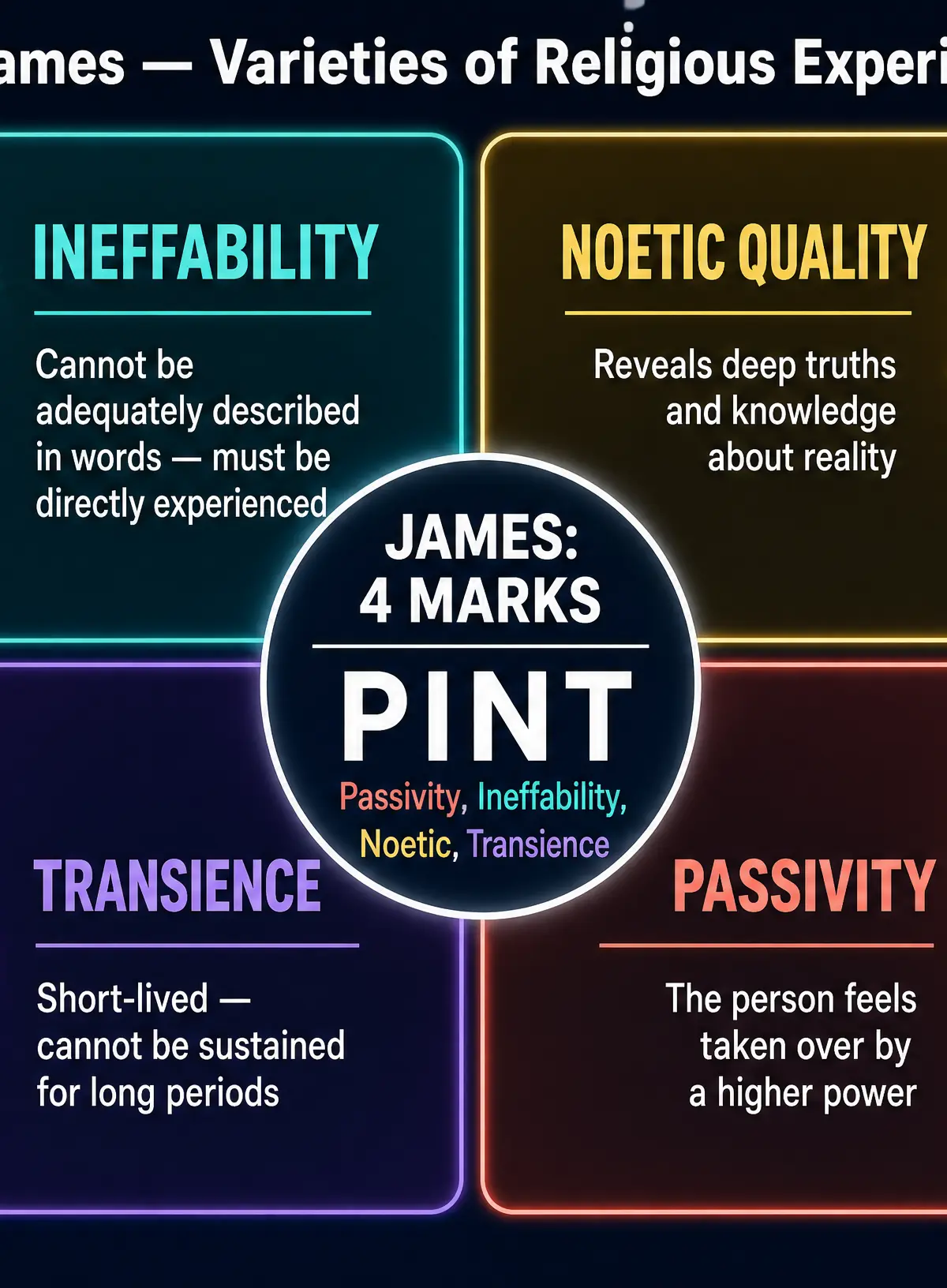
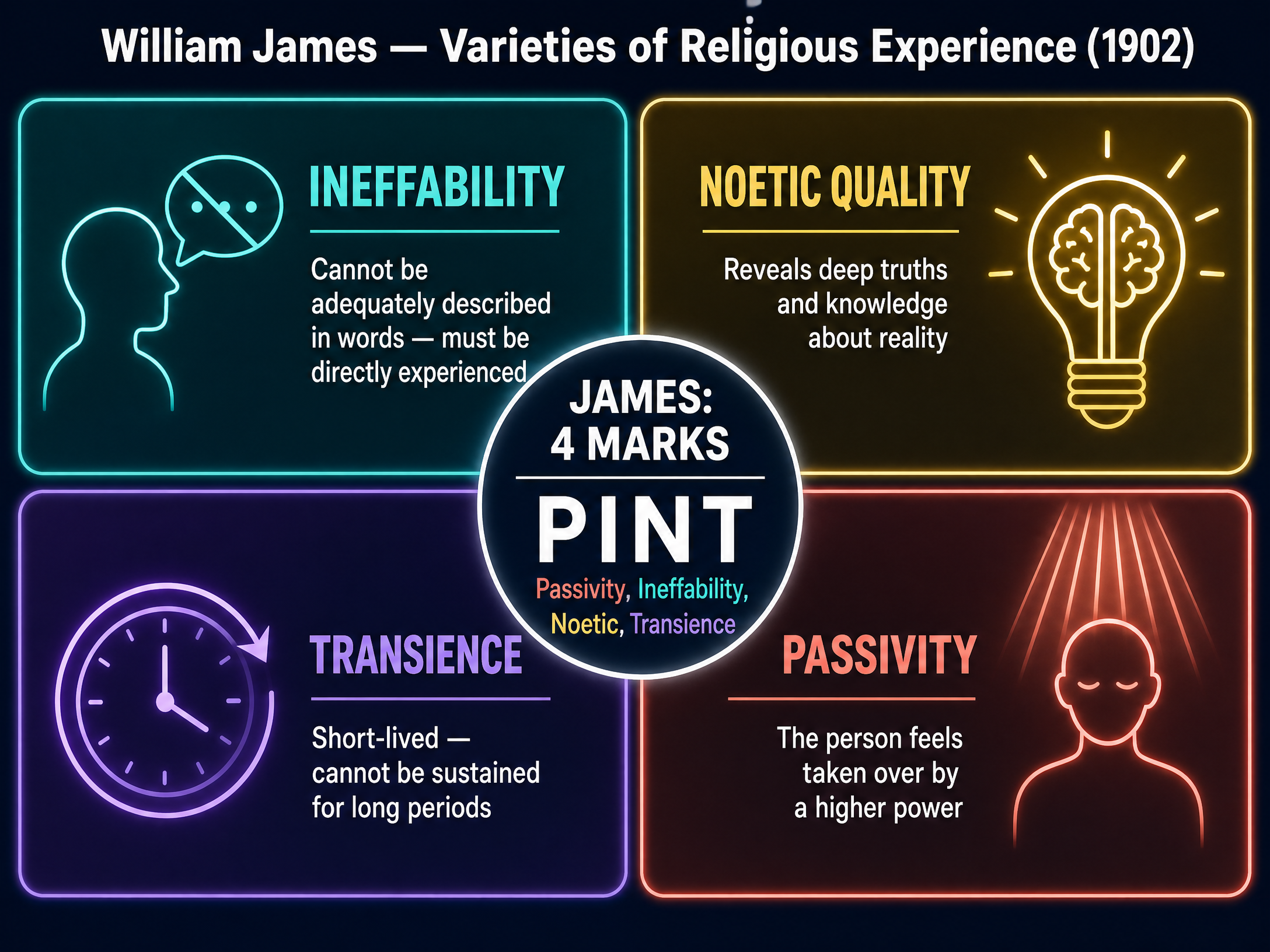
Key Ideas: James studied hundreds of first-hand accounts and identified four marks of genuine mystical experience (PINT: Passivity, Ineffability, Noetic quality, Transience).
Impact: He argued pragmatically that religious experiences should be judged by their "fruits" — if they produce positive moral changes in a person's life, they have value and should be taken seriously as evidence.
Rudolf Otto (1869–1937)
Role: German theologian; author of The Idea of the Holy (1917).
Key Ideas: Coined the term "numinous" to describe the experience of the holy as "wholly other". He famously described it as mysterium tremendum et fascinans — a mystery that is simultaneously terrifying and fascinating.
Impact: Otto's work helps explain the awe and dread often associated with encounters with the divine, distinguishing the numinous from ordinary mystical union.
Richard Swinburne (born 1934)
Role: Contemporary British philosopher of religion.
Key Ideas: Developed two crucial principles: the Principle of Credulity (how things seem is a reliable guide to how things are, unless proven otherwise) and the Principle of Testimony (we should trust what people report unless we have specific reasons not to).
Impact: Swinburne uses these principles to construct an inductive argument, suggesting the sheer volume of religious experiences makes it probable that God exists.
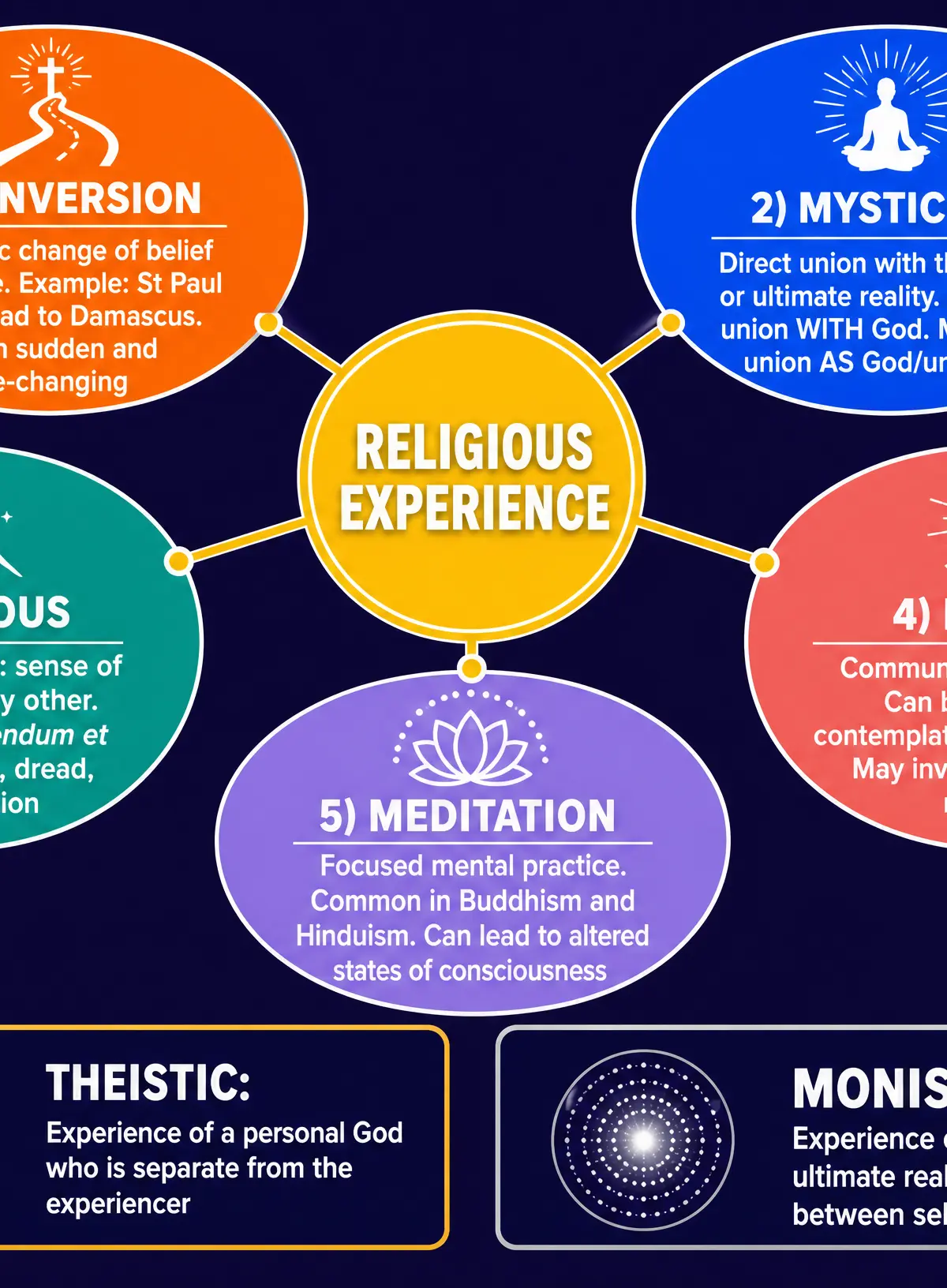
Types of Religious Experience
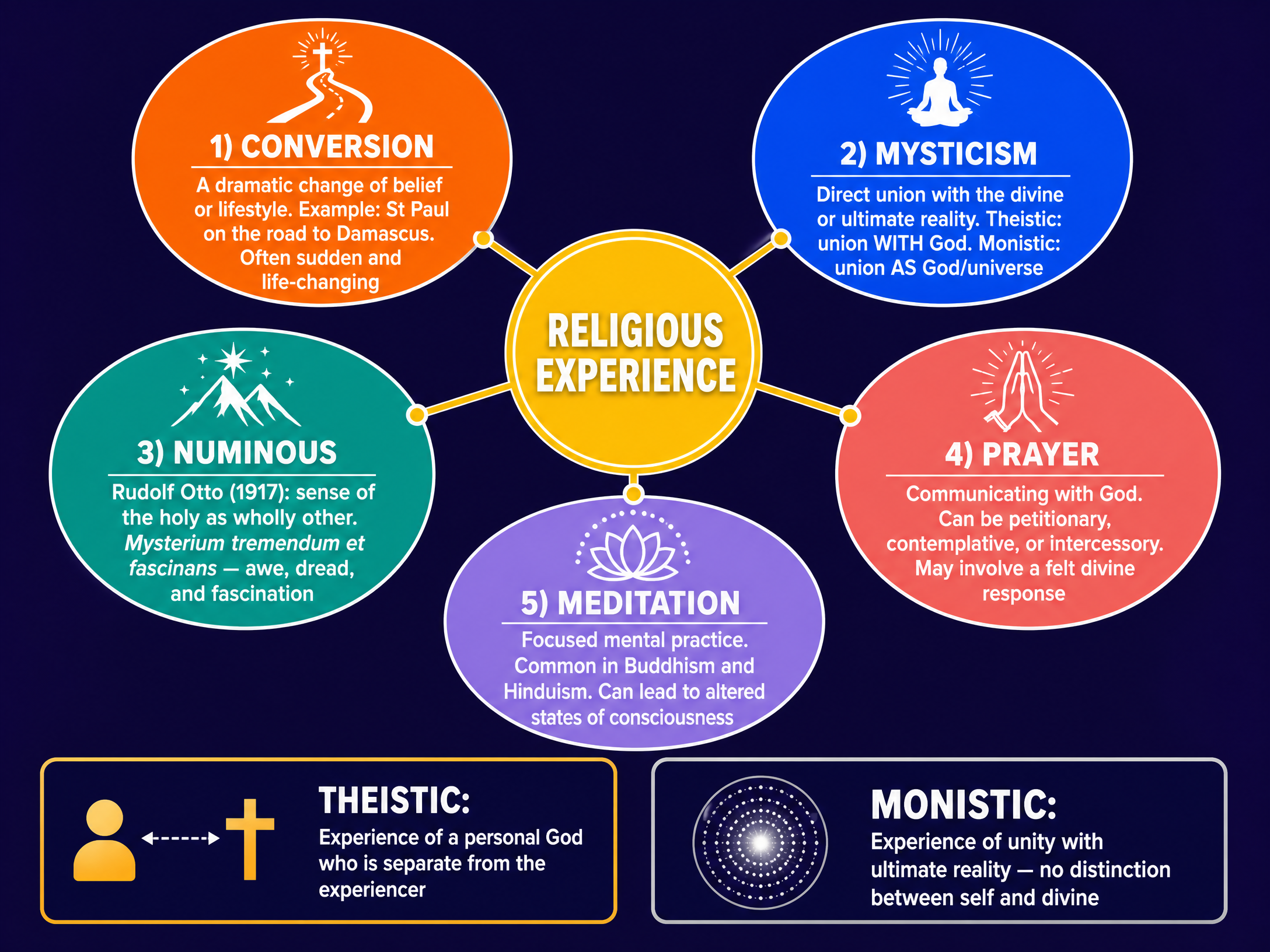
Conversion
What it is: A dramatic, often sudden change of belief or lifestyle.
Example: Saint Paul on the road to Damascus (Acts 9).
Exam Focus: Often used as strong evidence due to the visible, lasting change in the person's life (James's "fruits").
Mysticism
What it is: A sense of direct union with the divine or ultimate reality.
Distinction:
- Theistic: Union with a personal God who remains separate (e.g., St Teresa of Avila).
- Monistic: Dissolution of the self into ultimate reality; no distinction between experiencer and divine (e.g., in Advaita Vedanta Hinduism).
Numinous
What it is: An encounter with the holy as utterly other, inspiring awe and dread.
Example: Moses at the burning bush (Exodus 3) or Isaiah's vision in the Temple (Isaiah 6).
Prayer and Meditation
What it is: Prayer involves communicating with God (petitionary, intercessory, contemplative). Meditation is a disciplined mental practice common in Buddhism and Hinduism leading to altered states of consciousness.
Alternative Explanations (Challenges)
Examiners will expect you to contrast the religious interpretation with secular explanations:
Physiological (Michael Persinger)
Persinger's "God Helmet" experiment (1983) applied weak magnetic fields to the temporal lobes, inducing feelings of a "sensed presence". He argued religious experiences are merely unusual brain activity, not encounters with God.
Naturalistic (Richard Dawkins)
In The God Delusion (2006), Dawkins argues religious experience is a misfiring of evolved cognitive systems (like agent detection). It is an evolutionary by-product, not evidence of the divine.
Psychological (Sigmund Freud)
Freud argued religious experiences are a form of wish fulfilment — a projection of deep psychological needs for a protective father figure. God is a comforting illusion created by the mind.
Second-Order Concepts
Objectivist vs Subjectivist Views
Objectivist: The experience points to an external reality; God actually exists and caused the experience.
Subjectivist: The experience is entirely internal; it is generated by the subject's own mind/brain.
Propositional vs Non-Propositional Revelation
Propositional: God directly reveals specific truths or facts (e.g., the Ten Commandments).
Non-Propositional: God reveals Godself through an encounter, which the person then interprets. Religious experience is primarily non-propositional.
Visual Resources
3 diagrams and illustrations
Interactive Diagrams
1 interactive diagram to visualise key concepts
Conceptual Flow Outline
Theistic vs Monistic Interpretations
Worked Examples
3 worked examples — open one to explore the question and available guidance.
Practice Questions
Test your understanding — click to reveal model answers
Outline three types of religious experience. (3 marks)
Hint: Think of the flowchart: Conversion, Mysticism, Numinous.
Explain Richard Swinburne's philosophical defence of religious experience. (5 marks)
Hint: You must mention both the Principle of Credulity and the Principle of Testimony.
Explain the difference between theistic and monistic religious experiences. (4 marks)
Hint: Focus on the relationship between the experiencer and the divine.
'Psychological and physiological explanations prove that religious experiences are not real.' Evaluate this statement. (12 marks)
Hint: Balance Persinger and Freud against Swinburne and James.
Explain William James's pragmatic approach to evaluating religious experience. (5 marks)
Hint: Focus on the 'fruits' of the experience rather than its origins.