AQA · A-Level · Sociology
Course version: 7192 · Version from Sept 2015
Inequalities in the provision of, and access to, health care in…
Full specification wording
Health: inequalities in the provision of, and access to, health care in contemporary society
This topic explores how health care provision and access are unequally distributed in contemporary society.
Checked against the AQA 7192 specification (opens in a new tab) on .
- Point 3 of 5
- 4 key terms
Study notes
From the checked teaching notes for this specification point.
The idea
This topic explores how health care provision and access are unequally distributed in contemporary society. 'Provision' means the availability of services, highlighted by the 'inverse care law': areas with the greatest health needs, like deprived communities, often receive the poorest medical facilities and fewer GPs. 'Access' refers to the ability to utilise these services. Inequalities in access stem from cultural barriers, such as language differences among some minority ethnic groups, and material barriers, like transport costs or inflexible working hours. Analysing these disparities involves examining how social class, gender, ethnicity, and geographical location (the 'postcode lottery') shape experiences of the healthcare system.
What earns the marks
- Define the 'inverse care law' as the principle that the availability of good medical care tends to vary inversely with the need for it in the population served.
- Identify material barriers to healthcare access, such as the cost of travel to hospitals, prescription charges, or the inability to take paid time off work to attend appointments.
- Explain cultural barriers to access, including language differences, lack of health literacy, or mistrust of medical professionals among certain social groups.
- Describe the 'postcode lottery' as the geographical inequality in the provision of specific treatments or services depending on local health authority funding and priorities.
- Evaluate how intersectionality, such as the combination of working-class status and minority ethnic background, compounds inequalities in both provision and access.
Common mistakes and how to put them right
Confusing 'provision' with 'access'.
Put it right: Provision refers to the existence and funding of services in an area, whereas access refers to an individual's ability to use those existing services.
Assuming the NHS provides completely equal healthcare to all.
Put it right: Despite being free at the point of use, structural inequalities like the postcode lottery and the inverse care law mean healthcare is not experienced equally.
Blaming individuals entirely for poor access.
Put it right: Recognise that structural factors, such as inflexible working hours or lack of local transport infrastructure, create significant barriers beyond individual choice.
Exam tips
- Use the concept of the 'inverse care law' to demonstrate a theoretical understanding of structural inequalities in healthcare provision.
- When discussing access, explicitly distinguish between material barriers, like transport costs, and cultural barriers, like language.
- Apply contemporary examples, such as disparities in waiting times or access to specialist treatments across different regions, to illustrate the 'postcode lottery'.
Try the lesson
The start of the Health: inequalities in the provision of, and access to, health care in contemporary society lesson, made from checked teaching notes for this specification point.
Have a go first
Which sociological concept describes the phenomenon where the availability of good medical care tends to vary inversely with the need for it in the population served?
Listen
This topic explores how health care provision and access are unequally distributed in contemporary society. Provision' means the availability of services, highlighted by the 'inverse care law': areas with the greatest health needs, like deprived communities, often receive the poorest medical facilities and fewer GPs. 'Access' refers to the ability to utilise these services. Inequalities in access stem from cultural barriers, such as language differences among some minority ethnic groups, and material barriers, like transport costs or inflexible working hours. Analysing these disparities involves examining how social class, gender, ethnicity, and geographical location (the 'postcode lottery') shape experiences of the healthcare system. A strong answer earns marks for these points. Define the 'inverse care law' as the principle that the availability of good medical care tends to vary inversely with the need for it in the population served. Identify material barriers to healthcare access, such as the cost of travel to hospitals, prescription charges, or the inability to take paid time off work to attend appointments. Explain cultural barriers to access, including language differences, lack of health literacy, or mistrust of medical professionals among certain social groups. Describe the 'postcode lottery' as the geographical inequality in the provision of specific treatments or services depending on local health authority funding and priorities. A common slip: Confusing 'provision' with 'access'. Instead, Provision refers to the existence and funding of services in an area, whereas access refers to an individual's ability to use those existing services. Exam tip: Use the concept of the 'inverse care law' to demonstrate a theoretical understanding of structural inequalities in healthcare provision.
See it
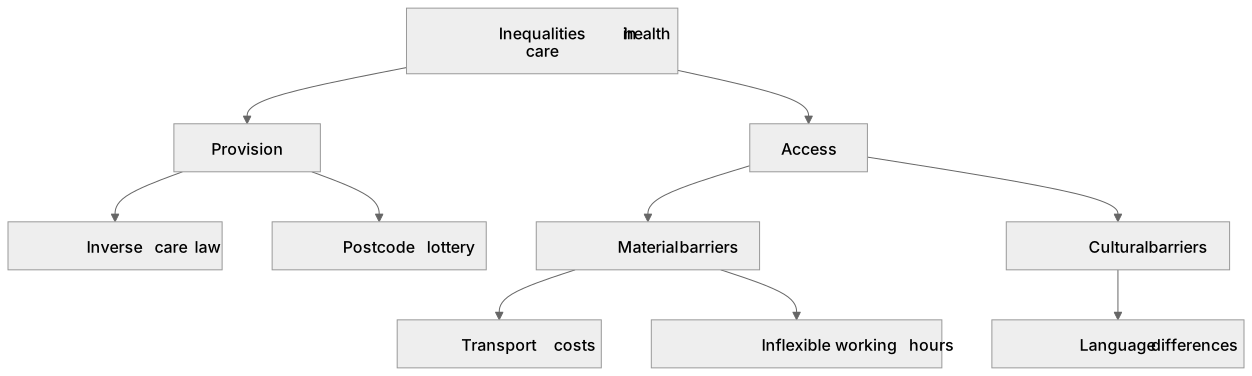
Key words
Say what each word means before you turn the card.
inverse care law
Try answering aloud or in your head before turning the card.
provision
Try answering aloud or in your head before turning the card.
access
Try answering aloud or in your head before turning the card.
postcode lottery
Try answering aloud or in your head before turning the card.
See every definition
- inverse care law
- The principle that the availability of good medical care tends to vary inversely with the need for it in the population served.
- provision
- The availability of services, which is poorest in areas with the greatest health needs, like deprived communities.
- access
- The ability to utilise services, which is limited by cultural barriers and material barriers.
- postcode lottery
- The geographical inequality in the provision of specific treatments or services depending on local health authority funding and priorities.
Label the diagram
Some boxes have lost their names. Pick the right name for each number.
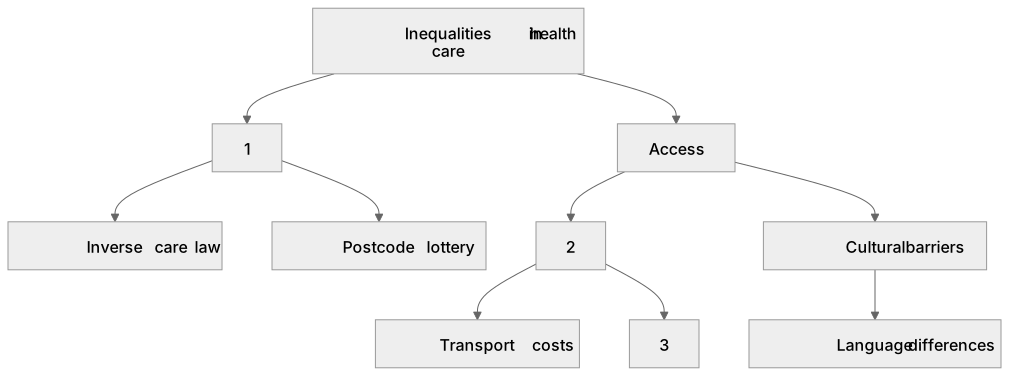
1Box 1
2Box 2
3Box 3
There is more to this lesson
The full lesson goes on to check your understanding and help you earn the marks. Create a free account to carry on, with your progress saved.
A week of Premium from your first lesson · Then the free plan continues · No card, no charge
Test your understanding of Health: inequalities in the provision of, and access to, health care in contemporary society
Active recall beats re-reading. Take an instant quiz now to test what you’ve learned and lock it into long-term memory.
A week of Premium from your first lesson · Then the free plan continues · No card, no charge