AQA · A-Level · Sociology
Course version: 7192 · Version from Sept 2015
Core themes - 4.1.3 Theory and Methods: the relationship between…
Full specification wording
Subject Content – A-level: Core themes - 4.1.3 Theory and Methods: the relationship between positivism, interpretivism and sociological methods; the nature of ‘social facts’
Positivism and interpretivism dictate the choice of sociological methods.
Checked against the AQA 7192 specification (opens in a new tab) on .
- Point 4 of 9
- 4 key terms
Study notes
From the checked teaching notes for this specification point.
The idea
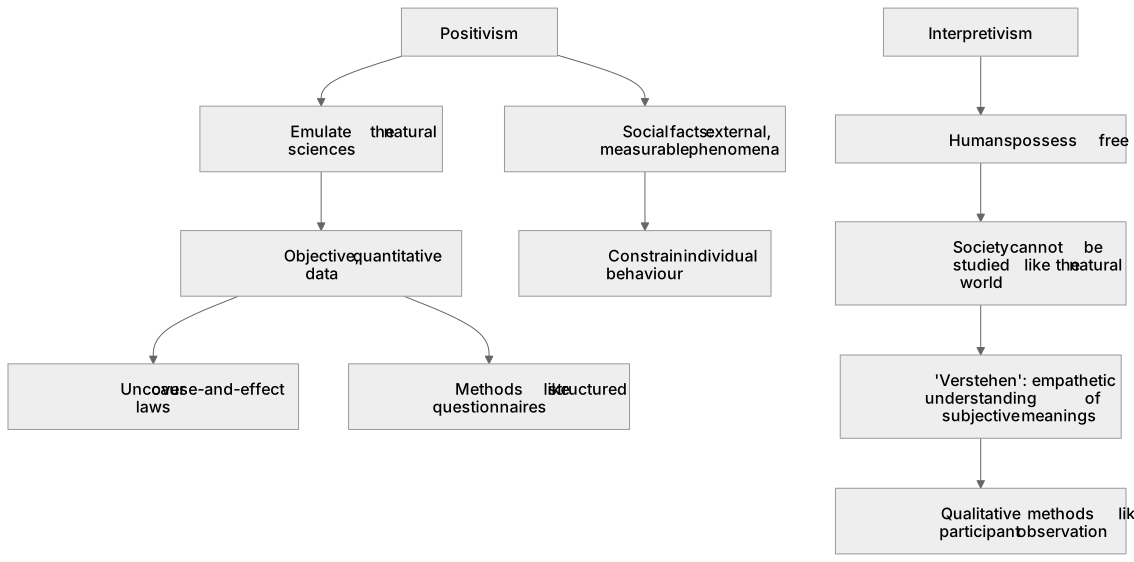
Positivism and interpretivism dictate the choice of sociological methods. Positivists argue sociology should emulate the natural sciences, seeking objective, quantitative data to uncover cause-and-effect laws. They favour methods like structured questionnaires. Central to positivism is Durkheim's concept of 'social facts'—external, measurable phenomena, such as laws or suicide rates, that constrain individual behaviour. Conversely, interpretivists argue that humans possess free will, meaning society cannot be studied like the natural world. They seek 'verstehen' (empathetic understanding) of subjective meanings, favouring qualitative methods like participant observation to uncover how individuals construct their social reality.
What earns the marks
- Identify positivism as an approach that seeks to uncover objective, scientific laws of human behaviour using quantitative methods.
- Recognise interpretivism as an approach focused on understanding the subjective meanings and motivations of individuals using qualitative methods.
- Define 'social facts' as external, measurable social structures and norms that exercise coercive power over individuals, as conceptualised by Durkheim.
- Link specific research methods to their theoretical perspectives, such as associating structured interviews with positivism and participant observation with interpretivism.
- Explain the concept of 'verstehen' as the interpretivist goal of achieving empathetic understanding of social actors.
Common mistakes and how to put them right
Confusing the preferred methods of each approach.
Put it right: Positivists prefer quantitative methods (e.g., official statistics) for reliability, while interpretivists prefer qualitative methods (e.g., unstructured interviews) for validity.
Misunderstanding 'social facts': believing social facts are merely statistical data.
Put it right: Social facts, according to Durkheim, are external social forces, institutions, and values that shape and constrain individual behaviour, which can be measured statistically.
Treating positivism and interpretivism as entirely mutually exclusive in practice.
Put it right: While theoretically distinct, many modern sociologists use triangulation, combining quantitative and qualitative methods to achieve both reliability and validity.
Exam tips
- When evaluating a research method, always explicitly link its strengths and limitations back to either positivist or interpretivist theoretical goals.
- Use Durkheim's study of suicide as a concrete example to illustrate how positivists use official statistics to identify social facts.
- Pay attention to key terminology in multiple-choice questions; words like 'reliability', 'objectivity', and 'representativeness' signal a positivist approach, whereas 'validity', 'subjectivity', and 'verstehen' signal an interpretivist approach.
Try the lesson
The start of the Subject Content – A-level: Core themes - 4.1.3 Theory and Methods: the relationship between positivism, interpretivism and sociological methods; the nature of ‘social facts’ lesson, made from checked teaching notes for this specification point.
Have a go first
According to Emile Durkheim and the positivist approach, which of the following best describes the nature of 'social facts'?
Listen
Positivism and interpretivism dictate the choice of sociological methods. Positivists argue sociology should emulate the natural sciences, seeking objective, quantitative data to uncover cause-and-effect laws. They favour methods like structured questionnaires. Central to positivism is Durkheim's concept of 'social facts'—external, measurable phenomena, such as laws or suicide rates, that constrain individual behaviour. Conversely, interpretivists argue that humans possess free will, meaning society cannot be studied like the natural world. They seek 'verstehen' (empathetic understanding) of subjective meanings, favouring qualitative methods like participant observation to uncover how individuals construct their social reality. A strong answer earns marks for these points. Identify positivism as an approach that seeks to uncover objective, scientific laws of human behaviour using quantitative methods. Recognise interpretivism as an approach focused on understanding the subjective meanings and motivations of individuals using qualitative methods. Define 'social facts' as external, measurable social structures and norms that exercise coercive power over individuals, as conceptualised by Durkheim. Link specific research methods to their theoretical perspectives, such as associating structured interviews with positivism and participant observation with interpretivism. A common slip: Confusing the preferred methods of each approach: incorrectly stating that positivists prefer qualitative methods. Instead, Positivists prefer quantitative methods (e.g., official statistics) for reliability, while interpretivists prefer qualitative methods (e.g., unstructured interviews) for validity. Exam tip: When evaluating a research method, always explicitly link its strengths and limitations back to either positivist or interpretivist theoretical goals.
See it
Key words
Say what each word means before you turn the card.
Positivism
Try answering aloud or in your head before turning the card.
Interpretivism
Try answering aloud or in your head before turning the card.
Social facts
Try answering aloud or in your head before turning the card.
Verstehen
Try answering aloud or in your head before turning the card.
See every definition
- Positivism
- An approach arguing that sociology should emulate the natural sciences, seeking objective, quantitative data to uncover cause-and-effect laws.
- Interpretivism
- An approach arguing that humans possess free will, so society cannot be studied like the natural world, favouring qualitative methods to uncover subjective meanings.
- Social facts
- External, measurable phenomena, such as laws or suicide rates, that constrain individual behaviour, as conceptualised by Durkheim.
- Verstehen
- Empathetic understanding of subjective meanings, sought by interpretivists to uncover how individuals construct their social reality.
Label the diagram
Some boxes have lost their names. Pick the right name for each number.
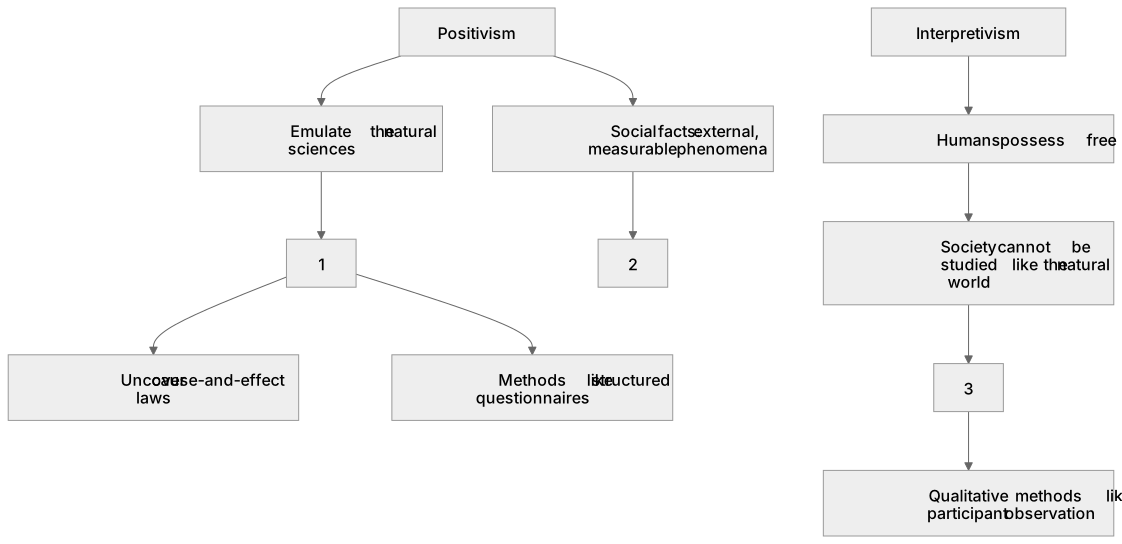
1Box 1
2Box 2
3Box 3
There is more to this lesson
The full lesson goes on to check your understanding and help you earn the marks. Create a free account to carry on, with your progress saved.
A week of Premium from your first lesson · Then the free plan continues · No card, no charge
Test your understanding of Subject Content – A-level: Core themes - 4.1.3 Theory and Methods: the relationship between positivism, interpretivism and sociological methods; the nature of ‘social facts’
Active recall beats re-reading. Take an instant quiz now to test what you’ve learned and lock it into long-term memory.
A week of Premium from your first lesson · Then the free plan continues · No card, no charge