Energy transfer during exothermic and endothermic reactions — AQA GCSE Chemistry
Energy transfer during exothermic and endothermic reactions explained
Energy transfer during exothermic and endothermic reactions covers 12 specification points, including Energy is conserved in chemical reactions.
Read the full explanation
and The amount of energy in the universe at the…. Open a point below for its explanation and revision guidance.
Energy is conserved in chemical reactions.
Energy cannot be created or destroyed, only transferred between stores. In a chemical reaction the total energy of the reactants and surroundings stays the same, but energy moves between the chemical store and the thermal store of the surroundings. In an exothermic reaction, energy is transferred from the chemical store to the surroundings, so the temperature rises; combustion of fuels is a familiar example. In an endothermic reaction, energy is transferred from the surroundings to the chemical store, so the temperature falls; thermal decomposition is an example. The conservation idea explains why a reaction that releases energy to the surroundings must have taken that energy from its reactants, and a reaction that absorbs energy must store it in its products. Use this to judge whether a statement about energy in reactions is consistent with conservation.
The amount of energy in the universe at the end of a chemical reaction is the same as before the reaction takes place.
Teach this as conservation of energy applied to a reaction. Energy is not created or destroyed; it is only transferred between the reacting system and its surroundings. Treat the universe as the reacting chemicals plus everything around them, so any energy lost by the chemicals is gained by the surroundings, and any energy gained by the chemicals comes from the surroundings. In an exothermic reaction the mixture warms and energy moves out to the surroundings; in an endothermic reaction the mixture cools and energy moves in. In both cases the total for chemicals plus surroundings is unchanged, so the energy of the universe at the end equals the energy before the reaction started. A useful check is to add the energy change of the chemicals to the energy change of the surroundings and confirm the sum is zero.
If a reaction transfers energy to the surroundings the product molecules must have less energy than the reactants, by the amount transferred.
Teach this as the energy bookkeeping of an exothermic reaction. The reactants have a certain total energy; the products have another. If the reaction transfers energy to the surroundings, that transferred amount has left the chemicals, so the products must have less energy than the reactants, and the difference equals the energy transferred. A burning fuel is a clear example: the reactants release energy that warms the surroundings, and the products end with lower energy than the reactants started with. The reverse holds for an endothermic reaction, where products have more energy than reactants because energy is taken in from the surroundings. Encourage learners to compare the energy of reactants and products and to link the gap to the direction and size of the transfer, rather than treating warming as energy appearing from nowhere.
An exothermic reaction is one that transfers energy to the surroundings so the temperature of the surroundings increases.
An exothermic reaction transfers energy from the reacting system to the surroundings, so the surroundings gain energy and their temperature rises. The key test is the direction of energy transfer and its observable effect: a thermometer placed in the surroundings, such as the air around a burning splint or the water in a neutralisation mixture, records an increase. Teach learners to reason from the surroundings, not from the reactants: energy leaves the reaction mixture and enters the surroundings, so the surroundings warm up. A common confusion is to say the reaction mixture itself gets hotter, which misstates where the temperature rise is measured. Link this to everyday examples such as burning fuel releasing heat and hand warmers warming the air, and contrast briefly with endothermic reactions that take energy in and cool the surroundings.
Exothermic reactions include combustion, many oxidation reactions and neutralisation.
Exothermic reactions transfer energy to the surroundings and warm them, and this statement names three families that behave this way. Combustion of fuels such as methane releases energy as it burns, warming the surrounding air. Many oxidation reactions release energy, for example when a metal reacts with oxygen or when magnesium burns brightly. Neutralisation, where an acid reacts with a base or alkali to form a salt and water, also transfers energy to the surroundings, so the mixture warms. Teach learners to recognise these as categories rather than a closed list: the word 'include' signals that other exothermic reactions exist. A common error is to treat every reaction involving oxygen as exothermic, so stress that the statement says many, not all, oxidation reactions.
Everyday uses of exothermic reactions include self-heating cans and hand warmers.
An exothermic reaction transfers energy to the surroundings, so the surroundings warm up. Everyday products apply this: a self-heating can holds a reaction that releases energy into the drink or food so it warms without a cooker, and a reusable hand warmer uses a crystallising or oxidising process that releases energy into the hand. In each case the reacting system loses energy and the surroundings gain it, which is why the temperature rises. To answer a multiple-choice question, identify which option describes energy being released to the surroundings and applied to warm something useful, and reject options describing energy being taken in, because those describe endothermic changes.
An endothermic reaction is one that takes in energy from the surroundings so the temperature of the surroundings decreases.
An endothermic reaction absorbs energy from its surroundings. Because energy leaves the surroundings and enters the reacting system, the surroundings cool down, so a thermometer placed nearby shows a fall in temperature. A familiar example is a cold pack used for sports injuries: the chemicals inside take in energy from the injured area, making it feel colder. In a multiple-choice question, look for the option that says energy is taken in from the surroundings and the temperature falls, and reject options saying energy is released or the surroundings get hotter, because those describe exothermic changes.
Endothermic reactions include thermal decompositions and the reaction of citric acid and sodium hydrogencarbonate.
Endothermic reactions take in energy from the surroundings, so the surroundings cool. The specification names two required examples. The first is thermal decomposition: a compound is broken down by heating, for example calcium carbonate decomposing when heated strongly. Energy must be supplied continuously for the decomposition to continue. The second is the reaction between citric acid and sodium hydrogencarbonate, which fizzes and takes in energy, cooling the mixture. Learn to classify each example as endothermic, to state that energy is taken in from the surroundings, and to distinguish these from exothermic reactions such as combustion or neutralisation, which release energy and warm the surroundings.
Some sports injury packs are based on endothermic reactions.
A sports injury pack can use an endothermic reaction to cool an injured area. When the pack is activated, for example by bending or squeezing it so that two reactants mix, the reaction takes in energy from its surroundings. Because energy is absorbed, the temperature of the pack and the surrounding tissue falls, giving a cooling effect. This is the practical application of endothermic reactions: energy is taken in from the surroundings rather than released to them. Link this to the citric acid and sodium hydrogencarbonate reaction, which is endothermic, and contrast it with exothermic reactions that would warm the area instead.
Students should be able to: distinguish between exothermic and endothermic reactions on the basis of the temperature change of the surroundings evaluate uses and applications of exothermic and endothermic reactions given appropriate information.
An exothermic reaction transfers energy from the reacting system to the surroundings, so a thermometer in the surroundings records a rise in temperature; an endothermic reaction takes energy in from the surroundings, so the surroundings cool and the reading falls. The distinction rests on the direction of temperature change of the surroundings, not on whether a reaction 'feels hot' or on the apparatus used. In an extended answer, apply this to real uses: hand warmers, self-heating cans and combustion fuels rely on energy released to the surroundings, while instant cold packs and some thermal decompositions rely on energy absorbed. Evaluate each use by linking the direction of energy transfer to the purpose, and weigh benefits such as portability or controllability against drawbacks such as cost, safety or limited duration.
Limited to measurement of temperature change. Calculation of energy changes or ΔH is not required.
This guidance defines the scope of the practical work on energy transfer: you measure temperature change with a thermometer, for example by recording the starting temperature of a solution, adding a reactant, and recording the highest or lowest temperature reached. The scope is deliberately limited to measurement; you are not required to calculate energy changes or ΔH, so do not convert temperature data into joules or enthalpy values. Read the guidance as a boundary on what will be assessed. Focus your reading and revision on choosing suitable apparatus, taking reliable readings, recording results in a table and describing the direction of temperature change, rather than on calorimetry formulae.
Required practical 4: investigate the variables that affect temperature changes in reacting solutions such as, eg acid plus metals, acid plus carbonates, neutralisations, displacement of metals.
This practical asks you to plan and carry out a fair test of how much the temperature of a reacting solution changes, then explain the pattern. Choose one reaction from the listed types, for example hydrochloric acid plus magnesium ribbon, acid plus sodium carbonate solution, acid plus alkali (neutralisation), or a more reactive metal displacing a less reactive one from its salt solution. Decide the variable you will change (such as concentration, mass of solid, or volume), the variable you will measure (temperature change), and the variables you hold constant (starting temperature, volumes, particle size). Use a polystyrene cup or insulated vessel, measure temperature with a thermometer at fixed intervals, and record results in a table before plotting a graph.
Watch and listen
Listen: Energy transfer during exothermic and endothermic reactions audio lesson
Read the full guide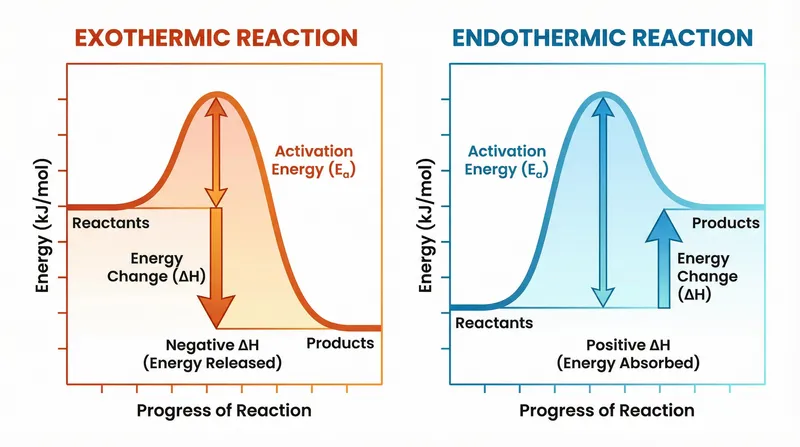
Interactive Diagrams
1 interactive diagram to visualise key concepts
Conceptual Flow Outline
Flowchart for identifying reaction types from temperature data.
Your focus
- State that energy is conserved in chemical reactions.
- Describe how energy is transferred in exothermic and endothermic reactions.
- Apply conservation of energy to explain observed temperature changes.
Show all 36 objectives
- State that the total energy of the universe is unchanged by a chemical reaction.
- Explain how energy is transferred between reacting chemicals and the surroundings in exothermic and endothermic reactions.
- Use the zero-sum energy check to judge whether a statement about a reaction is consistent with conservation of energy.
- Explain why products have less energy than reactants when a reaction transfers energy to the surroundings.
- Relate the size of the energy difference to the amount transferred.
- Contrast exothermic and endothermic energy changes using reactant and product energies.
- Define an exothermic reaction in terms of energy transfer to the surroundings
- Explain why the temperature of the surroundings increases in an exothermic reaction
- Classify a given reaction as exothermic by identifying the direction of energy transfer and the observed temperature change
- Identify combustion, many oxidation reactions and neutralisation as exothermic reactions
- Explain how each named example transfers energy to the surroundings
- Evaluate an option that presents a list of exothermic reactions as complete or as illustrative
- State that exothermic reactions transfer energy to the surroundings
- Give everyday uses of exothermic reactions including self-heating cans and hand warmers
- Distinguish exothermic from endothermic changes in a multiple-choice context
- Define an endothermic reaction as one that takes in energy from the surroundings
- Explain why the temperature of the surroundings decreases in an endothermic reaction
- Select the correct description of an endothermic change in a multiple-choice question
- Classify thermal decomposition as an endothermic reaction.
- Classify the reaction of citric acid and sodium hydrogencarbonate as endothermic.
- Explain that endothermic reactions take in energy and cool the surroundings.
- Explain how a sports injury pack uses an endothermic reaction to cool an injury.
- Describe the direction of energy transfer in an endothermic reaction.
- Distinguish endothermic cooling packs from exothermic reactions.
- Distinguish exothermic from endothermic reactions using the temperature change of the surroundings
- Explain the direction of energy transfer in each type of reaction
- Evaluate the uses and applications of exothermic and endothermic reactions using given information
- Identify that the practical work is limited to measuring temperature change
- Record starting and final temperatures accurately to find the change
- Explain that calculation of energy change or ΔH is outside the required scope
- Plan a fair test identifying independent, dependent and control variables for a reacting solution.
- Carry out the reaction safely and record temperature readings at intervals.
- Interpret the temperature change to classify the reaction as exothermic or endothermic.
Energy transfer during exothermic and endothermic reactions exam tips
Marking Points
- States that energy is conserved because it is transferred between stores rather than created or destroyed.
- Explains that exothermic reactions transfer energy from the chemical store to the surroundings.
- Explains that endothermic reactions transfer energy from the surroundings to the chemical store.
- Applies conservation to argue that total energy before and after a reaction is unchanged.
- States that energy is conserved, so the total energy of the universe is the same before and after a reaction.
- Identifies the universe as the reacting chemicals plus the surroundings, and tracks energy between them.
- Applies the idea to an exothermic reaction by showing energy transferred to the surroundings with no overall loss.
- Applies the idea to an endothermic reaction by showing energy taken in from the surroundings with no overall gain.
- Rejects the idea that a reaction creates or destroys energy, explaining that energy is only transferred.
- States that in an exothermic reaction the products have less energy than the reactants.
- Explains that the energy difference equals the amount transferred to the surroundings.
- Links the direction of energy transfer to the relative energy of reactants and products.
- Contrasts the exothermic case with an endothermic reaction, where products have more energy than reactants.
- Applies the reasoning to an example such as a burning fuel releasing energy to warm the surroundings.
- Identifies an exothermic reaction as one that transfers energy to the surroundings
- States that the temperature of the surroundings increases as a result of the energy transfer
- Recognises that the energy moves from the reaction to the surroundings rather than the reverse
- Applies the definition to a named example, such as combustion warming the surrounding air
- Distinguishes exothermic from endothermic by the direction of energy transfer and the resulting temperature change
- Names combustion as an example of an exothermic reaction
- Names many oxidation reactions as examples of exothermic reactions
- Names neutralisation as an example of an exothermic reaction
- Recognises that the list is illustrative rather than exhaustive because the statement uses the word 'include'
- Justifies a classification by linking the named reaction to energy transfer to the surroundings and a temperature rise
- Identifies that an exothermic reaction transfers energy to the surroundings
- Links self-heating cans to a reaction that releases energy and warms the contents
- Links hand warmers to a reaction or process that releases energy to warm the user
- Rejects options describing energy being taken in from the surroundings
- States that an endothermic reaction takes in energy from the surroundings
- Explains that the temperature of the surroundings decreases
- Rejects options describing energy being released to the surroundings
- Links the definition to an observable temperature fall in the surroundings
- Identifies thermal decomposition as an endothermic process that takes in energy from the surroundings.
- Recognises the reaction of citric acid and sodium hydrogencarbonate as endothermic.
- States that endothermic reactions absorb energy so the surroundings decrease in temperature.
- Distinguishes endothermic examples from exothermic reactions such as combustion that release energy.
- States that a sports injury pack uses an endothermic reaction to take in energy.
- Explains that absorbing energy lowers the temperature of the pack and cools the injured area.
- Links the cooling effect to energy transfer from the surroundings into the reaction.
- Contrasts the endothermic cooling pack with exothermic reactions that would release energy and warm the surroundings.
- States that an exothermic reaction raises the temperature of the surroundings because energy is transferred from the system to the surroundings
- States that an endothermic reaction lowers the temperature of the surroundings because energy is transferred from the surroundings to the system
- Identifies the direction of temperature change measured by a thermometer as the evidence that distinguishes the two types of reaction
- Applies the exothermic label to a named use such as a hand warmer or fuel combustion and explains that released energy warms the surroundings
- Applies the endothermic label to a named use such as an instant cold pack and explains that absorbed energy cools the surroundings
- Evaluates a use by weighing a benefit against a drawback, for example portability of a self-heating can against cost or limited heat output
- Selects one reaction type named in the practical and states the independent variable, dependent variable and at least two control variables.
- Uses an insulated vessel and a thermometer to measure the temperature of the reacting solution at stated intervals.
- Records results in a table with clear headings and units, then plots the temperature change against the independent variable.
- Explains the trend in temperature change by linking it to the energy transferred to or from the surroundings.
- Identifies whether the chosen reaction is exothermic or endothermic from the direction of the temperature change.
Examiner Tips
- 💡Use the phrase transferred between stores rather than lost or gained overall.
- 💡Match each option to either exothermic or endothermic behaviour before choosing.
- 💡Check that your chosen answer keeps total energy the same before and after the reaction.
- 💡Read the stem carefully to see whether it asks about the chemicals, the surroundings or the universe, then track energy between them.
- 💡Use the zero-sum check: energy change of chemicals plus energy change of surroundings equals zero.
- 💡Eliminate options that say energy is created, destroyed or lost, because conservation rules them out.
- 💡Compare the energy of reactants and products first, then use the direction of transfer to check your reasoning.
- 💡Remember the gap between reactant and product energy equals the energy transferred, not an arbitrary amount.
- 💡Use a familiar exothermic example to sanity-check whether the products should be lower or higher in energy.
- 💡Underline the words 'to the surroundings' and 'temperature increases' when reading the question so both parts of the definition are addressed
- 💡When an option mentions the reaction mixture getting hotter, check whether it also states the surroundings warm, and reject options that misplace the temperature change
- 💡Use a quick everyday example such as a burning splint to test each option against the idea that surroundings gain energy
- 💡Look for the word 'include' in options to judge whether a list is being presented as examples or as the complete set
- 💡Match each named reaction to the criterion of warming the surroundings before selecting an option
- 💡Reject options that claim all oxidation reactions are exothermic, since the statement specifies many
- 💡Read each option and ask whether energy is released to or taken from the surroundings
- 💡Recall that exothermic means the surroundings' temperature rises
- 💡Use the everyday examples of self-heating cans and hand warmers to anchor the definition
- 💡Check whether the option says energy is taken in and the temperature falls
- 💡Remember endothermic means surroundings cool, exothermic means surroundings warm
- 💡Use a cold pack as a mental model for an endothermic process
- 💡Read the question stem to see whether it asks for energy taken in or released before choosing.
- 💡Link each named example to a temperature change of the surroundings to justify the classification.
- 💡Keep the two required examples distinct in your notes so you can recall both under exam pressure.
- 💡Name the direction of energy transfer when explaining the cooling effect.
- 💡Use the phrase 'takes in energy from the surroundings' to show understanding of endothermic change.
- 💡Contrast the injury pack with an exothermic example to show you can distinguish the two types.
- 💡Define each term in one sentence using the direction of energy transfer, then give the matching temperature change.
- 💡For evaluation questions, name the application, state its purpose, and add one benefit and one drawback to reach the higher tariff.
- 💡Use the phrase 'temperature change of the surroundings' explicitly to show you understand what is being measured.
- 💡Read the scope statement first so you know the practical is about measurement, not calculation.
- 💡Record a starting temperature and the maximum or minimum temperature reached so the change can be found.
- 💡Describe the direction of temperature change clearly to show whether the reaction is exothermic or endothermic.
- 💡Name the exact reaction you chose and list your variables before describing the method.
- 💡State the intervals at which you measured temperature and why an insulated cup improves the result.
- 💡Use the phrase 'temperature change' with its direction (rise or fall) and link it to exothermic or endothermic behaviour.
Common Mistakes
- Claims that energy is used up or destroyed in an exothermic reaction; correct this by stating energy is transferred to the surroundings.
- States that energy is created during an endothermic reaction; correct this by stating energy is transferred from the surroundings to the chemical store.
- Confuses temperature change with energy being lost overall; correct this by explaining that the total energy is conserved even when the surroundings warm or cool.
- Claims that energy disappears during an exothermic reaction; explain instead that energy is transferred to the surroundings, keeping the total constant.
- Assumes the chemicals alone keep the same energy after reaction; state that the chemicals' energy changes while the universe total stays the same.
- Treats the surroundings as outside the accounting; include the surroundings so the total energy balances to zero overall.
- Claims the products have more energy than the reactants in an exothermic reaction; state that they have less by the amount transferred.
- Says energy is destroyed when it is transferred to the surroundings; explain that it moves to the surroundings and the gap equals that transfer.
- Treats the energy transferred as unrelated to the energy difference; state that the difference equals the amount transferred.
- Claims the reaction mixture cools while the surroundings warm without explaining the energy transfer; correct this by stating that energy leaves the reaction and enters the surroundings
- Says the reaction itself gets hotter as the definition of exothermic; correct this by locating the temperature rise in the surroundings
- Confuses exothermic with endothermic by reversing the direction of energy transfer; correct this by checking which side gains energy and warms up
- Omits the temperature increase and defines exothermic only as releasing energy; correct this by adding that the surroundings' temperature rises
- Treats every oxidation reaction as exothermic; correct this by noting the statement says many oxidation reactions, not all
- Lists combustion, oxidation and neutralisation but cannot say why they are exothermic; correct this by adding that each transfers energy to the surroundings and warms them
- Assumes the three named categories are the only exothermic reactions; correct this by reading 'include' as giving examples within a wider set
- Confuses neutralisation with an endothermic process; correct this by stating that acid reacting with alkali warms the surroundings
- Confuses exothermic with endothermic; remember exothermic releases energy so surroundings warm
- Assumes a self-heating can needs a battery or flame; the warming comes from a chemical reaction releasing energy
- Thinks the product itself gets colder; the surroundings and contents gain energy and warm up
- Says endothermic reactions release energy; correct this by stating they take in energy from the surroundings
- Claims the surroundings get hotter in an endothermic change; correct this by stating the surroundings cool down
- Mixes up the direction of energy transfer; remember energy moves from the surroundings into the reacting system
- Labels thermal decomposition as exothermic; correct this by stating that heating supplies energy that is taken in, so the reaction is endothermic.
- Assumes all reactions that need heating are exothermic; correct this by noting that supplying heat to break down a compound is energy taken in.
- Confuses the citric acid and sodium hydrogencarbonate reaction with an exothermic neutralisation; correct this by identifying it as endothermic and cooling.
- Claims the pack warms the injury; correct this by stating that an endothermic reaction takes in energy and cools the area.
- Says the reaction releases cold; correct this by explaining that energy is absorbed from the surroundings, lowering temperature.
- Describes the pack as exothermic because it feels cold to touch; correct this by linking the cold feeling to energy being taken in.
- Confuses the two types by saying an exothermic reaction cools the surroundings; correct this by linking exothermic to energy released to the surroundings and a temperature rise
- Judges reaction type from how the mixture feels rather than from the measured temperature change of the surroundings; correct this by using the thermometer reading as the evidence
- Describes energy as 'used up' or 'destroyed' in an endothermic reaction; correct this by stating that energy is transferred in from the surroundings
- Gives a use without evaluating it; correct this by stating at least one advantage and one limitation of the application
- Assumes energy change calculations are required and spends time on formulae; correct this by noting that the scope is limited to measuring temperature change
- Records only a single temperature instead of a starting and a final reading; correct this by measuring before and after the reaction
- Treats a temperature change in degrees Celsius as an energy value in joules; correct this by keeping the measurement as a temperature change only
- Changes more than one variable at once; keep all but the independent variable constant.
- Reads the thermometer without allowing it to settle or without eye level at the scale; wait for a steady reading and read at eye level.
- Describes the temperature change without linking it to energy transfer; state that a temperature rise shows energy released to the solution.