Section A: Core studies — OCR AS-Level Psychology
Section A: Core studies explained
Section A: Core studies covers 9 specification points, including Social; Key theme: Responses to people in… and Cognitive; Key theme: Memory; Classic study.
Read the full explanation
Open a point below for its explanation and revision guidance.
Area: Social; Key theme: Responses to people in authority; Classic study: Milgram (1963) Obedience; Contemporary study: Bocchiaro et al. (2012) Disobedience and whistle-blowing.
Obedience means following a direct instruction from someone perceived as legitimate authority, and this pair asks what ordinary people do when the instruction is wrong. Milgram tested forty American men who believed they were shocking a learner in a memory experiment, and found that every one continued to three hundred volts while twenty six of the forty went to the maximum, despite sweating, trembling and nervous laughter. Bocchiaro gave Dutch students the chance to comply with an unethical request, to refuse, or to report the researcher to an ethics committee, and found that roughly three quarters complied while under one in ten blew the whistle, with personality measures largely failing to predict who did what. Together they make a situational case and show that principled refusal is rarer than people expect.
Area: Cognitive; Key theme: Memory; Classic study: Loftus and Palmer (1974) Eyewitness testimony; Contemporary study: Grant et al. (1998) Context-dependent memory.
Memory is treated here as reconstructive and context-sensitive. Loftus and Palmer (1974) showed students films of traffic accidents and varied the verb in the critical question to investigate eyewitness testimony. Mean speed estimates rose from 31.8 mph (51.2 km/h) for 'contacted' to 40.5 mph (65.2 km/h) for 'smashed'. A week later, those who heard 'smashed' were more likely to report broken glass that was never in the film. Grant et al. (1998) investigated context-dependent memory by having participants read an article in silence or background noise, then tested them in matching or mismatching conditions. Scores were higher when study and test conditions matched, while noise on its own made no reliable difference.
Area: Developmental; Key theme: External influences on children’s behaviour; Classic study: Bandura et al. (1961) Transmission of aggression; Contemporary study: Chaney et al. (2004) Funhaler study.
Both investigations show behaviour being shaped by external influences. Bandura matched 72 nursery children on existing aggression, assigning them to watch an adult attack an inflatable doll, play quietly, or watch nobody. After mild frustration, they were observed for 20 minutes. Children who saw aggression reproduced the specific acts and phrases modelled; boys showed more imitative physical aggression than girls, and imitation was strongest from a same-sex model. Chaney fitted asthmatic Australian children with a Funhaler spacer carrying a whistle and a spinning disc. Parental reports showed more children medicated the previous day and more completed the recommended breathing cycles compared to a standard inhaler.
Area: Biological; Key theme: Regions of the brain; Classic study: Sperry (1968) Split brain study; Contemporary study: Casey et al. (2011) Neural correlates of delay of gratification.
Both investigations tie a psychological function to a particular part of the brain. Sperry tested eleven patients whose corpus callosum had been cut to control severe epilepsy, flashing images to one visual field for a fraction of a second while the eyes stayed fixed on a central point. A picture reaching the left hemisphere could be named, one reaching the right could not, yet the left hand could pick out the matching object by touch, and an emotional image drew a reaction the patient could not explain. Casey followed people first tested for delay of gratification as preschoolers into their forties and gave them a task requiring a response to be withheld; those who had waited poorly as children made more errors to happy faces, and scanning showed weaker inferior frontal activity with stronger ventral striatal activity.
Area: Individual differences; Key theme: Understanding disorders; Classic study: Freud (1909) Little Hans; Contemporary study: Baron-Cohen et al. (1997) Autism in adults.
The pair asks how a disorder is explained and how it is detected, and the two answers could hardly be further apart. Freud (1909) worked from letters written by the father of a five year old boy whose fear of horses began after he saw one collapse in the street, and read that fear as the boy's rivalry with a father he unconsciously wanted out of the way, displaced onto an animal. Baron-Cohen, Jolliffe, Mortimore and Robertson (1997) took the opposite route, showing adults of normal intelligence twenty five photographs of eyes and asking which of two mental state words fitted each pair. The autism and Asperger group averaged about sixteen correct against roughly twenty for both a general population group and a Tourette group, while gender judgement and basic emotion tasks showed no such gap. One study interprets a single life; the other counts a deficit across groups.
Individual studies: ‘Tell the story’ of each core study in terms of: background; method (design, sample, materials/apparatus, procedure); results; conclusions.
The board is saying that a study is remembered as a sequence rather than as a headline. The account runs from the problem the researcher inherited, through the decisions that turned it into a testable procedure, to the numbers and what those numbers licensed anyone to claim. Loftus and Palmer (1974) is the model to practise on: students watched short films of traffic accidents, were asked how fast the cars were going when they hit, smashed, collided, bumped or contacted each other, and gave mean estimates running from about forty one miles per hour for smashed down to just under thirty two for contacted, and a week later sixteen of the fifty given smashed reported broken glass that was never in the film. Every link in that chain carries marks, and the headline about leading questions carries none.
Core studies in their pairs: How the two studies are similar; How the two studies are different; To what extent the contemporary study changes our understanding of the key theme; To what extent the contemporary study changes our understanding of individual, social and cultural diversity.
The newer study in each pairing tests whether the classic claim survives a modern method, a different culture or a different measure. Milgram (1963) found that 26 of his 40 men went to the last switch on a generator marked 450 volts. Bocchiaro, Zimbardo and Van Lange (2012) gave Dutch students the further option of reporting the researcher, finding that most complied, only a small minority blew the whistle, and a separate group asked to predict their own behaviour badly overestimated their courage. Similarity and difference are key; harder marks come from arguing how far the newer evidence changes our understanding of the key theme, and what it tells us about individual, social and cultural diversity beyond male, American or student samples.
Methodological issues: The strengths and weaknesses of the different research methods and techniques; The strengths and weaknesses of different types of data; Ethical considerations; Validity; Reliability; Sampling bias; Ethnocentrism.
Each of these ideas is examined through the studies, so the reliable way to revise is to attach every issue to a study where it goes well and one where it goes badly. Piliavin, Rodin and Piliavin (1969) staged collapses on a New York subway train, which buys real behaviour from real passengers at the cost of consent and debriefing; Moray (1959) controlled his shadowing conditions precisely and paid for it with a task nobody performs outside a laboratory. Sperry (1968) worked with about a dozen people whose corpus callosum had already been cut to control epilepsy, so the sample can never be reassembled. Levine, Norenzayan and Philbrick (2001) ran the same three helping measures in large cities across twenty three countries, which is the practical answer to a measure built around one culture.
Key themes and areas of psychology: How each core study relates to its key theme; How each core study relates to the area of psychology it is placed within.
Every pairing sits under a theme, and every theme sits inside an area, so a complete answer travels down both. The social area treats behaviour as a product of the situation and of other people, which is where responses to authority and responses to people in need belong. The cognitive area treats the mind as a processor whose workings are inferred from performance, so memory and attention sit there. The developmental area asks how behaviour changes with age and experience, the biological area explains it through body and brain, and individual differences asks how and why people vary. A study earns theme marks by showing the theme in its findings, and area marks by showing that its assumptions and its method are the ones that area works with.
Watch and listen
Listen: Section A: Core studies audio lesson
Read the full guide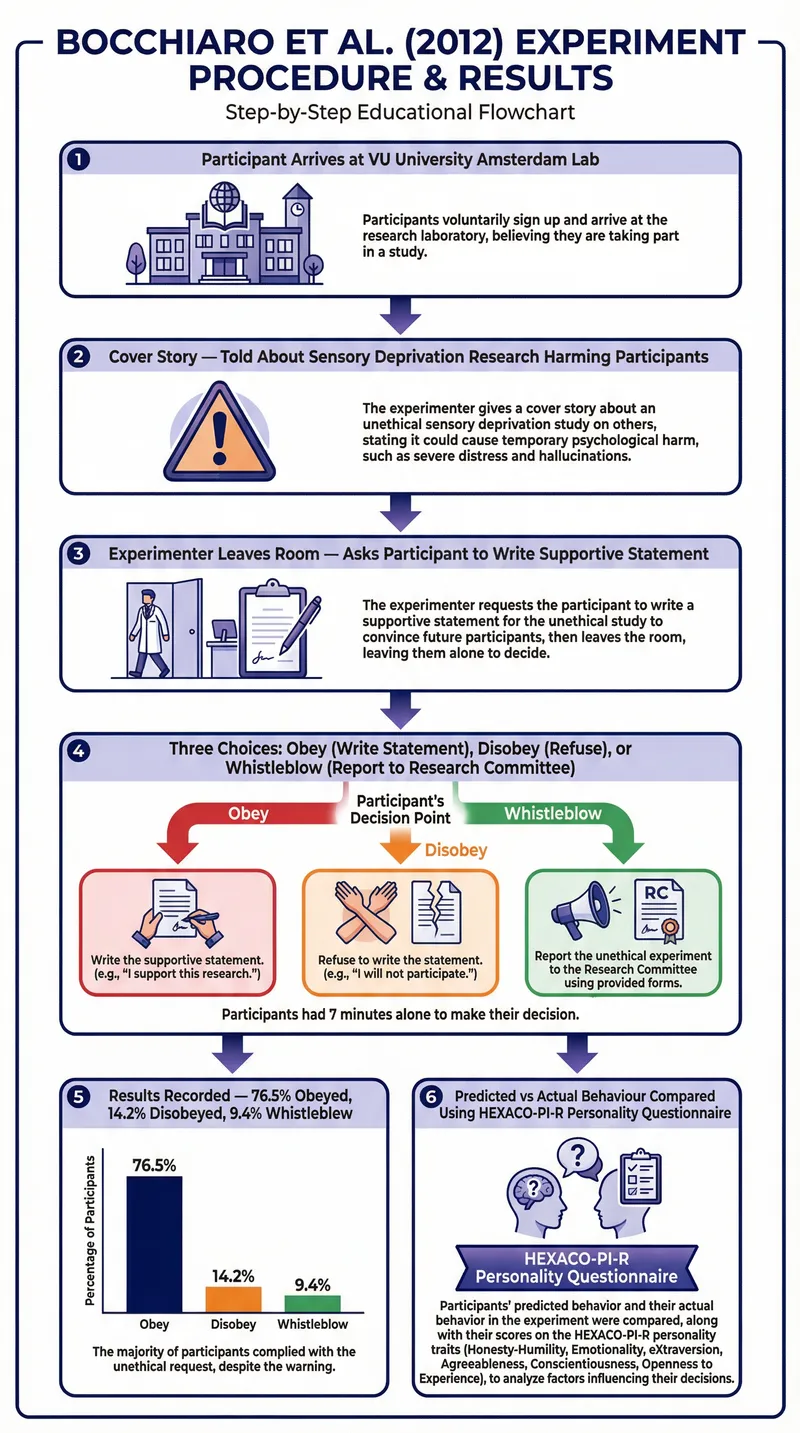
Interactive Diagrams
1 interactive diagram to visualise key concepts
Conceptual Flow Outline
Flowchart of the experimental procedure in Baron-Cohen et al. (1997).
Your focus
- Describe the procedures and headline findings of Milgram and Bocchiaro et al., including the rates of obedience, disobedience and whistle-blowing compared to initial predictions.
- Explain how both studies demonstrate situational factors in responses to authority and show that principled refusal is rarer than people expect.
- Evaluate the core studies by weighing the ethical costs of deception and psychological distress against the thoroughness of debriefing and challenges to internal validity.
Show all 27 objectives
- Describe the procedures and findings of Loftus and Palmer (1974) regarding eyewitness testimony and Grant et al. (1998) regarding context-dependent memory.
- Evaluate the core studies in terms of ecological validity, sample bias, and usefulness.
- Compare the two studies regarding their specific focus on reconstructive memory versus context-dependent memory.
- Describe the methodology and findings of Bandura et al. (1961) regarding the transmission of aggression.
- Explain how Chaney et al. (2004) applied operant conditioning to improve treatment adherence in children.
- Compare the two studies in terms of their approach to external influences on children's behaviour.
- Explain the methodological importance of the fixation point and brief exposure time in Sperry's split-brain study for isolating visual information to a single hemisphere.
- Analyse the findings of Sperry's research as evidence for the lateralisation of language to the left hemisphere and the dissociation of right hemisphere functions.
- Compare the behavioural and neural responses to 'hot' and 'cool' tasks in Casey et al.'s longitudinal study, evaluating the scan results as neural correlates rather than direct causes of delayed gratification.
- Explain how Freud interpreted Little Hans's phobia and fantasies, such as the giraffe and plumber, as evidence of unconscious rivalry and displacement rather than focusing solely on the diagnostic label.
- Compare the performance of the autism group with the control groups on the Eyes Task, gender recognition, and basic emotion tasks to identify a specific theory of mind deficit.
- Analyse how these two contrasting studies contribute to the understanding of disorders, contrasting Freud's interpretation of a single life with Baron-Cohen et al.'s measurement of a subtle deficit across groups of adults with normal intelligence.
- Explain the methodological features of each core study, detailing the experimental design, sample characteristics, materials, and procedure.
- Analyse the results of each core study by comparing specific figures and directional findings between named conditions.
- Evaluate how the conclusions of each core study address its original background aims, using specific examples such as Loftus and Palmer's research on leading questions.
- Compare classic and contemporary core studies to identify specific similarities and differences.
- Evaluate the extent to which contemporary studies change our understanding of key psychological themes.
- Assess how contemporary research informs our understanding of individual, social and cultural diversity.
- Evaluate the strengths and weaknesses of different research methods and data types by applying them to specific core studies, such as the ecological validity of field experiments versus the control of laboratory settings.
- Analyse methodological issues including internal and external reliability, validity, sampling bias, and ethnocentrism within the context of specific psychological research.
- Apply ethical considerations to core studies by linking specific ethical guidelines, such as deception and the right to withdraw, to the procedural details of the research.
- Explain how the assumptions and methodological choices of a core study place it within a specific area of psychology, such as the biological or cognitive area.
- Analyse how the specific findings of a core study illustrate its designated key theme, using examples such as brain plasticity or responses to people in need.
- Evaluate studies that can be placed in multiple areas of psychology by identifying the distinct principles and findings that connect them to each respective area and key theme.
Section A: Core studies flashcards
Card 1 of 12
Understanding disorders
Section A: Core studies exam tips
Marking Points
- Name the procedure precisely: the participant read word pairs and pressed switches labelled from fifteen volts to four hundred and fifty, and was kept going by four standardised prods, the last insisting there was no other choice but to continue.
- Quote the headline result with its comparison, that sixty five per cent went to the maximum when psychiatrists and students had predicted almost nobody would.
- For Bocchiaro, credit the three outcome categories of obedience, disobedience and whistle blowing, and the finding that a separate comparison group grossly underestimated how many would comply.
- Evaluation marks come from naming the ethical costs, deception, a compromised right to withdraw and psychological distress, and then weighing them against the thorough debriefing and the follow up in which most participants said they were glad to have taken part.
- Evaluation credit is available for a named critique, Baumrind (1964) arguing that the distress inflicted was not justified by what was learned, and Orne and Holland (1968) arguing that participants in a laboratory may not have believed the shocks were real, which is a challenge to internal validity rather than to ethics.
- For Loftus and Palmer (1974), name the five verbs (smashed, collided, bumped, hit, contacted) and state that estimates fell in that order, providing evidence that wording shaped the eyewitness testimony.
- For the second experiment, credit the delayed broken glass question as the crucial measure, because it probes memory a week later rather than an immediate guess, supporting reconstruction over response bias.
- Describe the context design of Grant et al. (1998) accurately as an independent measures study where the environment at learning (silent or noisy) was crossed with the environment at testing, reporting the significant effect of matching on context-dependent memory.
- Application marks come from turning the context finding into advice, such as revising in silent conditions resembling the examination room to support recall.
- Naming contrasting evidence earns evaluation credit, such as Yuille and Cutshall (1986) finding witnesses to a real shooting resisted leading questions, or Godden and Baddeley (1975) finding context effects in divers.
- Name the three model conditions and the deliberate mild aggression arousal, because frustrating every child equally is what makes the comparison between conditions fair.
- Distinguish imitative aggression, such as the exact mallet blows and phrases copied from the adult, from non-imitative aggression, which is the measure showing more than simple copying.
- For the inhaler research, credit positive reinforcement by name and explain the mechanism: the whistle and spinner reward a slow deep breath, which raises adherence to the treatment.
- Quote the adherence outcome as a comparison between the incentive device and the ordinary spacer over successive weeks in the same families, rather than as a single percentage floating free.
- Explain why the fixation point and the very brief exposure matter, since an image shown for a fraction of a second cannot be captured by an eye movement and so reaches only one hemisphere.
- Report the split brain findings as a dissociation, that the right hemisphere can recognise and select but cannot speak, which is evidence for language being lateralised to the left.
- For the follow up research, distinguish the cool task using neutral faces from the hot task using happy and fearful faces, because the group difference emerges only when the cue is emotionally attractive.
- Credit the scan result as a correlate, that differences in frontal control and reward regions accompany the behavioural difference rather than being shown to cause it.
- Credit for Freud comes from the evidence and not the label, so write that Hans feared a white horse with a black muzzle and blinkers would bite him, and that Freud read the muzzle and the blinkers as his father's moustache and glasses.
- Name the fantasies and what each was taken to show, for example the giraffe fantasy read as taking the mother from the father, and the plumber fantasy read as identification once Hans imagines being given a larger widdler.
- For the Eyes Task the mark is in the comparison: the autism group scored lower than both other groups on mental state judgements while matching them on gender recognition and basic emotion recognition, which is why the deficit is claimed to be specific to theory of mind.
- Saying that the newer study finds a subtle deficit in adults of normal intelligence who pass ordinary false belief tasks earns the point about what it adds to the theme.
- Design credit comes from naming it and showing how it worked, for example independent measures with each participant hearing only one verb, rather than the word independent on its own.
- A sample scores when it carries a number and a source, such as forty five students in the first experiment, because the later point about generalising rests on it.
- Results need a figure and a direction, so give the means for two named conditions and say which was higher, then save interpretation for the conclusion.
- A conclusion earns marks when it answers the aim, for example that the wording of a question can change what is reported and may alter the stored memory itself.
- A similarity scores when it is specific and genuinely shared, for example that both used a deceptive cover story in a laboratory setting, not that both studied behaviour.
- Differences are best taken one dimension at a time, such as sample and culture, then type of data, then ethics, with a detail from each study under each heading.
- For the change in understanding, take a position and support it: the newer study may confirm, extend or limit the older claim, and the mark is for a judgement backed by a result.
- Diversity marks come from naming who was studied and who was not, for example that an all-male American sample says little about women or about cultures with different norms of authority.
- A strength of a method counts when it is shown happening in the study, for example that a field experiment keeps the independent variable under the researcher's control while the behaviour stays natural.
- Types of data are credited by consequence, so say that numbers allow conditions to be compared and tested statistically, while a case record keeps the meaning that an average removes.
- Split reliability into internal and external, for example standardised instructions and identical verbal prods for every participant, against whether a repeat of the whole study gives the same result.
- Ethics answers score most when the guideline and the study detail arrive together, such as deception and the right to withdraw in a study where participants believed the shocks were real.
- Theme credit comes from a finding, for example that the kittens Blakemore and Cooper reared seeing only vertical stripes behaved as though blind to horizontal ones, which is what makes the theme brain plasticity.
- Area credit comes from assumptions and method together, so say that Maguire's use of structural scans to relate posterior hippocampal volume to years of taxi driving is biological because the explanation offered is physical.
- Where a study could sit in two areas, say which principle places it in each, for example that Bandura is developmental through the age of the children and social through the influence of another person.
- Naming the pair as well as the theme shows that a theme is a category rather than a single study, which is what longer answers are rewarded for.
Examiner Tips
- 💡Questions often give a short scenario, such as a new employee told to falsify a record, and ask you to suggest why the person complies, so name the situational feature and tie it to the scenario rather than retelling the study.
- 💡A comparison here usually wants one similarity and one difference, for example that both used deception in a controlled setting, but only one offered a third response of reporting the researcher.
- 💡When evaluating the sample, say what it rules out rather than that it is unrepresentative, for example that forty American men tell us nothing about women or about obedience outside that culture.
- 💡Free will and determinism is the debate most often attached here, so be ready to argue that a situational account is soft determinism, since a minority did refuse under exactly the same pressure.
- 💡Questions on this theme often ask you to explain how the two differ in what they claim about memory, so state plainly that one manipulates information given after the event and the other manipulates the surroundings at learning and recall.
- 💡An evaluation question may ask about usefulness, so link the verb research to police interviewing and the context research to revision strategy, stating what each cannot tell us.
- 💡This pair is regularly used for questions on usefulness and on research with children, so prepare one strong point on each, including that young children were deliberately upset in the doll research.
- 💡A comparison can be answered on the type of data: structured observation in short timed intervals for Bandura against parental self-report for Chaney, noting what each type of data risks.
- 💡Expect a question on generalisability for the split brain research, so make the point specific, that a handful of patients with long standing epilepsy and years of medication is not a model of a typical brain.
- 💡The delay of gratification follow up is the standard vehicle for questions on longitudinal research, so weigh decades of data against attrition and the small number who were actually scanned.
- 💡Reductionism is the debate most often attached to this theme, so practise arguing both that locating a function in a region is powerful and that it leaves the whole person out.
- 💡Questions on this pair often ask you to explain one weakness of the case study method using Hans, so anchor it in the study, such as the father being a follower of Freud who asked the questions.
- 💡If asked how far the newer study changes our understanding of understanding disorders, argue extent rather than describing: it standardises and quantifies what Freud interpreted, but it measures a deficit instead of explaining its origin.
- 💡A compare question rewards a named dimension, so open with the type of data or the size of the sample and keep both studies in the same sentence.
- 💡Component two asks about a named part of a named study, so practise saying each procedure in three or four sentences that a stranger could follow.
- 💡Where a question says outline the method, the marks are spread across design, sample, materials and procedure, so give a sentence to each rather than four sentences on procedure.
- 💡If asked to explain a conclusion, tie it to a specific result, because a conclusion with no number behind it is marked as assertion.
- 💡Plan two similarities and two differences before you begin writing to ensure a structured and balanced comparison.
- 💡Use signposts such as 'whereas' and 'by contrast', because the examiner needs to see the two studies held against each other inside the same sentence.
- 💡These marks are usually collected in short answers, so one precise sentence carrying a study detail beats a paragraph of general method knowledge.
- 💡Where a question names a study and asks for a weakness, the weakness has to be one that really applies to that study rather than one copied from a general list.
- 💡If asked to suggest how validity could be improved, give a change to the procedure and say what that change would control.
- 💡Component two asks about themes and areas in the same question, so keep the pairs, their themes and their areas on a single sheet and learn it as a map.
- 💡An explain question about an area wants two things, the principle and the evidence from the named study, so give both in the opening sentences.
- 💡If you argue a study belongs in a different area, justify it with a principle of that area or the claim will read as a guess.
Common Mistakes
- Writing that Milgram let participants shock someone; no shock was ever delivered, the learner was a confederate and the protests were a pre recorded tape played to every participant.
- Calling the research unethical and stopping there; the examiner wants the cost weighed against what was learned and how participants were treated afterwards.
- Treating Bocchiaro as a straight replication; his participants faced a form and an ethics committee rather than a suffering victim, and his interest was in who reports wrongdoing.
- Saying the verb research proved memory is permanently destroyed. Correction: The second experiment shows information can be added, and a response bias account cannot be ruled out from the first experiment's data alone.
- Reporting the context research as showing that noise damages learning. Correction: Noise made no reliable difference on its own, but the mismatch between learning and testing environments did.
- Forgetting that both studies used student participants watching or reading material with no personal stake. Correction: Acknowledge this limits ecological validity and what they say about a real, frightening crime.
- Saying the doll research proved that television causes violence; a live adult model was used, the target was a toy built to be struck, and behaviour was measured minutes later rather than years on.
- Describing the inhaler research as having a separate control group; each family acted as its own comparison across weeks in a repeated-measures design, which is why novelty is a serious criticism.
- Explaining the incentive inhaler with social learning theory; the mechanism is operant reinforcement, and mixing the two theories loses explanation marks.
- Saying split brain patients cannot see anything in the left visual field; they see it perfectly well but cannot put it into words.
- Describing the split brain work as a true experiment; the surgery was carried out for medical reasons, so the researcher never manipulated the independent variable.
- Claiming the follow up shows that waiting for a sweet as a child predicts success in life; what was measured decades later was performance on a laboratory inhibition task.
- Writing that Hans was frightened of horses because he saw one fall over, which is the learning theory alternative offered against Freud rather than Freud's own conclusion.
- Reporting the Eyes Task as a test of emotion recognition, when the choices are mental states such as concerned or arrogant and basic emotion recognition was a control task the autism group passed.
- Claiming Freud collected the data himself. He met the boy once and worked from the father's written reports, which is exactly where the leading questions and researcher bias objections come from.
- Putting the conclusion into the results, so the answer says the verb changed the memory when the mark was for the mean speed estimates.
- Giving the background as a topic, such as this study was about memory, instead of the problem behind it, such as doubt about the reliability of courtroom testimony.
- Describing materials vaguely as videos, when the marks are for the film clips of traffic accidents taken from driver safety films.
- Listing everything both studies did instead of selecting comparable features, which produces two descriptions and no comparison at all.
- Answering the change in understanding with more description of the newer study, when the question is about the theme rather than about the study.
- Treating diversity as one closing sentence about generalisability, when the mark is for naming a group the finding may not hold for and saying why.
- Confusing reliability with validity, so the answer argues that a consistent measure must therefore be measuring the right thing.
- Calling a sample biased without saying what the bias does, when the mark is for naming the group the finding may not extend to.
- Describing ethnocentrism as simple prejudice. It is the use of one culture's norms as the yardstick for everyone, which is a fault in the design before it is an attitude in the researcher.
- Describing the area instead of the study, so the answer defines the cognitive area at length and never says what Moray's participants were asked to do.
- Assuming the area is decided by the topic. It is decided by the kind of explanation offered, which is why a study of memory carried out with scans can be argued into the biological area.
- Attaching the wrong theme to a pair, for example filing moral development under external influences on children's behaviour.