Pearson Edexcel · GCSE · Economics
Productivity and division of labour
Master the core concepts of productivity and the division of labour. Learn how Adam Smith's pin factory changed the world, understand the difference between labour and total factor productivity, and discover why specialisation isn't always perfect.
- 4 min read
- 3 worked examples
- 5 practice questions
- 6 key terms
Study Notes
Overview
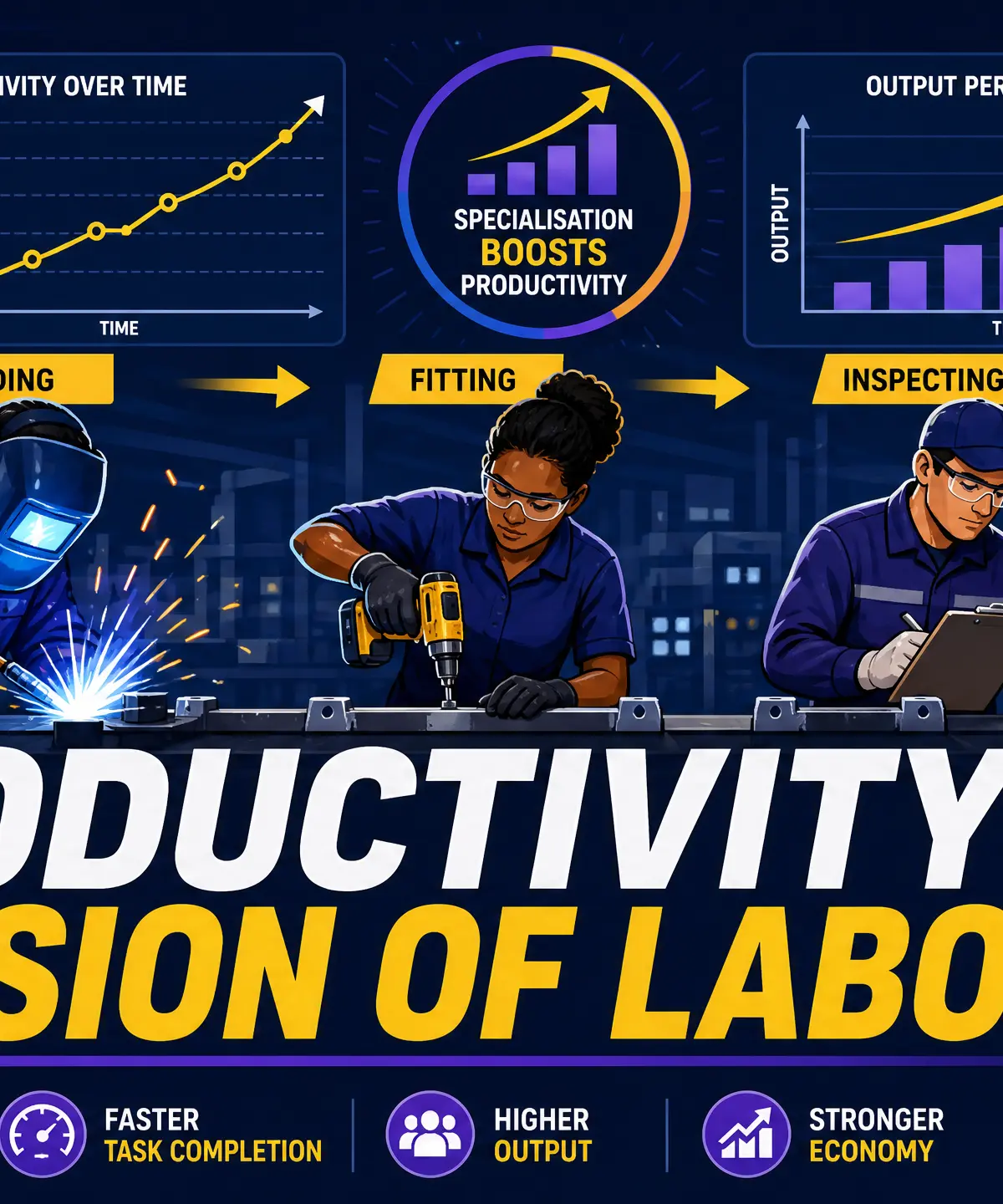
Productivity and the division of labour are foundational concepts in Economics that explain how societies create wealth and improve living standards. Originating with Adam Smith's observations in 1776, these ideas explain why modern manufacturing is so efficient and why global supply chains exist. Examiners expect you to precisely define productivity as a ratio of output to input, and to critically evaluate the division of labour, showing you understand both its immense power to lower unit costs and its potential drawbacks, such as worker alienation and structural vulnerability.
Key Concepts & Developments
The Division of Labour
What it is: The process of breaking down the production of a good or service into separate tasks, with different workers specialising in each task.
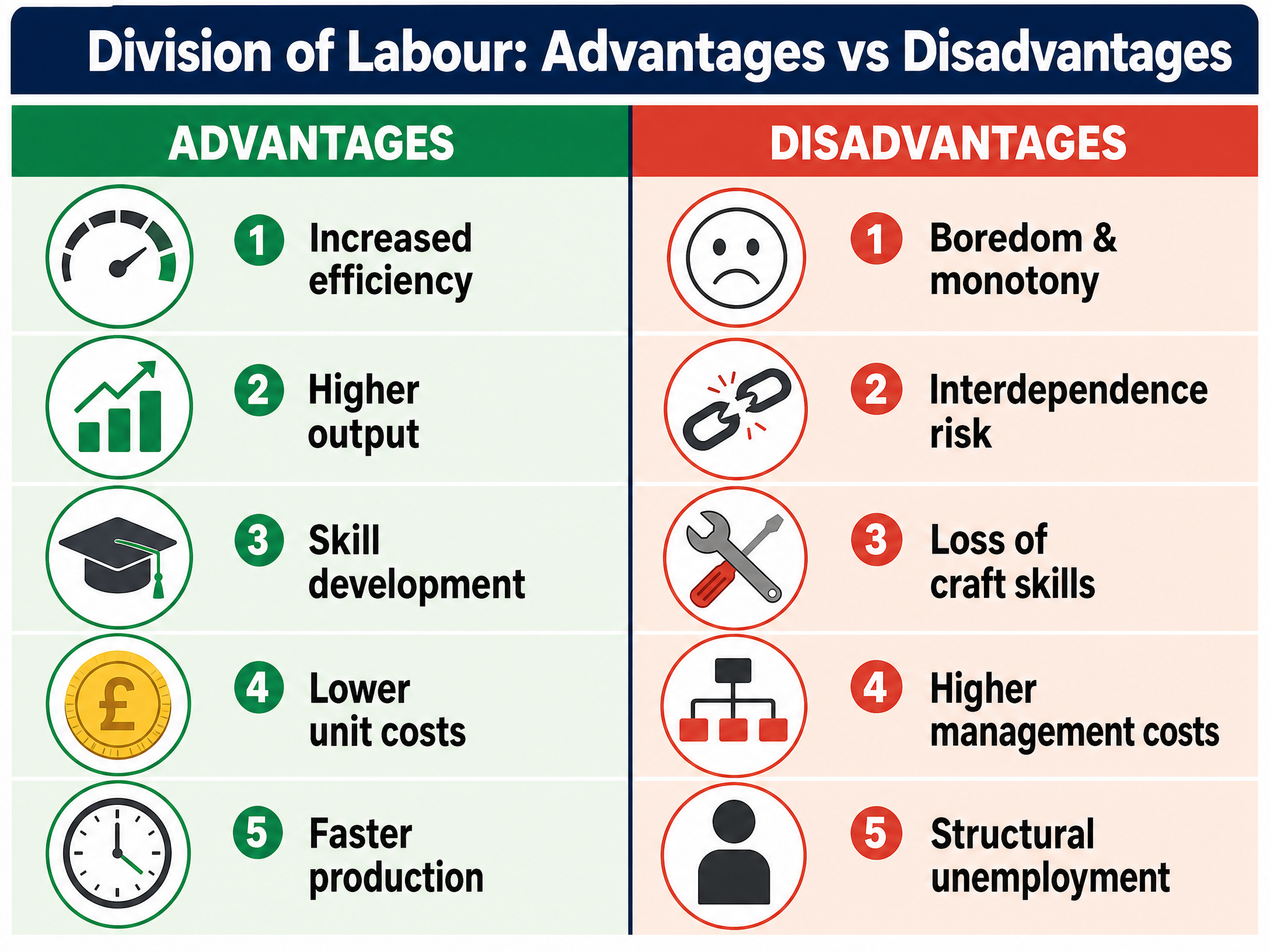
Why it matters: It is the basis of mass production and modern economic growth. By splitting tasks, firms can achieve economies of scale and dramatically lower unit costs.
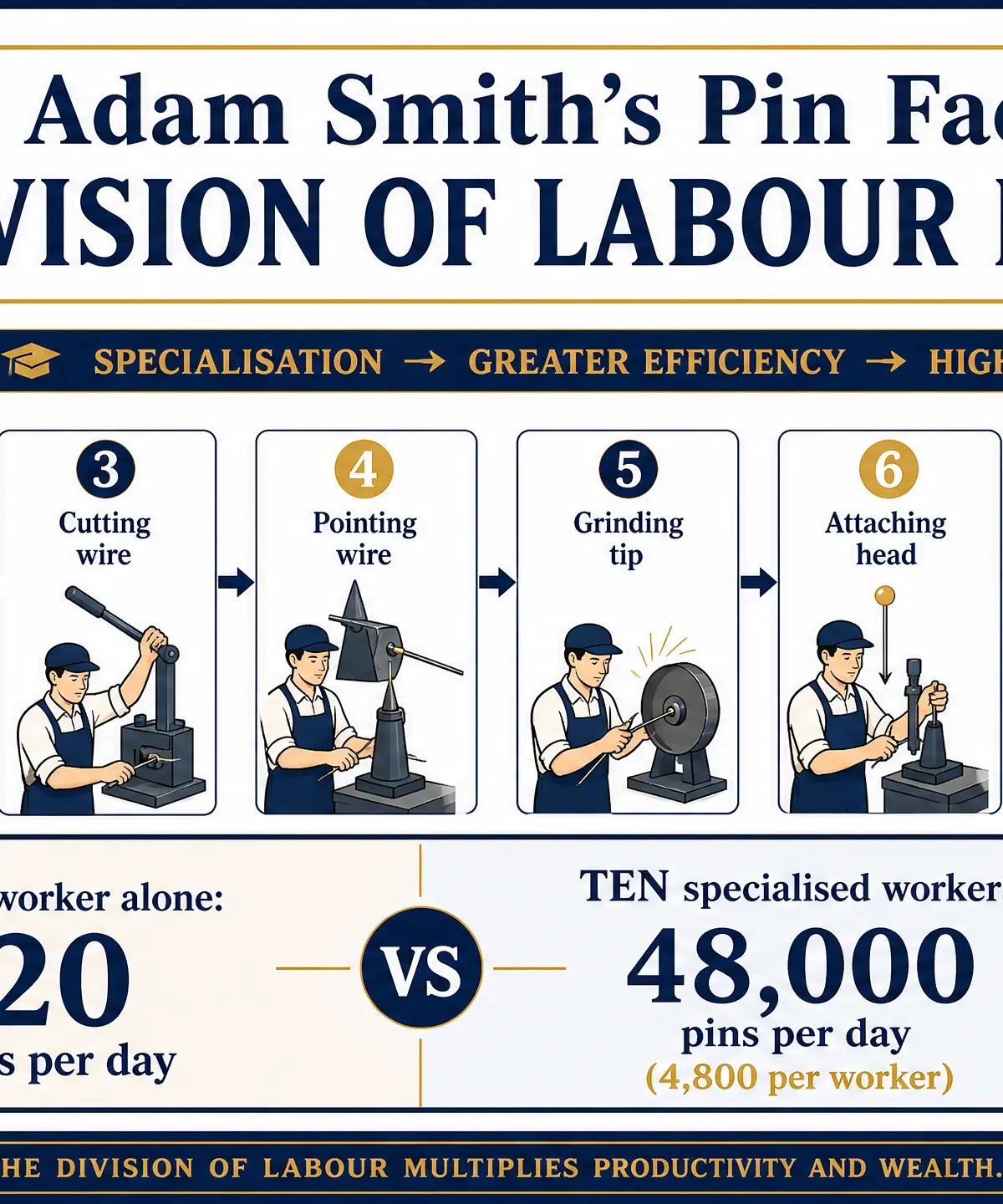
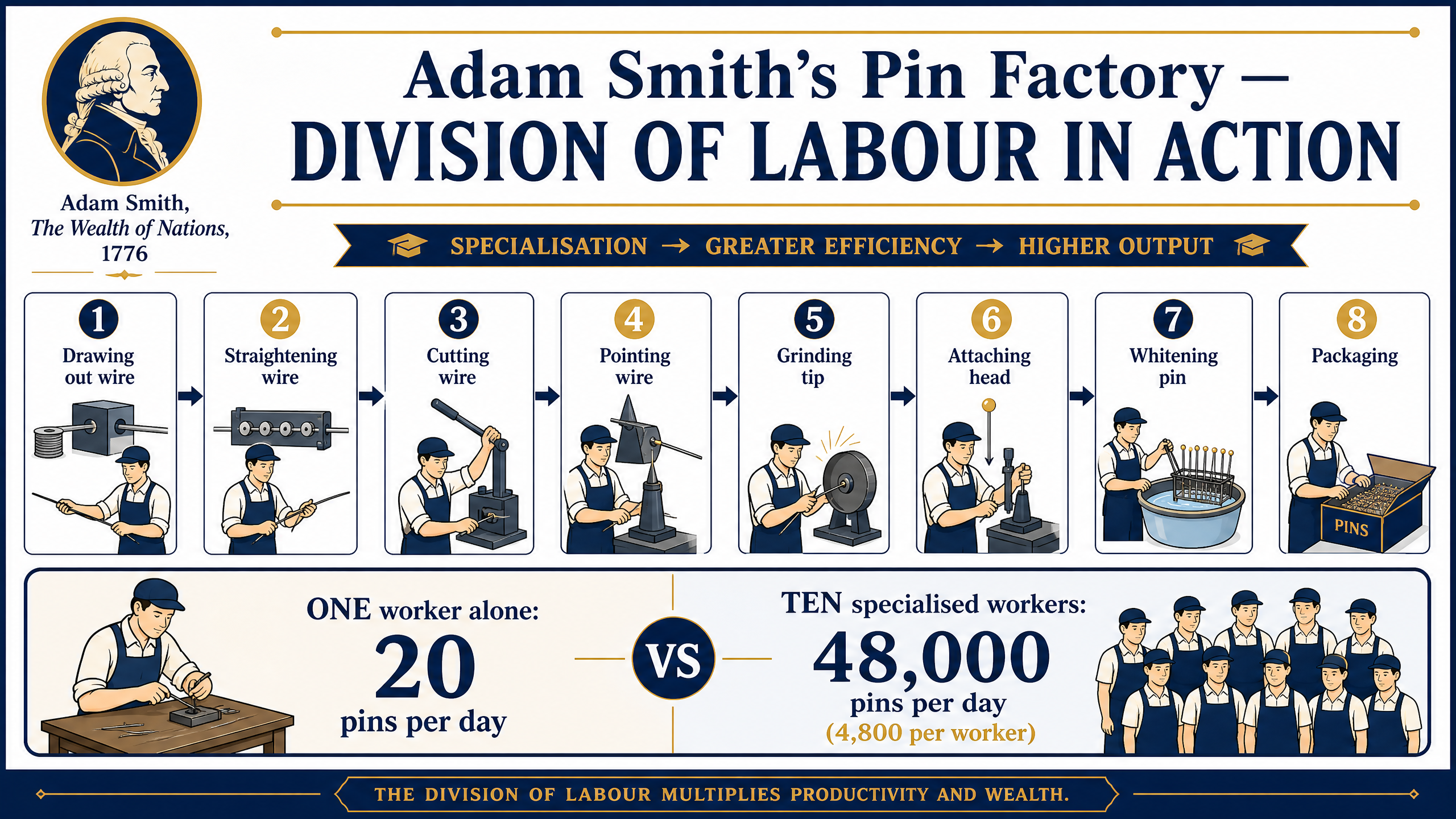
Specific Knowledge: First formalised by Adam Smith in The Wealth of Nations (1776) using the example of a pin factory, where 10 workers could produce 48,000 pins a day by dividing the process into 18 distinct steps.
Productivity
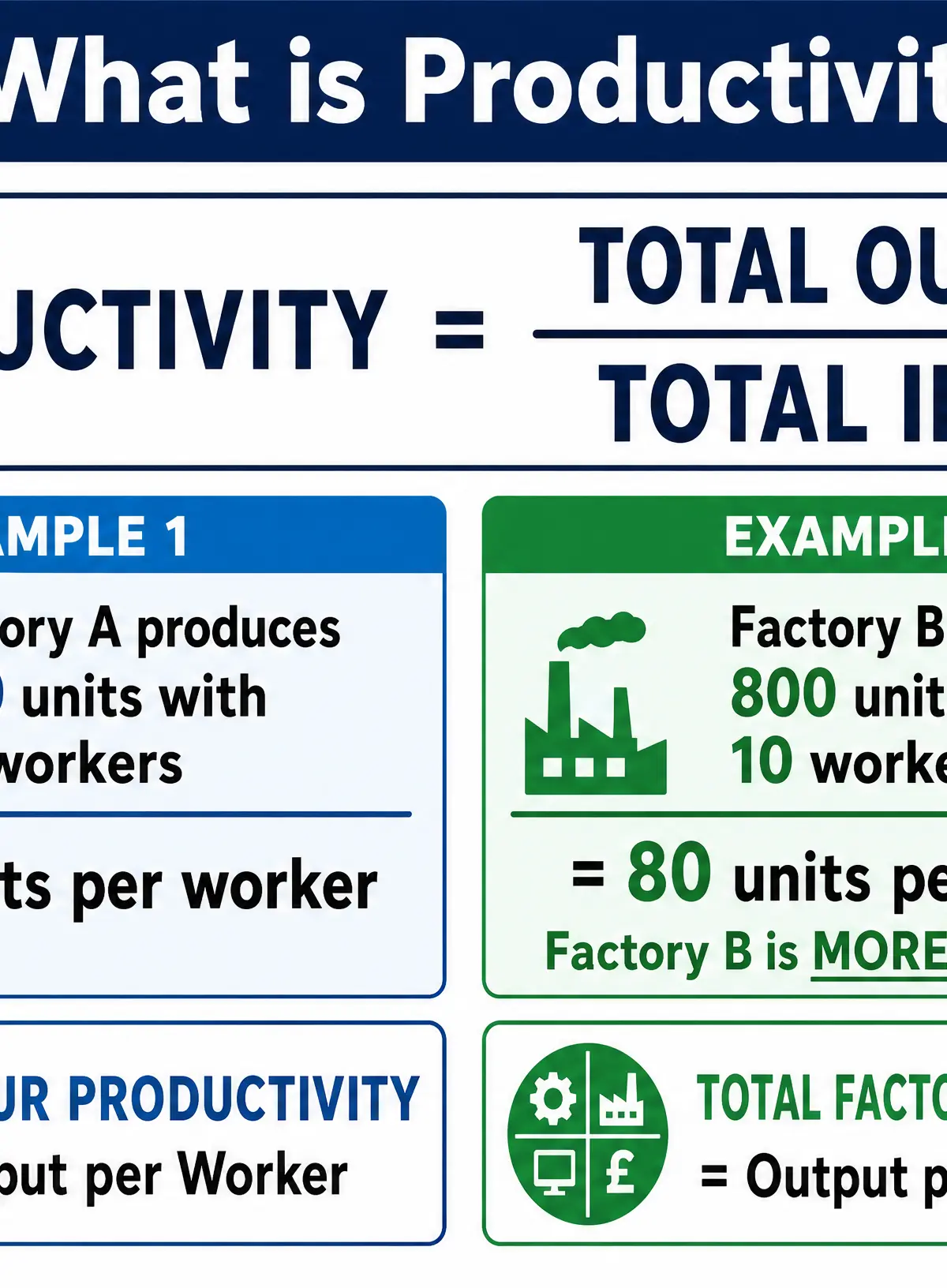
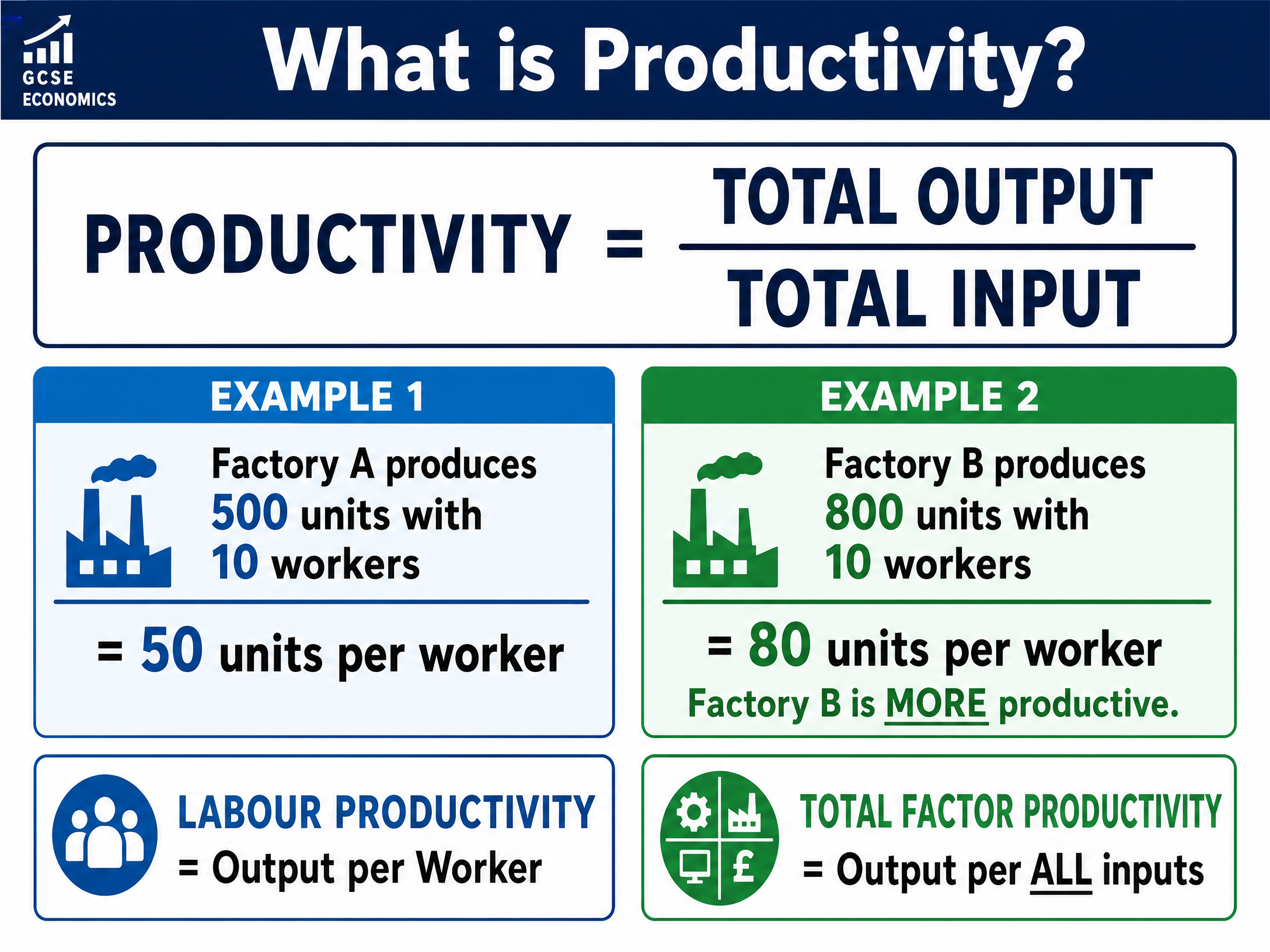
What it is: The ratio of output produced per unit of input used in the production process.
Why it matters: Higher productivity is the main driver of economic growth and higher living standards in an economy. It allows firms to produce more with the same resources, increasing profit margins and potentially lowering prices for consumers.
Specific Knowledge: Labour productivity = Total Output / Number of Workers. Total factor productivity = Total Output / All Inputs.
Second-Order Concepts
Causes of High Productivity
Productivity is driven by several key factors: the skill and education level of the workforce (human capital), the quality and quantity of machinery and technology available (physical capital), the motivation of workers, and how efficiently the production process is organised (e.g., through the division of labour).
Consequences of Division of Labour
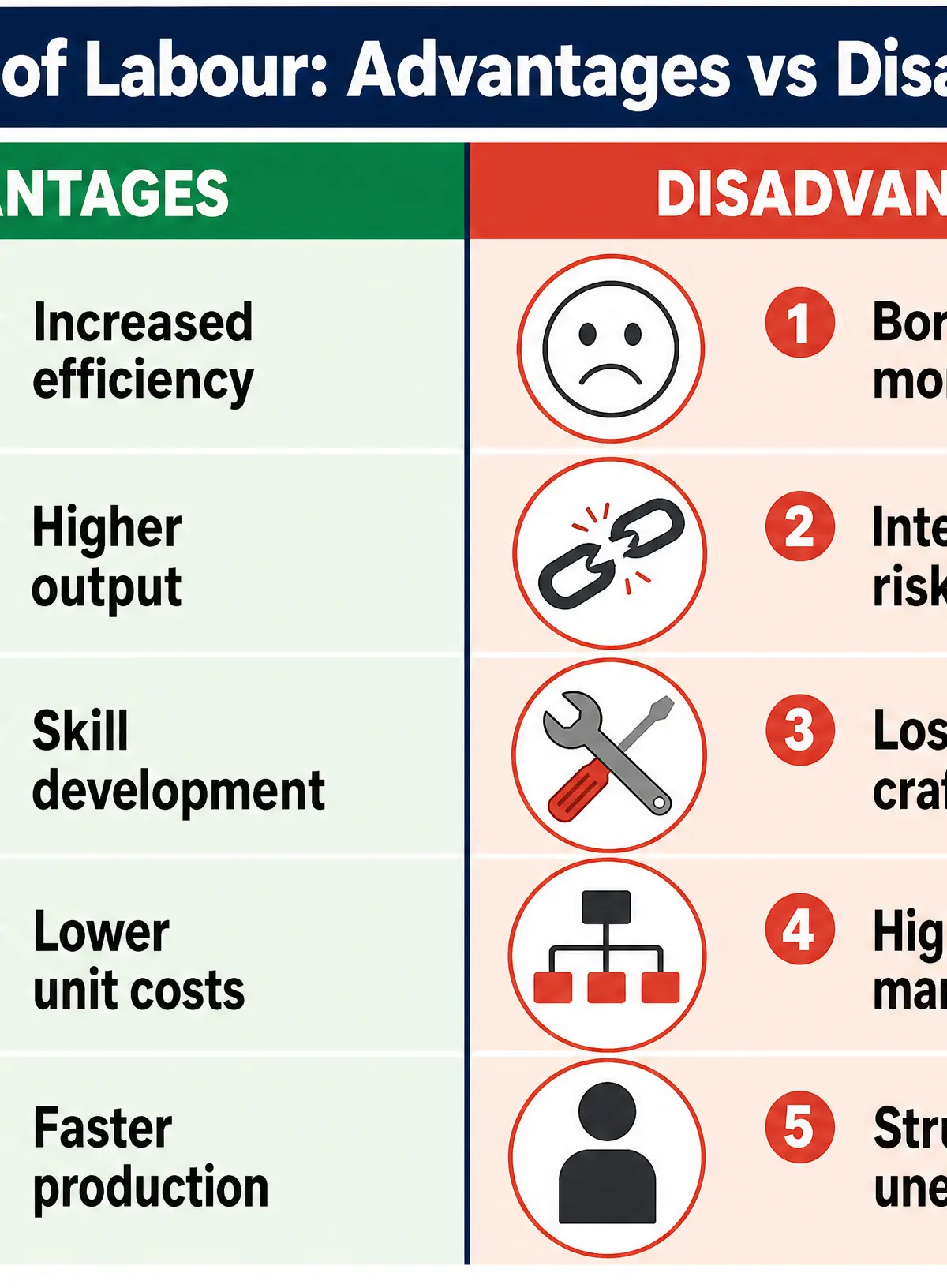
The immediate consequence of the division of labour is a massive increase in output and efficiency. Workers become highly skilled at their specific tasks, less time is wasted switching tools, and machinery can be used more intensively. However, long-term consequences can include worker demotivation due to monotonous tasks, and increased vulnerability of the production line if one stage fails.
Significance
Understanding these concepts is crucial because they explain the transition from pre-industrial craft production to modern industrial and post-industrial economies. The principles of division of labour now apply globally, with different countries specialising in different stages of production.
Audio Revision
Listen to our 10-minute podcast episode covering all the key points, examiner tips, and a quick-fire recall quiz:

Visual Resources
3 diagrams and illustrations
Interactive Diagrams
1 interactive diagram to visualise key concepts
Conceptual Flow Outline
The logical chain showing how Division of Labour leads to lower unit costs.
Worked Examples
3 worked examples — open one to explore the question and available guidance.
Practice Questions
Test your understanding — click to reveal model answers
Define the term 'labour productivity'. (2 marks)
Hint: Remember it's a ratio.
A bakery employs 8 staff and produces 2,400 loaves of bread a day. Following the introduction of a new division of labour system, they now produce 3,200 loaves a day with the same number of staff. Calculate the percentage increase in labour productivity. (3 marks)
Hint: Calculate initial productivity, then new productivity, then find the percentage change.
Explain one reason why the division of labour might lead to a decrease in productivity over time. (3 marks)
Hint: Think about the psychological impact on the worker.
Evaluate the view that the division of labour is always beneficial for a manufacturing firm. (9 marks)
Hint: You need arguments agreeing it's beneficial, arguments disagreeing, and a final conclusion.
State the difference between division of labour and specialisation. (2 marks)
Hint: One is a broad concept, the other is specific to a production line.