Mensuration and calculation — AQA GCSE Mathematics
Verified courseTeaching note checked against the official specification.
Mensuration and calculation covers finding perimeters, areas and volumes of 2D and 3D shapes, including circles, prisms, cylinders, cones and spheres, plus compound shapes and correct unit conversion. In AQA GCSE Mathematics you must recall and apply formulae such as pi r squared, pi d, and volume equals cross-sectional area times length, showing clear method and giving answers with correct units.
Mensuration and calculation explained
Mensuration and calculation covers 13 specification points, including Use standard units of measure and related… and Measure line segments and angles in geometric….
Read the full explanation
Open a point below for its explanation and revision guidance.
use standard units of measure and related concepts (length, area, volume/capacity, mass, time, money etc.)
This topic requires you to choose and use standard units for length, area, volume or capacity, mass, time and money, and to apply the related concepts that link them. For length, work in mm, cm, m and km; for area, use mm², cm², m² and km²; for volume and capacity, use mm³, cm³, m³ and litres, remembering that 1 cm³ = 1 ml and 1 m³ = 1000 litres. Mass is measured in mg, g, kg and tonnes, time in seconds, minutes, hours and years, and money in pounds and pence. You must convert correctly, for example 3.5 m = 350 cm, 2 m² = 20 000 cm², and 4.2 litres = 4200 cm³. In an MCQ, read the unit in the question and in each option, then eliminate options whose unit or magnitude is wrong before calculating.
measure line segments and angles in geometric figures, including interpreting maps and scale drawings and use of bearings
This topic covers measuring line segments and angles in geometric figures, interpreting maps and scale drawings, and using bearings. To measure a line segment, place a ruler's zero mark at one endpoint and read the length at the other. To measure an angle, place a protractor's centre on the vertex, align the baseline with one arm, and read the scale from 0° along that arm. On a scale drawing, use the given scale to convert a measured length to a real length; for example, 1 cm : 5 m means a 4 cm drawing length represents 20 m. A bearing is a three-figure clockwise angle measured from north, so 45° clockwise from north is written 045°. In an extended response, show each measurement, scale conversion and bearing calculation clearly.
know and apply formulae to calculate: area of triangles, parallelograms, trapezia; volume of cuboids and other right prisms (including cylinders)
This row requires you both to know and to apply mensuration formulae. For area: a triangle uses half base times perpendicular height; a parallelogram uses base times perpendicular height; a trapezium uses half the sum of the parallel sides times the perpendicular height. For volume: a cuboid uses length × width × height; any right prism uses cross-sectional area × length, and a cylinder is a right prism whose cross-section is a circle, so its volume is πr²h. Always identify the perpendicular height, not a slanted edge, and keep all lengths in the same unit before calculating. For example, a trapezium with parallel sides 6 cm and 10 cm and perpendicular height 4 cm has area ½ × (6 + 10) × 4 = 32 cm².
know the formulae: circumference of a circle = 2πr = πd area of a circle = πr² calculate perimeters of 2D shapes, including circles areas of circles and composite shapes
This row requires you to know the circle formulae and to calculate perimeters and areas, including composite shapes. Circumference = 2πr, which equals πd because the diameter is twice the radius. Area of a circle = πr². To find the perimeter of a composite shape, add every outer edge, using the circumference formula for any circular arc and remembering that a semicircle contributes half the circumference plus its straight diameter. To find the area of a composite shape, split it into rectangles, triangles or circles, calculate each part and add or subtract as appropriate. For example, a circle of radius 5 cm has area π × 5² = 25π cm², approximately 78.5 cm².
surface area and volume of spheres, pyramids, cones and composite solids
For a sphere, use volume = (4/3)πr³ and surface area = 4πr². For a cone, volume = (1/3)πr²h and curved surface area = πrl, where l is the slant height; total surface area adds the base circle πr². For a pyramid, volume = (1/3) × base area × perpendicular height; surface area is the sum of the base and triangular faces. Composite solids are split into these simpler parts, calculating each part and adding or subtracting as appropriate. Always use the perpendicular height for volume, not a slant edge, and keep units consistent, converting lengths before calculating areas or volumes. For example, a cone with radius 3 cm and perpendicular height 4 cm has slant height 5 cm, volume 12π cm³ and curved surface area 15π cm².
calculate arc lengths, angles and areas of sectors of circles
A full circle has circumference 2πr and area πr². A sector is a fraction of the circle, determined by the angle θ at the centre. The arc length is (θ/360) × 2πr, and the sector area is (θ/360) × πr². You may also be asked to find the angle θ given the arc length or sector area, by rearranging these formulas. For example, a sector with radius 6 cm and angle 60° has arc length (60/360) × 2π × 6 = 2π cm and area (60/360) × π × 6² = 6π cm². Always use the radius, not the diameter, and ensure the angle is in degrees when using these fractions. When working with composite shapes, carefully identify which fraction of the circle is required and add any straight edges to find the total perimeter.
apply the concepts of congruence and similarity, including the relationships between lengths in similar figures
Congruent figures are identical in shape and size, meaning corresponding lengths and angles are equal. Similar figures have equal corresponding angles and corresponding lengths in a constant ratio called the scale factor. To apply these concepts, identify corresponding vertices and sides, then set up a proportion. For example, if triangle ABC is similar to DEF with AB = 6 cm and DE = 9 cm, the scale factor from ABC to DEF is 1.5, so every length in DEF is 1.5 times the matching length in ABC. Congruence is the special case where the scale factor is exactly 1. Match corresponding parts correctly before calculating an unknown length, and use similarity to find missing dimensions in geometric figures.
including the relationships between lengths, areas and volumes in similar figures (Higher tier only)
For similar figures, if the length scale factor is k, then the area scale factor is k² and the volume scale factor is k³. This extends the basic similarity idea: corresponding lengths are in ratio k, corresponding areas are in ratio k², and corresponding volumes are in ratio k³. For example, two similar cylinders have heights in the ratio 2 : 3, so their base areas are in the ratio 4 : 9 and their volumes are in the ratio 8 : 27. To solve problems, first find the length scale factor from a pair of corresponding lengths, then square it for areas or cube it for volumes. Conversely, if you know an area ratio, take the square root to find the length ratio; if you know a volume ratio, take the cube root. Always check that the figures are similar and that you are comparing corresponding parts. This relationship is Higher tier only.
know the formulae for: Pythagoras’ theorem, a² + b² = c² and the trigonometric ratios, sin θ = opposite/hypotenuse, cos θ = adjacent/hypotenuse and tan θ = opposite/adjacent apply them to find angles and lengths in right-angled triangles in two dimensional figures
This row requires you to know and apply Pythagoras’ theorem and the three trigonometric ratios in right-angled triangles in two dimensions. Pythagoras’ theorem states that for a right-angled triangle with hypotenuse c and legs a and b, a² + b² = c². The trigonometric ratios are sin θ = opposite/hypotenuse, cos θ = adjacent/hypotenuse and tan θ = opposite/adjacent, where θ is an angle in the triangle. To find a missing side, substitute two known lengths into the appropriate formula and solve. To find a missing angle, use the inverse trigonometric function on the ratio of the two relevant sides. For example, if the opposite side is 3 cm and the hypotenuse is 5 cm, sin θ = 3/5 = 0.6, so θ = sin⁻¹(0.6) ≈ 36.9°. Always identify the hypotenuse, the side opposite the angle and the side adjacent to the angle before choosing a formula.
apply them to find angles and lengths in right-angled triangles and, where possible, general triangles in two and three dimensional figures (Higher tier only)
This Higher tier row applies Pythagoras’ theorem and the trigonometric ratios to right-angled triangles in two and three dimensions. In a solid, identify a right-angled triangle within a face or use a face or space diagonal, then apply a² + b² = c² or sin, cos or tan. For a general triangle, use the given information to identify or construct a right-angled triangle where possible; the sine and cosine rules belong to the separate Higher-tier criterion on those rules. Always identify the relevant triangle before choosing a method.
know the exact values of sin θ and cos θ for θ = 0°, 30°, 45°, 60° and 90° know the exact value of tan θ for θ = 0°, 30°, 45°, 60°
For sin θ, the exact values for 0°, 30°, 45°, 60° and 90° are 0, 1/2, √2/2, √3/2 and 1. For cos θ, the values are 1, √3/2, √2/2, 1/2 and 0. For tan θ, the values for 0°, 30°, 45° and 60° are 0, 1/√3, 1 and √3. Note that tan 90° is undefined and is not required. A reliable method is to sketch the graphs or use the special triangles: a 30°–60°–90° triangle with sides 1, √3 and 2, and a 45°–45°–90° triangle with sides 1, 1 and √2. For example, sin 30° = opposite/hypotenuse = 1/2. In an MCQ, you may be asked to identify a correct value or match an expression to its exact value. Always check the quadrant if the angle is not in the range 0° to 90°, but this statement only covers those angles.
know and apply the sine rule, a/sin A = b/sin B = c/sin C and cosine rule, a² = b² + c² − 2bc cos A to find unknown lengths and angles (Higher content only)
This Higher-tier topic requires you to know and apply the sine rule and cosine rule to find unknown lengths and angles in non-right-angled triangles. The sine rule states a/sin A = b/sin B = c/sin C, where a, b, c are side lengths and A, B, C are the opposite angles. Use it when you know a matching side and angle pair plus one other side or angle. The cosine rule states a² = b² + c² − 2bc cos A, and can be rearranged to find an angle: cos A = (b² + c² − a²)/(2bc). Use it when you know two sides and the included angle, or all three sides. For example, if b = 5 cm, c = 7 cm and A = 60°, then a² = 5² + 7² − 2×5×7×cos 60° = 25 + 49 − 35 = 39, so a = √39 cm. In an MCQ, you must choose the correct rule and substitute accurately, paying attention to whether the angle is included between the two known sides.
know and apply Area = ½ab sin C to calculate the area, sides or angles of any triangle (Higher content only)
This Higher-only result lets you find a triangle's area from two sides and the included angle, or work backwards to find a missing side or angle. The formula is Area = ½ab sin C, where a and b are the two sides meeting at angle C. For example, if a = 7 cm, b = 9 cm and C = 40°, then Area = ½ × 7 × 9 × sin 40° ≈ 20.2 cm². To find a side, substitute the known area, one side and the angle, then rearrange: 2 × Area ÷ (b sin C) = a. To find an angle, rearrange to sin C = 2 × Area ÷ (ab), then use the inverse sine. If the triangle is obtuse at C, subtract the calculator's acute answer from 180°, because sin(180° - θ) = sin θ. Your calculator must be in degree mode. This formula works for any triangle, extending your mensuration toolkit beyond ½ × base × height.
Watch and listen
Listen: Mensuration and calculation audio lesson
Read the full guide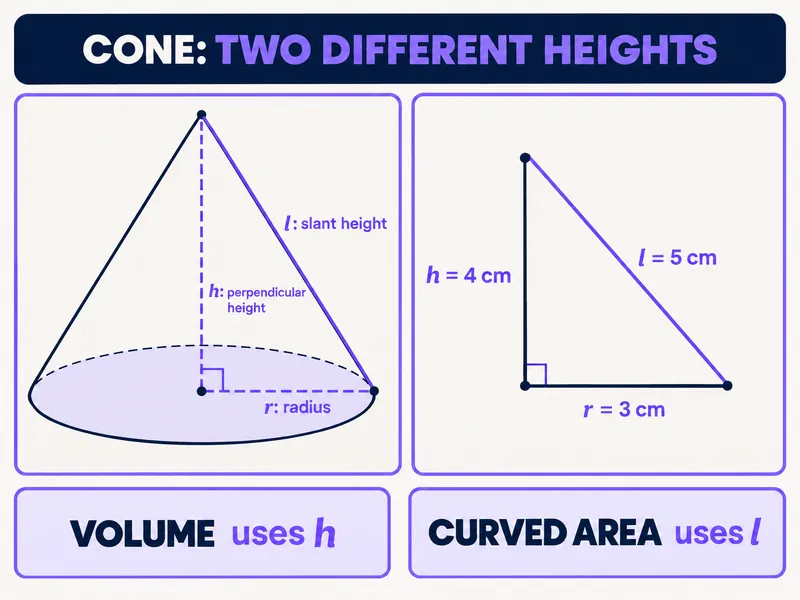
Interactive Diagrams
1 interactive diagram to visualise key concepts
Conceptual Flow Outline
Choose a volume or surface-area route, then check the dimensions, exposed surfaces and units. {{asset:solid_method.png}}
Your focus
- Identify the correct standard unit for a stated measurement context.
- Convert fluently between metric units of length, area, volume/capacity, mass, time and money.
- Apply the relationship between volume and capacity to solve multiple-choice problems.
Show all 39 objectives
- Measure line segments and angles accurately using a ruler and protractor.
- Convert between drawing lengths and real lengths using a given scale.
- Calculate and use three-figure bearings in maps and geometric figures.
- State the area formulae for triangles, parallelograms and trapezia.
- Calculate the volume of a cuboid and of other right prisms, including cylinders.
- Select and apply the appropriate formula to a given 2D or 3D shape, using consistent units.
- State the formulae for the circumference and area of a circle.
- Calculate the perimeter of 2D shapes, including circles and parts of circles.
- Calculate the area of circles and of composite shapes by splitting them into standard shapes.
- State and use the formulas for the volume and surface area of a sphere.
- Calculate the volume and surface area of a pyramid and a cone, using the perpendicular height where required.
- Solve problems involving composite solids by breaking them into simpler solids and combining their volumes or surface areas.
- Calculate the arc length of a sector using the angle at the centre and the radius.
- Calculate the area of a sector using the angle at the centre and the radius.
- Find the angle of a sector given its arc length or area and the radius.
- Identify corresponding sides and angles in congruent and similar figures.
- Calculate an unknown length in similar figures using a scale factor or proportion.
- Apply the relationship between lengths in similar figures to solve geometric problems.
- Use the relationships between length, area and volume scale factors in similar figures.
- Calculate an unknown area or volume given a length scale factor.
- Determine a length scale factor from a given area or volume ratio.
- State Pythagoras’ theorem and the three trigonometric ratios accurately.
- Apply Pythagoras’ theorem to calculate a missing side in a two-dimensional right-angled triangle.
- Apply trigonometric ratios and their inverses to calculate a missing side or angle in a two-dimensional right-angled triangle.
- Apply Pythagoras’ theorem and trigonometric ratios to right-angled triangles in two and three dimensions.
- Recognise when a general triangle can be decomposed into right-angled triangles and identify the required construction or information.
- Identify and extract right-angled triangles from three-dimensional figures to solve problems.
- Recall the exact values of sin θ and cos θ for θ = 0°, 30°, 45°, 60° and 90°.
- Recall the exact value of tan θ for θ = 0°, 30°, 45° and 60°.
- Select the correct exact value from a set of options in a multiple-choice question.
- State the sine rule and the cosine rule accurately.
- Apply the sine rule to find an unknown length or angle in a non-right-angled triangle.
- Apply the cosine rule to find an unknown length or angle in a non-right-angled triangle.
- State the formula Area = ½ab sin C and identify the included angle C.
- Substitute known values into Area = ½ab sin C to calculate the area of a triangle.
- Rearrange Area = ½ab sin C to calculate a missing side or a missing angle, adjusting for obtuse angles where necessary.
Mensuration and calculation flashcards
Card 1 of 12
Area of a triangle
Which command word is this?
You must work out a numerical answer using the given information. Show clear method, include units, and round only if the question specifies a degree of accuracy.
Mensuration and calculation exam tips
Topic Overview
Mensuration and calculation is the branch of geometry that deals with measuring lengths, perimeters, areas, surface areas and volumes of 2D and 3D shapes. In AQA GCSE Mathematics you must confidently use formulae for rectangles, triangles, parallelograms, trapezia, circles, prisms, cylinders, pyramids, cones and spheres, and apply these to compound shapes and real-world problems.
This topic matters because it connects algebra, ratio, rounding and unit conversion in practical contexts such as construction, engineering and design. It also forms the foundation for later work on similarity, trigonometry and calculus, so secure understanding of formulae and units is essential for success in both Foundation and Higher tier exams.
Key Concepts
- →Perimeter is the distance around a 2D shape; for a circle it is called the circumference and is calculated using C = pi x d or C = 2 x pi x r.
- →Area is measured in square units: rectangle = length x width, triangle = half x base x perpendicular height, parallelogram = base x perpendicular height, trapezium = half x (a + b) x height, circle = pi x r squared.
- →Volume is measured in cubic units: for a prism or cylinder, volume = cross-sectional area x length; for a pyramid or cone, volume = one third x base area x perpendicular height; for a sphere, volume = four thirds x pi x r cubed.
- →Surface area is the total area of all faces of a 3D shape; for a cylinder it is 2 x pi x r squared + 2 x pi x r x h, and for a sphere it is 4 x pi x r squared.
- →Compound shapes must be split into simpler shapes, and missing lengths found using the given dimensions before calculating total area or volume.
Marking Points
- Selects the appropriate standard unit for a given measurement context, such as cm for a pencil length or m³ for a room volume.
- Converts between metric units of length, area, volume/capacity, mass, time and money using correct multiplicative factors.
- Applies the relationship between volume and capacity, including 1 cm³ = 1 ml and 1 m³ = 1000 litres.
- Uses squared and cubed unit notation correctly, for example cm² and m³, and distinguishes area from volume units.
- Interprets and compares quantities given in different units by converting to a common unit before choosing an answer.
- Measures a line segment accurately with a ruler, placing the zero mark at one endpoint and reading to a suitable precision.
- Measures an angle accurately with a protractor, aligning the centre with the vertex and the baseline with one arm, and reads the correct scale.
- Interprets a scale drawing by using the given scale to convert between drawing lengths and real lengths.
- Calculates a three-figure bearing as a clockwise angle from north, using 000° to 360° notation.
- Uses bearings and scale together to describe or find a position on a map or in a geometric figure.
- Communicates each step of measurement, conversion and bearing calculation so the method can be followed.
- Area of a triangle = ½ × base × perpendicular height, using the perpendicular height rather than a slanted side.
- Area of a parallelogram = base × perpendicular height.
- Area of a trapezium = ½ × (sum of the parallel sides) × perpendicular height.
- Volume of a cuboid = length × width × height.
- Volume of any right prism = cross-sectional area × length, applied consistently to the named solid.
- Volume of a cylinder = πr²h, treating the circular cross-section as the prism face.
- Circumference of a circle = 2πr, equivalently πd, using the radius or diameter correctly.
- Area of a circle = πr², squaring the radius before multiplying by π.
- Perimeter of a 2D shape found by adding all outer edges, including curved edges where present.
- Perimeter of a composite shape found by identifying and summing only the boundary edges, not internal dividing lines.
- Area of a composite shape found by splitting it into standard shapes and adding or subtracting their areas.
- Correct use of π, either as an exact value in terms of π or as a decimal approximation as required.
- Uses the correct formula for the volume of a sphere: V = (4/3)πr³.
- Uses the correct formula for the surface area of a sphere: A = 4πr².
- Calculates the volume of a pyramid using V = (1/3) × base area × perpendicular height.
- Calculates the volume of a cone using V = (1/3)πr²h and the curved surface area using πrl, where l is the slant height.
- Decomposes a composite solid into spheres, pyramids, cones or other simple solids, then combines their volumes or surface areas correctly, including subtracting any hidden internal faces.
- Uses the formula for arc length: arc length = (θ/360) × 2πr, where θ is the angle at the centre in degrees.
- Uses the formula for the area of a sector: area = (θ/360) × πr².
- Rearranges the arc length or sector area formula to find the angle θ when the arc length or area and radius are known.
- Applies these formulas to solve problems, including those involving composite shapes or perimeters of sectors.
- States that congruent figures have equal corresponding lengths and angles, while similar figures have equal corresponding angles and proportional corresponding lengths.
- Identifies the scale factor as the ratio of a length in the image to the corresponding length in the original figure.
- Sets up and solves a proportion to find an unknown length in a pair of similar figures.
- Recognises that congruence is the special case of similarity with a scale factor of 1.
- Applies the relationship between lengths in similar figures to calculate missing dimensions.
- State that for similar figures the length scale factor is k, the area scale factor is k² and the volume scale factor is k³.
- Calculate an unknown area or volume using the square or cube of the length scale factor.
- Find the length scale factor by taking the square root of an area ratio or the cube root of a volume ratio.
- Apply the relationships to solve problems involving similar 2D shapes and 3D solids.
- Recognise that the relationships hold only when the figures are similar.
- Correctly state Pythagoras’ theorem as a² + b² = c², where c is the hypotenuse.
- Correctly state sin θ = opposite/hypotenuse, cos θ = adjacent/hypotenuse and tan θ = opposite/adjacent.
- Identify the hypotenuse, opposite and adjacent sides correctly for a given angle in a right-angled triangle.
- Substitute known lengths into Pythagoras’ theorem to find a missing side in a two-dimensional right-angled triangle.
- Use a trigonometric ratio and its inverse to find a missing angle in a two-dimensional right-angled triangle.
- Use a trigonometric ratio to find a missing side in a two-dimensional right-angled triangle when one side and one angle are known.
- Apply Pythagoras’ theorem to find a length in a right-angled triangle within a two-dimensional or three-dimensional figure.
- Apply trigonometric ratios to find an angle or length in a right-angled triangle within a two-dimensional or three-dimensional figure.
- Identify or construct a suitable right-angled triangle within a three-dimensional figure, such as a face diagonal or space diagonal, and use it to find the required length or angle.
- For a general triangle, recognise when a right-angled decomposition is possible and state what additional information or construction is needed when it is not.
- Correctly states sin 0° = 0, sin 30° = 1/2, sin 45° = √2/2, sin 60° = √3/2, sin 90° = 1.
- Correctly states cos 0° = 1, cos 30° = √3/2, cos 45° = √2/2, cos 60° = 1/2, cos 90° = 0.
- Correctly states tan 0° = 0, tan 30° = 1/√3, tan 45° = 1, tan 60° = √3.
- Recognises that tan 90° is undefined and is not required by this statement.
- Uses exact surd forms rather than decimal approximations when exact values are requested.
- Correctly states the sine rule as a/sin A = b/sin B = c/sin C and uses it to find an unknown side or angle when a matching pair is known.
- Correctly states the cosine rule as a² = b² + c² − 2bc cos A and uses it to find an unknown side when two sides and the included angle are known.
- Rearranges the cosine rule to cos A = (b² + c² − a²)/(2bc) to find an unknown angle when all three sides are known.
- Substitutes values accurately into the chosen rule, including correct use of the included angle and correct order of operations.
- Solves the resulting equation to find the unknown length or angle, giving the answer to an appropriate degree of accuracy.
- Selects the correct formula Area = ½ab sin C and identifies a and b as the two sides that include angle C.
- Substitutes known values correctly, including using the included angle rather than a non-included angle.
- Calculates the area accurately, for example ½ × 7 × 9 × sin 40° ≈ 20.2 cm², with correct units.
- Rearranges the formula correctly to find a missing side: a = 2 × Area ÷ (b sin C).
- Rearranges the formula correctly to find a missing angle: sin C = 2 × Area ÷ (ab), then applies inverse sine.
- Adjusts the angle for an obtuse triangle by subtracting the acute inverse sine value from 180°.
- Uses degree mode on the calculator when the angle is given in degrees and rounds appropriately.
Examiner Tips
- 💡Underline the unit required in the question and the units in the options before doing any arithmetic.
- 💡Write down the conversion factor you are using, for example 1 m = 100 cm, so you can check the direction of the conversion.
- 💡For area and volume, convert the linear measurement first and then square or cube it, rather than multiplying the area or volume by a linear factor.
- 💡Estimate the size of the answer in real terms, such as whether a bottle holds about 2 litres or 2 m³, to reject impossible options.
- 💡Mark the vertex and the two arms of the angle before placing the protractor, and keep the protractor still while reading.
- 💡Write the scale as a ratio or statement, such as 1 cm : 5 m, and show the conversion calculation explicitly.
- 💡For bearings, draw or extend a north line at the point of reference and mark the clockwise angle before calculating.
- 💡Check that your final answer is sensible: an angle between 0° and 180° for a basic figure, and a bearing between 000° and 360°.
- 💡Write the formula you are using before substituting numbers, so the method is visible and any slip is easier to spot.
- 💡Label the perpendicular height on a diagram before calculating, especially for triangles and trapezia.
- 💡Check the unit of the answer: area in square units such as cm², volume in cubic units such as cm³.
- 💡For a composite or unfamiliar right prism, find the cross-sectional area first, then multiply by the length.
- 💡Decide whether the question asks for perimeter, area or volume before choosing a formula.
- 💡Sketch and label the shape, marking radii, diameters and any straight edges you need.
- 💡Leave answers in terms of π when an exact value is requested, and only round at the final step otherwise.
- 💡For composite shapes, write down each part's area or edge length separately so nothing is missed or double-counted.
- 💡Write down the formula you are using before substituting values; this makes your method clear and helps you avoid formula errors.
- 💡For composite solids, sketch and label the separate parts, showing clearly whether you are adding or subtracting volumes or areas.
- 💡Check that your final answer has the correct units: volume in cubic units (for example cm³) and area in square units (for example cm²).
- 💡Write down the formula you are using and substitute the values carefully, keeping the angle in degrees for the fraction θ/360.
- 💡If you need to find the angle, rearrange the formula before substituting numbers to reduce arithmetic errors.
- 💡Check that your answer is sensible: an arc length should be less than the full circumference, and a sector area should be less than the full circle area.
- 💡Write the similarity statement with vertices in corresponding order before doing any calculation.
- 💡Label the scale factor clearly and state whether you are enlarging or reducing the figure.
- 💡Check your answer by substituting back into the proportion to confirm both ratios are equal.
- 💡Write down the length scale factor first, then show the squaring or cubing step clearly.
- 💡If given an area or volume ratio, state the root you are taking before calculating.
- 💡Use units consistently and check that your final answer has the correct unit (for example cm² for area, cm³ for volume).
- 💡Sketch the right-angled triangle and label the hypotenuse, opposite and adjacent sides before choosing a formula.
- 💡Check that your calculator is in degree mode when working with angles in degrees.
- 💡Round final answers to a sensible degree of accuracy, usually three significant figures unless the question states otherwise, and show your substitution clearly.
- 💡Draw a clear diagram of the two-dimensional or three-dimensional figure and mark all known lengths and angles.
- 💡For three-dimensional problems, extract and redraw the relevant right-angled triangle before calculating.
- 💡Check that the selected triangle is genuinely right-angled, label its sides relative to the angle, and avoid rounding until the final answer.
- 💡Memorise the special triangles: a 30°–60°–90° triangle with sides 1, √3 and 2, and a 45°–45°–90° triangle with sides 1, 1 and √2. You can quickly derive any required value from them.
- 💡In multiple-choice questions, eliminate options that use decimals when the question asks for exact values, and check that surds are fully simplified where appropriate.
- 💡Write out the values in a small table at the start of your working if you are unsure, then use the table to answer the question accurately.
- 💡Sketch and label the triangle clearly, marking which sides and angles are known and which are required. This helps you decide whether the sine rule or cosine rule is appropriate.
- 💡In multiple-choice questions, check each option by substituting into the correct rule; eliminate options that use the wrong rule or incorrect order of operations.
- 💡When finding an angle with the cosine rule, rearrange to make cos A the subject before substituting, and remember to use the inverse cosine function to obtain the final angle.
- 💡Label the triangle clearly before substituting: mark the two sides you will use and the angle between them as C.
- 💡When finding an angle, check the diagram to see if it is obtuse; if so, remember to subtract your calculator's answer from 180°.
- 💡Give units for area (for example cm²) and for lengths (for example cm), and round only at the final step unless the question says otherwise.
- 💡Always write down the formula you are using before substituting numbers. This earns method marks even if you make an arithmetic error later.
- 💡Show every stage of your working, including any unit conversions and the final rounding. AQA awards marks for correct method, not just the final answer.
- 💡Check that your answer is sensible: for example, a volume in cm cubed should be much larger than the corresponding area in cm squared, and a circumference should be roughly three times the diameter.
Common Mistakes
- Treating area and volume conversions as if they were length conversions. Correction: square the length factor for area and cube it for volume, so 1 m² = 10 000 cm² and 1 m³ = 1 000 000 cm³.
- Confusing capacity and volume units, for example writing 1 litre = 1 m³. Correction: 1 litre = 1000 cm³ and 1 m³ = 1000 litres.
- Using non-standard or mixed units in a calculation, such as adding metres to centimetres without converting. Correction: convert all quantities to the same unit first.
- Ignoring the unit given in the answer options and selecting a numerically correct value with the wrong unit. Correction: check both the number and the unit in every option.
- Reading the wrong protractor scale and giving an angle that is the supplement of the true angle. Correction: check whether the angle is acute or obtuse and read the scale that starts at 0° on the arm you are measuring from.
- Writing a bearing with fewer than three digits, such as 45° instead of 045°. Correction: always write bearings as three figures between 000° and 360°.
- Measuring a bearing anticlockwise from north or from the wrong north line. Correction: start at north and measure clockwise, using the north line marked on the diagram.
- Applying a scale incorrectly, for example multiplying when the drawing is larger than the real object. Correction: identify whether the scale makes the drawing smaller or larger and convert in the correct direction.
- Using a slanted side as the height: the height must be perpendicular to the base, so identify the perpendicular distance before substituting.
- Forgetting the half in the triangle or trapezium formula: both require the factor ½, so check the formula before calculating.
- Mixing units, such as centimetres and metres, in one calculation: convert all lengths to a common unit first, then state the area in square units or the volume in cubic units.
- Treating the diameter as the radius in a cylinder: halve the diameter to obtain the radius before using πr²h.
- Confusing circumference and area formulae: circumference uses 2πr or πd, while area uses πr², so check which quantity is asked for.
- Using the diameter in place of the radius in πr²: halve the diameter first, then square the radius.
- Adding internal dividing lines when finding the perimeter of a composite shape: only the outer boundary counts.
- Forgetting the straight edge of a semicircle: its perimeter is half the circumference plus the diameter.
- Using the slant height instead of the perpendicular height in the volume formula for a cone or pyramid. Correction: identify the perpendicular height from the base to the apex and use that in V = (1/3) × base area × height.
- Confusing the formulas for volume and surface area of a sphere, for example using 4πr² for volume. Correction: volume is (4/3)πr³ and surface area is 4πr².
- Forgetting to include the base area when finding the total surface area of a cone or pyramid. Correction: total surface area includes the base plus all lateral faces; for a cone, add πr² to the curved surface area.
- Mixing units, such as using a radius in centimetres with a height in metres. Correction: convert all lengths to the same unit before substituting into any formula.
- Using the diameter instead of the radius in the formulas. Correction: always check whether the given length is a radius or diameter; if it is a diameter, halve it before substituting.
- Forgetting to divide by 360 when finding a fraction of the circle. Correction: the fraction of the circle is θ/360, so multiply the full circumference or area by this fraction.
- Mixing up the formulas for arc length and sector area. Correction: arc length uses 2πr (circumference) and area uses πr² (area of circle).
- Matching non-corresponding sides when forming a ratio; correct this by tracking the order of vertices in the similarity statement, for example ABC ~ DEF means AB corresponds to DE.
- Assuming that equal angles alone prove congruence; correct this by remembering that similarity needs equal angles and proportional sides, while congruence also requires equal lengths.
- Using the scale factor in the wrong direction; correct this by checking whether the unknown length belongs to the original or the image and multiplying or dividing accordingly.
- Using the length scale factor directly for area or volume; correct this by squaring for area and cubing for volume.
- Forgetting to take the square root or cube root when working from an area or volume ratio back to a length ratio; correct this by reversing the power.
- Mixing up which figure is the original and which is the image; correct this by clearly labelling the scale factor direction.
- Assuming the relationships apply to non-similar figures; correct this by checking that all corresponding angles are equal and all corresponding lengths are in the same ratio.
- Misidentifying the hypotenuse as any slanted side rather than the side opposite the right angle; correct by always locating the right angle first and choosing the side opposite it.
- Using the wrong trigonometric ratio for the given sides; correct by labelling opposite and adjacent relative to the angle in question before selecting sin, cos or tan.
- Forgetting to use the inverse trigonometric function when finding an angle; correct by applying sin⁻¹, cos⁻¹ or tan⁻¹ to the ratio.
- Substituting into Pythagoras’ theorem without squaring the sides; correct by ensuring each term is squared, for example a² + b² = c², not a + b = c.
- Assuming every triangle is right-angled; correct by checking for a right angle and using a suitable construction or stated method when no right angle is present.
- Failing to identify the correct right-angled triangle in a three-dimensional figure; correct by sketching the relevant face or cross-section and labelling the known lengths.
- Using a sloping edge or diagonal without checking which triangle it belongs to; correct by drawing the relevant face or cross-section before calculating.
- Rounding too early in a multi-step calculation; correct by keeping full calculator precision until the final answer.
- Mixing up the sine and cosine values for 30° and 60°. Correction: sin 30° = 1/2 and cos 60° = 1/2, while sin 60° = √3/2 and cos 30° = √3/2.
- Writing tan 30° as √3 instead of 1/√3. Correction: tan 30° = 1/√3, which is equivalent to √3/3, while tan 60° = √3.
- Attempting to give a value for tan 90°. Correction: tan 90° is undefined and is not required by this statement.
- Using rounded decimals such as 0.87 for √3/2 when an exact value is expected. Correction: leave answers in exact surd form unless the question asks for a decimal.
- Using the sine rule when the cosine rule is required, such as when two sides and the included angle are known. Correction: use the cosine rule for this combination, and use the sine rule only when you have a matching side and opposite angle pair.
- Forgetting to square the side lengths in the cosine rule, for example writing a² = b + c − 2bc cos A. Correction: the correct form is a² = b² + c² − 2bc cos A.
- Mislabelling sides and angles so that the side does not correspond to the opposite angle. Correction: always check that side a is opposite angle A, side b opposite angle B, and side c opposite angle C before substituting.
- Using the cosine rule with the wrong angle, such as using an angle that is not included between the two known sides. Correction: identify the included angle carefully before substituting.
- Using a side that is not part of the included angle: the formula needs the angle between the two sides being multiplied.
- Forgetting the factor of ½: the area is half the product ab sin C, so omitting ½ doubles the answer.
- Rearranging incorrectly when finding a side or angle: for a side, divide 2 × Area by (the other side × sin C).
- Forgetting to subtract the acute angle from 180° when finding an obtuse included angle, leading to an incorrect acute answer.
- Leaving the calculator in radian mode: when the angle is in degrees, the calculator must be in degree mode.
- Students often confuse radius and diameter, using the diameter in formulae that require the radius. Always halve the diameter first and label your diagram clearly.
- Students sometimes use the slant height instead of the perpendicular height in area and volume formulae for triangles, parallelograms, trapezia, cones and pyramids. The perpendicular height is the vertical distance between the base and the opposite side or vertex.
- Students frequently forget to convert units before calculating, for example mixing cm and m. Convert all lengths to the same unit at the start, and remember that 1 m squared = 10,000 cm squared and 1 m cubed = 1,000,000 cm cubed.
Revision Plan
- 1Day 1-2: Revise all 2D area and perimeter formulae, including circles. Create a formula sheet from memory and check it against your textbook.
- 2Day 3-4: Practise compound 2D shapes, splitting them into rectangles, triangles and circles. Focus on finding missing lengths and using correct units.
- 3Day 5-6: Learn 3D volume and surface area formulae for prisms, cylinders, pyramids, cones and spheres. Complete at least ten mixed practice questions.
- 4Day 7-8: Work through past AQA GCSE exam questions on mensuration, timing yourself and marking your answers using the official mark scheme.
- 5Day 9-10: Review your mistakes, redo any incorrect questions, and create flashcards for formulae and unit conversions to test yourself regularly.
Exam Question Types
- 📋Calculate the area or perimeter of a compound 2D shape: split the shape into simpler parts, find missing lengths, and show all working. Remember to give units.
- 📋Calculate the volume or surface area of a 3D shape such as a cylinder, cone or sphere: write the formula, substitute the correct radius or height, and round as instructed.
- 📋Solve a real-world problem involving unit conversion, for example finding the cost of painting a wall or the capacity of a tank: convert units first, then apply the correct formula.
- 📋Higher tier only: work with similar shapes to find missing lengths, areas or volumes using scale factors, or solve problems involving frustums and composite solids.
Command Word Expectations (AQA)
You must work out a numerical answer using the given information. Show clear method, include units, and round only if the question specifies a degree of accuracy.
Similar to calculate, but often used when the method is not immediately obvious. You must show all steps of your reasoning to gain full marks.
You must round your final answer to 3 significant figures. Do not round intermediate steps, or you may lose accuracy marks. State the rounded answer clearly.
You must demonstrate that a given result is true by showing every step of your working. The final answer is given, so all marks are for correct method and clear communication.
How Students Lose Marks (Examiner Pitfalls)
Step-by-Step Worked Solutions
Question: A cylindrical water tank has a radius of 1.5 m and a height of 4 m. Calculate the volume of the tank in cubic metres, giving your answer to 3 significant figures. Use pi = 3.142.
- 1.Step 1: Identify the shape as a cylinder and write down the formula: volume = pi x r squared x h.
- 2.Step 2: Substitute r = 1.5 and h = 4: volume = 3.142 x 1.5 squared x 4.
- 3.Step 3: Calculate 1.5 squared = 2.25, then 3.142 x 2.25 = 7.0695, then 7.0695 x 4 = 28.278.
- 4.Step 4: Round to 3 significant figures and state units: 28.3 m cubed.
Question: A compound shape is made from a rectangle of length 12 cm and width 5 cm with a semicircle of diameter 5 cm attached to one of the shorter sides. Calculate the total area of the shape, giving your answer to 1 decimal place. Use pi = 3.142.
- 1.Step 1: Split the compound shape into a rectangle and a semicircle.
- 2.Step 2: Area of rectangle = 12 x 5 = 60 cm squared.
- 3.Step 3: Radius of semicircle = 5 divided by 2 = 2.5 cm. Area of full circle = pi x 2.5 squared = 3.142 x 6.25 = 19.6375 cm squared. Area of semicircle = 19.6375 divided by 2 = 9.81875 cm squared.
- 4.Step 4: Total area = 60 + 9.81875 = 69.81875 cm squared.
- 5.Step 5: Round to 1 decimal place: 69.8 cm squared.