Structure and calculation — AQA GCSE Mathematics
Verified courseTeaching note checked against the official specification.
Structure and calculation covers the fundamental rules of number: place value, the four operations, order of operations (BIDMAS), rounding and estimation, factors, multiples, primes, powers, roots, and standard form. Mastery of these skills is essential for all other GCSE Mathematics topics, including algebra, ratio, and problem solving.
Structure and calculation explained
Structure and calculation covers 14 specification points, including Order positive and negative integers, decimals… and Apply the four operations, including formal….
Read the full explanation
Open a point below for its explanation and revision guidance.
order positive and negative integers, decimals and fractions use the symbols =, ≠, <, >, ≤, ≥
Ordering means placing numbers on a number line from least to greatest. For integers, remember that negative numbers are less than zero and less than any positive number: −7 < −2 < 0 < 3. For decimals, compare place value column by column: 0.3 < 0.25 is false because 0.30 > 0.25. For fractions, rewrite with a common denominator or convert to decimals: 3/4 = 0.75, so 2/3 < 3/4. The symbols =, ≠, <, >, ≤, ≥ let you state exact relationships. For example, −5 ≤ −5 is true because ≤ includes equality, and 4 ≠ 5 shows inequality. When ordering a mixed list of positive and negative integers, decimals and fractions, convert all to decimals or a common form first, then compare.
apply the four operations, including formal written methods, to integers, decimals and simple fractions (proper and improper), and mixed numbers – all both positive and negative understand and use place value (eg when working with very large or very small numbers, and when calculating with decimals)
This topic covers applying the four operations to integers, decimals, simple fractions (proper and improper) and mixed numbers, including both positive and negative values. Formal written methods include column addition, subtraction, long multiplication and division. For decimals, align decimal points when adding or subtracting. For fractions, find a common denominator for addition and subtraction; for multiplication, multiply numerators and denominators. Convert mixed numbers to improper fractions before multiplying or dividing; to divide fractions, multiply by the reciprocal of the divisor. Understand and use place value: when working with very large or very small numbers, use powers of ten, e.g. 3.2 × 10⁴ = 32000, and apply place value when calculating with decimals.
recognise and use relationships between operations, including inverse operations (eg cancellation to simplify calculations and expressions) use conventional notation for priority of operations, including brackets, powers, roots and reciprocals
This topic links operations by their opposites and by order. Inverse operations undo each other: addition and subtraction, multiplication and division, squaring and square-rooting, and reciprocals. Recognising these lets you cancel common factors in a fraction such as 18/24 to 3/4, or rearrange an expression. Priority of operations is the agreed order: work inside brackets first, then powers and roots, then multiplication and division left to right, then addition and subtraction left to right. For example, 3 + 4 × 2² = 3 + 4 × 4 = 3 + 16 = 19, not 49. A reciprocal of a non-zero number n is 1/n, so the reciprocal of 5 is 1/5 and of 2/3 is 3/2. Brackets, powers, roots and reciprocals all change which operation happens first.
use the concepts and vocabulary of prime numbers, factors (divisors), multiples, common factors, common multiples, highest common factor, lowest common multiple, prime factorisation, including using product notation and the unique factorisation theorem
This topic builds the vocabulary of number structure. A prime number has exactly two factors, 1 and itself, so 2, 3, 5, 7, 11 and 13 are prime, while 1 is not prime. A factor (divisor) of a number divides it exactly; a multiple is the result of multiplying it by an integer. Common factors are shared by two or more numbers, and the highest common factor (HCF) is the largest of these. Common multiples are shared multiples, and the lowest common multiple (LCM) is the smallest positive one. Prime factorisation writes a number as a product of primes, for example 360 = 2³ × 3² × 5. The unique factorisation theorem states that every integer greater than 1 has a prime factorisation that is unique apart from the order of the factors.
apply systematic listing strategies
Systematic listing means finding all possible outcomes of a situation by working in a fixed, repeatable order rather than writing items at random. A good method is to fix one choice and vary the others in turn: for two starters and three mains, list starter 1 with each main, then starter 2 with each main, giving 2 × 3 = 6 combinations. Tables, ordered lists and tree diagrams all support this. The skill is assessed by checking whether your list is complete and contains no repeats, so a clear system matters more than speed. At Foundation and Higher tier you may be asked for the number of outcomes or for the outcomes themselves, and marks reward evidence of an organised approach as well as the final answer.
including use of the product rule for counting (Higher tier only)
The product rule for counting gives the total number of outcomes when a task has successive independent choices: multiply the number of options at each stage. For example, a 4-digit code using digits 0–9 with repetition allowed has 10 × 10 × 10 × 10 = 10⁴ possibilities; if repetition is not allowed, the choices reduce at each stage, giving 10 × 9 × 8 × 7 = 5040. The rule also applies to choosing from separate groups, such as 3 starters and 5 mains giving 3 × 5 = 15 meal combinations. This content is Higher tier only. Questions may ask for the total count or for a missing number of options, so identify the stages and whether repetition is permitted before multiplying.
use positive integer powers and associated real roots (square, cube and higher), recognise powers of 2, 3, 4, 5
A positive integer power records repeated multiplication: 2⁴ means 2 × 2 × 2 × 2 = 16, where 2 is the base and 4 the index. The associated real root reverses that process, so √16 = 4 because 4² = 16, and ∛27 = 3 because 3³ = 27. Higher roots follow the same logic: the fourth root of 81 is 3, since 3⁴ = 81. Recognising powers of 2, 3, 4 and 5 means recalling 2, 4, 8, 16, 32, 64; 3, 9, 27, 81; 4, 16, 64; and 5, 25, 125, and linking each to its root. For a multiple-choice question, work out the value or root directly, then compare with the options rather than guessing from the appearance of the numbers.
estimate powers and roots of any given positive number (Higher tier only)
Estimating a power or root means finding a value close enough to the true answer without calculating it exactly. For a root, bracket the number between two known powers: since 7² = 49 and 8² = 64, √55 lies between 7 and 8, and closer to 7 because 55 is nearer 49. For a power, use nearby known values: 3³ = 27, so 3.1³ is slightly greater than 27. This Higher tier skill applies to any given positive number, including decimals and numbers that are not perfect powers. By establishing a justified interval, the approximate value of a complex calculation can be determined confidently.
calculate with roots, and with integer indices
This row asks you to calculate, not merely recognise, with two linked ideas: roots and integer indices. A root reverses a power, so √49 = 7 because 7² = 49, and ∛64 = 4 because 4³ = 64. An integer index tells you how many times the base multiplies itself: 2⁵ = 2 × 2 × 2 × 2 × 2 = 32. Negative integer indices give reciprocals: 3⁻² = 1/3² = 1/9. The index laws let you combine powers with the same base: aᵐ × aⁿ = aᵐ⁺ⁿ, aᵐ ÷ aⁿ = aᵐ⁻ⁿ, and (aᵐ)ⁿ = aᵐⁿ. Any non-zero base to the power zero equals 1, so 7⁰ = 1. In a multiple-choice question, work out the value or simplified form yourself before comparing options, and check signs and reciprocals carefully.
calculate with fractional indices (Higher tier only)
This Higher tier row extends index work to fractional indices. A unit fraction index means a root: a^(1/n) is the nth root of a, so 25^(1/2) = 5 and 27^(1/3) = 3. A general fractional index combines a root and a power: a^(m/n) means the nth root of a raised to the power m, equivalently the mth power of the nth root. So 8^(2/3) = (∛8)² = 2² = 4, and 16^(3/4) = (⁴√16)³ = 2³ = 8. Negative fractional indices combine a reciprocal with a root and power: 27^(−1/3) = 1/∛27 = 1/3. Take the root first when the numbers are friendly, since the intermediate value stays small. In a multiple-choice question, evaluate fully before comparing options.
calculate exactly with fractions
To calculate exactly with fractions, values must be kept in fraction form rather than converted to decimals. When adding or subtracting fractions, first find a common denominator to create equivalent fractions. For example, to compute 2/3 + 1/4, use the common denominator 12 to get 8/12 + 3/12 = 11/12. When multiplying fractions, multiply the numerators together and the denominators together. For division, multiply the first fraction by the reciprocal of the second. For instance, 2/3 ÷ 4/5 becomes 2/3 × 5/4 = 10/12, which simplifies to 5/6. Always simplify the final answer to its lowest terms by cancelling common factors. Leave answers as improper fractions unless a mixed number is specifically requested.
calculate exactly with multiples of π
To calculate exactly with multiples of π, treat π as an algebraic symbol and retain it in the final answer. When adding or subtracting, combine the coefficients of like terms, such as 3π + 5π = 8π. For multiplication and division, operate on the numerical coefficients while keeping π as a factor, for example, 2π × 3 = 6π and 6π ÷ 2 = 3π. If a calculation involves π and other numbers, leave π in the expression unless a decimal approximation is explicitly requested. For instance, the exact circumference of a circle with a radius of 4 cm is calculated as 2 × π × 4, which simplifies to 8π cm. Using exact values is crucial in geometry problems involving circles, cylinders, and spheres to avoid premature rounding errors.
calculate exactly with surds simplify surd expressions involving squares (eg √12 = √(4 × 3) = √4 × √3 = 2√3) and rationalise denominators (Higher tier only)
Surds are irrational roots left in exact form. To simplify √12, find the largest square factor: 12 = 4 × 3, so √12 = √4 × √3 = 2√3. This uses √(ab) = √a × √b for non-negative a and b. For calculations, combine like surds: 3√2 + 5√2 = 8√2, and multiply coefficients and radicands separately: 2√3 × 4√5 = 8√15. Rationalising a denominator removes the surd from the bottom. For a single term, multiply numerator and denominator by that surd: 6/√3 = (6√3)/(√3 × √3) = (6√3)/3 = 2√3. For a binomial denominator such as 1/(3 + √2), multiply by the conjugate 3 − √2: the denominator becomes 3² − (√2)² = 9 − 2 = 7, giving (3 − √2)/7. Higher tier only.
calculate with and interpret standard form A × 10ⁿ, where 1 ≤ A < 10 and n is an integer
Standard form writes a number as A × 10ⁿ, where A is at least 1 and less than 10, and n is an integer. For large numbers, n is positive: 45 000 = 4.5 × 10⁴ because the decimal point moves four places left. For small numbers, n is negative: 0.00072 = 7.2 × 10⁻⁴ because the decimal point moves four places right. To convert from standard form, evaluate the power of 10 and multiply: 3.2 × 10⁵ = 320 000. To calculate, adjust coefficients and powers separately: (2 × 10³) × (4 × 10⁵) = 8 × 10⁸; (6 × 10⁷) ÷ (2 × 10²) = 3 × 10⁵. If a result is not in standard form, adjust it: 12 × 10³ = 1.2 × 10⁴. Interpret standard form in context, for example recognising that 5 × 10⁻³ metres is 5 millimetres. For addition or subtraction, first rewrite both numbers with the same power of 10, then add or subtract the coefficients and normalise the result; for example, 3.2 × 10^4 + 4.5 × 10^3 = 3.65 × 10^4.
Watch and listen
Listen: Structure and calculation audio lesson
Read the full guide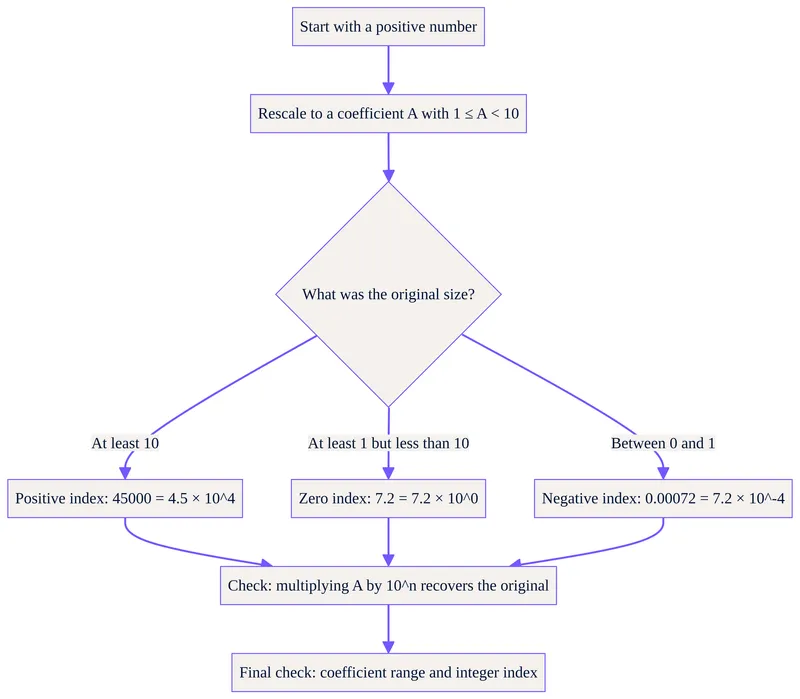
Your focus
- Order a set of positive and negative integers, decimals and fractions from least to greatest.
- Select the correct symbol from =, ≠, <, >, ≤, ≥ to complete a statement.
- Justify the order of a mixed set by converting to a common form.
Show all 44 objectives
- Carry out the four operations with positive and negative integers, decimals and fractions using formal methods.
- Convert between mixed numbers and improper fractions and calculate with them.
- Use place value to multiply and divide by powers of ten and to position decimal points correctly.
- State the inverse operation for a given operation and use it to undo a calculation.
- Simplify a numerical or algebraic expression by cancelling common factors.
- Evaluate expressions correctly using brackets, powers, roots and reciprocals in the conventional order.
- Identify prime numbers and express a composite number as a product of primes using index notation.
- Find the highest common factor and lowest common multiple of two or more numbers using lists or prime factorisation.
- Explain the meaning of factor, multiple, common factor and common multiple, and state the unique factorisation theorem.
- Construct a complete list of outcomes using a fixed, repeatable order.
- Use a table or tree diagram to organise outcomes systematically.
- Check a completed list for repeats and omissions before giving the final answer.
- Identify the stages or groups in a counting problem.
- Apply the product rule by multiplying the number of options at each stage.
- Adjust the count correctly when repetition is not permitted.
- Evaluate positive integer powers of a number.
- Evaluate square, cube and higher real roots of suitable positive numbers.
- Recall and identify powers of 2, 3, 4 and 5 and match them to their roots.
- Estimate a square, cube or higher root of a positive number by bracketing it between known powers.
- Estimate a power of a positive number by comparing it with a known value.
- Justify an estimate by reference to the bracketing values.
- Evaluate square roots and cube roots of suitable numbers, including negative cube roots.
- Evaluate positive, zero and negative integer powers of a base.
- Apply the index laws to simplify and evaluate expressions with integer indices.
- Interpret a^(1/n) as the nth root of a and evaluate it for suitable values.
- Evaluate a^(m/n) by taking the nth root and raising the result to the power m.
- Evaluate negative fractional indices as reciprocals of the corresponding positive fractional power.
- Add and subtract fractions with different denominators by finding a common denominator.
- Multiply fractions and simplify the result by cancelling common factors.
- Divide fractions by multiplying by the reciprocal of the divisor.
- Simplify fractions to their lowest terms.
- Add and subtract multiples of π by combining like terms.
- Multiply and divide expressions involving multiples of π.
- Leave answers in terms of π when exact values are required in geometric calculations.
- Apply exact multiples of π in formulas for circumference, area, and volume.
- Simplify surd expressions by extracting square factors, for example √12 = 2√3.
- Perform exact calculations involving addition, subtraction and multiplication of surds.
- Rationalise denominators, including binomial denominators, using the conjugate.
- Write numbers in standard form A × 10ⁿ with 1 ≤ A < 10 and n an integer.
- Calculate with numbers in standard form, including addition, subtraction, multiplication and division.
- Interpret numbers given in standard form in a variety of contexts.
Structure and calculation flashcards
Card 1 of 12
Calculating exactly with fractions
Which command word is this?
Work out the value of something, showing all necessary steps. A correct answer with no working may still gain full marks, but working is expected.
Structure and calculation exam tips
Topic Overview
Structure and calculation is the foundation of GCSE Mathematics. It covers the rules and conventions for working with numbers, including the order of operations, rounding, estimation, factors, multiples, primes, powers, roots, and standard form. These skills are essential for solving problems in algebra, geometry, ratio, proportion, and statistics.
This topic also develops numerical fluency and problem-solving skills. You will learn to perform calculations accurately, make sensible estimates, and express numbers in different forms. A strong grasp of structure and calculation is crucial for success in both calculator and non-calculator exams, and it underpins many real-world applications.
Key Concepts
- →Order of operations (BIDMAS): Brackets, Indices, Division and Multiplication (left to right), Addition and Subtraction (left to right).
- →Place value and rounding: Understanding the value of each digit, rounding to decimal places and significant figures, and using estimation to check answers.
- →Factors, multiples, primes, and prime factorisation: Finding factors and multiples, identifying prime numbers, and expressing a number as a product of its prime factors.
- →Powers and roots: Calculating squares, cubes, and higher powers, and finding square roots, cube roots, and other roots, including using index laws.
- →Standard form: Writing very large or very small numbers as A x 10^n where 1 ≤ A < 10 and n is an integer, and performing calculations with numbers in standard form.
Marking Points
- Correctly orders positive and negative integers, including placing negative numbers to the left of zero and positive numbers to the right.
- Compares decimals by aligning place value, recognising that 0.30 is greater than 0.25.
- Compares fractions by finding a common denominator or converting to decimals, e.g. 2/3 < 3/4.
- Uses =, ≠, <, >, ≤, ≥ correctly, including the inclusive meaning of ≤ and ≥.
- Orders a mixed set of positive and negative integers, decimals and fractions by converting to a common form.
- Applies column addition and subtraction accurately to integers and decimals, aligning place value.
- Uses formal written methods like long multiplication and division correctly for integers and decimals.
- Adds and subtracts simple fractions (proper and improper) by finding a common denominator, including negative fractions.
- Multiplies and divides fractions, including improper fractions and mixed numbers converted to improper form.
- Applies sign rules for both positive and negative numbers across all four operations.
- Understands and uses place value when working with very large or very small numbers, and when calculating with decimals.
- Identifies inverse pairs correctly: addition with subtraction, multiplication with division, squaring with square-rooting, and a number with its reciprocal.
- Applies cancellation to simplify a calculation or expression by dividing numerator and denominator by a common factor.
- Evaluates expressions using the conventional order: brackets, then powers and roots, then multiplication and division, then addition and subtraction.
- Recognises that a reciprocal of a non-zero number n is 1/n and uses it to rewrite division as multiplication.
- Uses brackets to change the order of operations and explains how the value changes.
- Distinguishes between expressions such as (−3)² = 9 and −3² = −9 by applying priority of operations.
- Defines a prime number as having exactly two distinct factors, 1 and itself, and identifies primes correctly.
- Lists factors (divisors) and multiples of a given number and distinguishes between the two ideas.
- Finds common factors and common multiples of two or more numbers and selects the highest common factor or lowest common multiple as required.
- Writes a composite number as a product of primes using index notation, for example 360 = 2³ × 3² × 5.
- Uses prime factorisation to find the HCF and LCM of two numbers by comparing prime factors.
- States that the prime factorisation of an integer greater than 1 is unique apart from the order of the factors.
- Uses a fixed order, such as fixing one item and cycling through the others, so no outcome is missed or duplicated.
- Produces a complete list or count of outcomes for the given situation, for example 6 combinations from 2 starters and 3 mains.
- Recognises when a table, ordered list or tree diagram is an efficient systematic structure.
- Checks the list for repeats and omissions before stating the final answer.
- Identifies the separate stages or groups of choices in the situation.
- Multiplies the number of options at each stage to obtain the total number of outcomes.
- Adjusts the number of options when repetition is not allowed, for example 10 × 9 × 8 × 7 = 5040 for a 4-digit code.
- Interprets the result in context, such as the number of possible codes or meal combinations.
- Correctly evaluates a positive integer power by repeated multiplication, for example 2⁵ = 32 or 5³ = 125.
- Correctly evaluates a square root, cube root or higher real root of a suitable positive number, for example √81 = 9, ∛64 = 4 or the fourth root of 16 is 2.
- Recognises and recalls powers of 2, 3, 4 and 5, such as 2⁶ = 64, 3⁴ = 81, 4³ = 64 and 5² = 25.
- Selects the option that matches a correctly computed value or root, showing the working that supports the choice.
- Brackets a root between two consecutive integers using known squares or cubes, for example √55 lies between 7 and 8.
- Refines an estimate by comparing the given number with the bracketing powers, for example √55 is closer to 7 than to 8.
- Estimates a power by relating it to a known value, for example using 3³ = 27 to place 3.1³ slightly above 27.
- Justifies the estimated value by establishing a clear mathematical interval or comparison.
- Evaluates square roots of perfect squares, for example √81 = 9, and recognises that a negative number has no real square root.
- Evaluates cube roots including negative radicands, for example ∛125 = 5 and ∛(−27) = −3.
- Evaluates positive integer powers, for example 3⁴ = 81, and applies the zero index rule a⁰ = 1 for non-zero a.
- Interprets negative integer indices as reciprocals, for example 5⁻² = 1/25, and evaluates them correctly.
- Applies index laws for multiplication, division and brackets with the same base, for example 4⁵ × 4⁻² = 4³ = 64.
- Selects the single correct option after independent calculation rather than by matching surface features of the options.
- Interprets a unit fraction index as a root, for example 64^(1/2) = 8 and 64^(1/3) = 4.
- Interprets a general fractional index as root then power, for example 27^(2/3) = (∛27)² = 3² = 9.
- Evaluates fractional indices where the numerator is not 1, for example 16^(3/4) = (⁴√16)³ = 2³ = 8.
- Handles negative fractional indices as reciprocals, for example 8^(−2/3) = 1/(∛8)² = 1/4.
- Chooses the root-first order to keep arithmetic exact, for example evaluating 32^(2/5) as (⁵√32)² = 2² = 4.
- Selects the single correct option after independent evaluation rather than by pattern-matching the options.
- Identifies the correct operation and applies the appropriate fraction rule.
- Finds a valid common denominator when adding or subtracting fractions.
- Correctly multiplies by the reciprocal of the divisor when dividing fractions.
- Simplifies the final fraction to its lowest terms by dividing by common factors.
- Treats π as a symbolic constant/factor during addition and subtraction of terms.
- Correctly multiplies or divides numerical coefficients while retaining π in the expression.
- Substitutes exact values into geometric formulas for circumference, area, or volume.
- Leaves the final answer in terms of π rather than converting to a decimal.
- Simplify a surd by extracting the largest square factor, for example √12 = √(4 × 3) = √4 × √3 = 2√3.
- Add or subtract surds only when the radicands are identical, for example 3√2 + 5√2 = 8√2.
- Multiply surds by multiplying coefficients and radicands separately, for example 2√3 × 4√5 = 8√15.
- Rationalise a single-term denominator by multiplying numerator and denominator by the surd, for example 6/√3 = 2√3.
- Rationalise a binomial denominator by multiplying by the conjugate, for example 1/(3 + √2) = (3 − √2)/7.
- Write a number in standard form as A × 10ⁿ with 1 ≤ A < 10 and n an integer, for example 45 000 = 4.5 × 10⁴.
- Convert a number from standard form to ordinary form by evaluating the power of 10 and multiplying, for example 3.2 × 10⁵ = 320 000.
- Add and subtract numbers in standard form by converting them to the same power of 10 or to ordinary numbers, for example 3.2 × 10⁴ + 4.5 × 10³ = 3.65 × 10⁴.
- Multiply numbers in standard form by multiplying coefficients and adding indices, for example (2 × 10³) × (4 × 10⁵) = 8 × 10⁸.
- Divide numbers in standard form by dividing coefficients and subtracting indices, for example (6 × 10⁷) ÷ (2 × 10²) = 3 × 10⁵.
- Adjust a result into correct standard form when the coefficient is not between 1 and 10, for example 12 × 10³ = 1.2 × 10⁴.
- Interpret standard form in context, for example 5 × 10⁻³ metres = 5 millimetres.
Examiner Tips
- 💡Convert all numbers to decimals to two or three places before ordering a mixed list.
- 💡Check the inequality direction by reading it as 'less than' from left to right.
- 💡For fractions, cross-multiply to compare quickly: a/b < c/d if ad < bc (with positive denominators).
- 💡Estimate the answer first to check the position of the decimal point when calculating with decimals.
- 💡For fractions, always simplify your final answer and convert improper fractions to mixed numbers if asked.
- 💡When dividing decimals, multiply both numbers by a power of ten to make the divisor an integer.
- 💡Underline the operation that must be done first before starting a calculation, then rewrite the expression step by step.
- 💡When a question asks for a reciprocal, write it as a fraction such as 1/7 or invert a fraction such as 5/8 to 8/5, and check the value is not zero.
- 💡Use brackets in your working to show the order you intend, especially when substituting negative numbers into expressions with powers.
- 💡Write a factor tree or repeated division clearly so the prime factors can be checked, then collect repeated primes into index form.
- 💡For HCF and LCM questions, write both prime factorisations in index form and compare powers of each prime.
- 💡Check whether a question asks for the highest common factor or the lowest common multiple before giving a final answer.
- 💡Write the system down first, for example 'fix the first choice, then vary the second', so the method is visible.
- 💡Use a table or tree diagram when there are two or more categories, as it makes omissions easier to spot.
- 💡Finish by counting or checking the list against the structure to confirm completeness.
- 💡Write the number of options for each stage before multiplying, so the structure is clear.
- 💡Check whether repetition is allowed, as this decides whether the options stay constant or decrease.
- 💡Multiply step by step and keep the product in context rather than giving a bare number.
- 💡Write the repeated multiplication out in full for small powers so the value can be checked quickly.
- 💡Learn the power lists for 2, 3, 4 and 5, since recognition questions reward instant recall.
- 💡Substitute each option back into the power or root to test it, which is faster and safer than estimating when the numbers are small.
- 💡Write the two known powers that bracket the target number before making a final estimate.
- 💡Compare the target with each bracket to decide which side the estimate falls on.
- 💡Check the chosen estimate by squaring or cubing it mentally to confirm it is mathematically plausible.
- 💡Work out the exact value or simplified power before looking at the options, then match your result to the list.
- 💡Rewrite negative indices as reciprocals first, for example 10⁻³ = 1/1000, so sign errors are easier to spot.
- 💡Check index-law answers by expanding small cases, such as confirming 2³ × 2² = 8 × 4 = 32 = 2⁵.
- 💡For roots, ask which number multiplied by itself the required number of times gives the radicand, and note whether the radicand is negative.
- 💡Rewrite a^(m/n) as (ⁿ√a)ᵐ before calculating, and take the root first when the radicand is a perfect power.
- 💡For negative fractional indices, write the reciprocal first, for example 16^(−3/4) = 1/(⁴√16)³, then evaluate.
- 💡Check your answer by raising it to the reciprocal power, for example confirming 4^(3/2) = 8 because 8^(2/3) = 4.
- 💡Keep exact values rather than decimals so the option you choose matches the exact surd or integer given.
- 💡Always check if fractions can be simplified before multiplying to make the calculation easier.
- 💡Show your working clearly, especially when finding common denominators.
- 💡Leave answers as improper fractions unless the question explicitly asks for a mixed number.
- 💡Check whether the question asks for an exact answer or a decimal approximation before calculating.
- 💡When squaring a term like 3π, remember to square both the 3 and the π to get 9π².
- 💡Use the formula sheet for circumference and area, and substitute values carefully while keeping π.
- 💡Look for the largest square factor of the radicand; extracting it in one step avoids repeated simplification.
- 💡When rationalising a binomial denominator, multiply by the conjugate and expand carefully, remembering that (√a)² = a.
- 💡Check whether the question asks for an exact answer; if so, leave the surd in simplified form rather than giving a decimal approximation.
- 💡Check that the coefficient is at least 1 and less than 10 before writing your final answer.
- 💡For multiplication and division, handle the coefficients and the powers of 10 separately, then combine.
- 💡When interpreting a contextual value, convert the standard form to an ordinary number to judge whether the answer is sensible.
- 💡Always show your working, especially in multi-step calculations. Method marks are often available even if the final answer is wrong.
- 💡When using a calculator, write down intermediate values to avoid rounding errors and to show your method.
- 💡Check whether the question asks for an exact answer, an estimate, or a rounded answer. Pay attention to the required form (e.g., standard form, significant figures).
Common Mistakes
- Thinking −7 > −2 because 7 > 2; correction: on a number line, −7 is further left, so −7 < −2.
- Believing 0.3 < 0.25 because 3 < 25; correction: align decimal places, 0.30 > 0.25.
- Writing 1/4 > 1/3 because 4 > 3 in the denominators; correction: convert to decimals, 0.25 < 0.333...
- Using < when ≤ is required for equal values, e.g. writing 5 < 5 instead of 5 ≤ 5.
- Misaligning decimal points when adding, e.g. adding the 4 in 3.4 to the 1 in 2.15; correction: align the decimal points so the tenths are added together, writing 3.4 as 3.40.
- Forgetting to convert mixed numbers to improper fractions before multiplying, e.g. 1½ × 2/3; correction: convert 1½ to 3/2 first.
- Applying the wrong sign rule, e.g. (−5) × (−2) = −10; correction: the product of two negatives is positive, so (−5) × (−2) = 10.
- Misplacing the decimal point after multiplication, e.g. 0.3 × 0.4 = 1.2; correction: 0.3 × 0.4 = 0.12.
- Working strictly left to right and adding before multiplying. Correction: multiplication and division are completed before addition and subtraction, so 2 + 3 × 4 = 14, not 20.
- Treating a reciprocal as the negative of a number. Correction: the reciprocal of 4 is 1/4, while the negative is −4; they are different ideas.
- Squaring a negative number without brackets and keeping the negative sign. Correction: −3² means −(3²) = −9, whereas (−3)² = 9.
- Cancelling terms that are added rather than factors that are multiplied. Correction: in (x + 2)/2 you cannot cancel the 2s because the numerator is a sum, not a product.
- Treating 1 as a prime number. Correction: 1 has only one factor, so it is not prime; the smallest prime is 2.
- Confusing factors with multiples. Correction: factors divide a number exactly, while multiples are obtained by multiplying the number by integers.
- Stopping a factor tree before all branches are prime. Correction: continue until every branch ends in a prime, then write the product with indices.
- Choosing the LCM as the product of the two numbers without checking for shared factors. Correction: for 6 and 8 the LCM is 24, not 48, because 6 and 8 share the factor 2.
- Listing outcomes at random and losing track: the correction is to fix one choice and vary the others in a set order.
- Counting an outcome twice because order was not controlled: the correction is to keep one consistent order throughout the list.
- Stopping as soon as a pattern appears: the correction is to continue the system until every branch is exhausted.
- Adding the numbers of options instead of multiplying: the correction is to multiply the options at each independent stage.
- Keeping the same number of options when repetition is not allowed: the correction is to reduce the options by one at each successive stage.
- Miscounting the stages, for example treating a 4-digit code as three choices: the correction is to count each position or group separately.
- Multiplying the base by the index instead of using repeated multiplication: 2⁴ is 2 × 2 × 2 × 2 = 16, not 2 × 4 = 8.
- Confusing a square root with halving: √64 = 8 because 8² = 64, not 32.
- Treating a cube root as dividing by 3: ∛27 = 3 because 3³ = 27, not 9.
- Assuming every root is an integer: many roots are irrational, so a question may expect a decimal approximation or a surd rather than a whole number.
- Rounding the number before rooting it and losing accuracy: estimating √55 from 49 and 64 is correct, rather than replacing 55 with 50 and guessing.
- Assuming an estimate must be a whole number: a root can lie between integers, so the answer may be a decimal.
- Confusing the direction of the estimate for powers: a larger base gives a larger power for an index greater than 1, so 3.1³ is greater than 3³.
- Ignoring the size of the gap: 55 is 6 above 49 but 9 below 64, so the root is nearer 7 than 8.
- Treating a negative index as making the answer negative: the learner writes 2⁻³ = −8. The correction is that a negative index means a reciprocal, so 2⁻³ = 1/2³ = 1/8.
- Confusing the root with division by the index: the learner computes √36 as 36 ÷ 2 = 18. The correction is that √36 asks which number squares to 36, so √36 = 6.
- Adding the bases instead of the indices when multiplying powers: the learner writes 2³ × 2² = 4⁵. The correction is that the base stays the same and the indices add, so 2³ × 2² = 2⁵ = 32.
- Assuming every number has a real square root: the learner gives √(−16) = −4. The correction is that squaring any real number gives a non-negative result, so √(−16) has no real value, though ∛(−64) = −4 is valid.
- Multiplying the base by the fraction: the learner computes 9^(1/2) as 9 × 1/2 = 4.5. The correction is that a unit fraction index is a root, so 9^(1/2) = 3.
- Swapping the root and the power: the learner computes 8^(2/3) by taking the square root of 8 cubed, rather than the cube root of 8 squared, incorrectly giving √512 instead of 4. The correction is that the denominator gives the root and the numerator gives the power, so 8^(2/3) = (∛8)² = 2² = 4.
- Ignoring the negative sign in a fractional index: the learner writes 4^(−1/2) = −2. The correction is that the negative sign means a reciprocal, so 4^(−1/2) = 1/√4 = 1/2.
- Taking the power first with large numbers and losing accuracy: the learner computes 27^(2/3) as (27²)^(1/3) = 729^(1/3) and then struggles. The correction is to take the root first, so (∛27)² = 3² = 9.
- Adding or subtracting fractions without a common denominator. Correction: find a common denominator first.
- Multiplying denominators when adding fractions but forgetting to multiply the numerators by the same factor. Correction: always create equivalent fractions.
- Dividing fractions by multiplying by the divisor instead of its reciprocal. Correction: multiply by the reciprocal of the second fraction.
- Replacing π with 3.14 or 22/7 when an exact answer is required. Correction: keep π in the answer.
- Treating π as a variable that can be solved for, rather than a constant value. Correction: recognise π as a specific irrational number.
- Forgetting to include π in the final answer after multiplying the numerical parts. Correction: ensure π remains in the result.
- Thinking √(a + b) = √a + √b. This is false; for example √(9 + 16) = √25 = 5, not 3 + 4 = 7. Only the product rule √(ab) = √a × √b is valid for non-negative a and b.
- Adding surds with different radicands, such as writing √2 + √3 = √5. They are unlike terms and cannot be combined; leave the expression as √2 + √3.
- Rationalising a denominator by multiplying only the numerator by the surd. Both numerator and denominator must be multiplied by the same surd to keep the value unchanged.
- Forgetting to simplify the final surd after rationalising, for example leaving 6√3/3 instead of writing 2√3.
- Using a coefficient outside the range 1 ≤ A < 10, such as writing 12 × 10³ instead of 1.2 × 10⁴. The coefficient must be at least 1 and less than 10.
- Miscounting the power of 10 when converting a small number, for example writing 0.00072 as 7.2 × 10⁴ instead of 7.2 × 10⁻⁴. The power is negative for numbers less than 1.
- Adding coefficients when multiplying numbers in standard form, for example writing (2 × 10³) × (4 × 10⁵) = 6 × 10⁸ instead of 8 × 10⁸. Coefficients are multiplied.
- Forgetting to adjust the power when the product of coefficients is 10 or more, for example leaving 15 × 10² instead of writing 1.5 × 10³.
- Students often think that multiplication always comes before division in BIDMAS, but they have equal priority and should be done left to right. Similarly for addition and subtraction.
- When rounding to significant figures, students may start counting from the first zero after the decimal point, but significant figures start from the first non-zero digit.
- Students sometimes believe that 1 is a prime number, but a prime number must have exactly two distinct factors: 1 and itself. 1 has only one factor, so it is not prime.
Revision Plan
- 1Day 1-2: Revise order of operations (BIDMAS) and practice with negative numbers and indices. Complete a set of mixed problems.
- 2Day 3-4: Focus on rounding, estimation, and significant figures. Practice rounding to decimal places and significant figures, and use estimation to check calculations.
- 3Day 5-6: Study factors, multiples, primes, and prime factorisation. Practice finding HCF and LCM using prime factors.
- 4Day 7-8: Learn powers, roots, and index laws. Practice calculations involving squares, cubes, and roots, including fractional and negative indices.
- 5Day 9-10: Master standard form: converting between ordinary and standard form, and multiplying/dividing numbers in standard form. Complete past paper questions on all topics.
Exam Question Types
- 📋Straightforward calculation questions: e.g., 'Calculate the value of ...' or 'Work out ...'. Show all steps clearly.
- 📋Problem-solving with number properties: e.g., 'Find the highest common factor of ...' or 'Express ... as a product of prime factors'. Use systematic methods.
- 📋Estimation and rounding: e.g., 'Estimate the value of ...' or 'Round ... to ... significant figures'. Pay attention to the required degree of accuracy.
- 📋Standard form: e.g., 'Write ... in standard form' or 'Calculate ... giving your answer in standard form'. Ensure the coefficient is between 1 and 10.
Command Word Expectations (AQA)
Work out the value of something, showing all necessary steps. A correct answer with no working may still gain full marks, but working is expected.
Give an approximate value by rounding numbers to 1 significant figure (unless otherwise specified). Show the rounded values and the calculation.
Express a number or expression in a specific form, e.g., standard form or prime factor form. Ensure the final answer meets the required format.
How Students Lose Marks (Examiner Pitfalls)
Step-by-Step Worked Solutions
Question: Calculate the exact value of (3.2 x 10^4) x (2.5 x 10^3). Give your answer in standard form.
- 1.Step 1: Multiply the coefficients: 3.2 x 2.5 = 8.
- 2.Step 2: Multiply the powers of 10: 10^4 x 10^3 = 10^(4+3) = 10^7.
- 3.Step 3: Combine: 8 x 10^7. This is already in standard form because 8 is between 1 and 10.
Question: Write 360 as a product of its prime factors. Give your answer in index form.
- 1.Step 1: Divide by the smallest prime: 360 ÷ 2 = 180.
- 2.Step 2: Continue dividing by 2: 180 ÷ 2 = 90, 90 ÷ 2 = 45.
- 3.Step 3: 45 is not divisible by 2, so divide by next prime 3: 45 ÷ 3 = 15, 15 ÷ 3 = 5.
- 4.Step 4: 5 is prime, so stop. The prime factors are 2, 2, 2, 3, 3, 5.
- 5.Step 5: Write in index form: 2^3 x 3^2 x 5.